Jeremy Guo, Jingwen Weng, Fangyuan Zhou, Xuejun Gu
{"title":"An industry perspective on hyaluronidase co-formulated biopharmaceutics","authors":"Jeremy Guo, Jingwen Weng, Fangyuan Zhou, Xuejun Gu","doi":"10.1016/j.jconrel.2025.02.069","DOIUrl":null,"url":null,"abstract":"<div><div>To deliver biopharmaceutics, subcutaneous (SC) route surpasses intravenous (IV) route unequivocally in time and cost savings, but it has been limited by the injection volume of no greater than 2 mL for a long time. Recently, the adoption of hyaluronidase has become a plausible method to realize high-dose high-volume biopharmaceutical products for SC injection. Among the hyaluronidase family, the recombinant human PH20 appears to be the most reliable candidate with excellent efficacy and safety for co-formulation development. As of 2024, a total of eight hyaluronidase co-formulated biological products have been approved by regulatory authorities. This review article systematically summarized the commercial hyaluronidase co-formulated biopharmaceutics and highlighted the critical aspects of the development of future products regarding selection of hyaluronidase, formulation and process development, non-clinical evaluation, and clinical investigation. Of note, considering the uniqueness of each therapeutic agent, early and effective communication with regulatory authorities is of vital importance to successful development. Discussions were further Expanded to cover the combination of hyaluronidase co-formulations with large-volume handheld autoinjectors. The ultimate goal of this review is to provide a practical and comprehensive reference that will substantially contribute to the development of hyaluronidase co-formulated biopharmaceuticals, thereby advancing the field and benefiting patients worldwide.</div></div>","PeriodicalId":15450,"journal":{"name":"Journal of Controlled Release","volume":"381 ","pages":"Article 113573"},"PeriodicalIF":11.5000,"publicationDate":"2025-02-24","publicationTypes":"Journal Article","fieldsOfStudy":null,"isOpenAccess":false,"openAccessPdf":"","citationCount":"0","resultStr":null,"platform":"Semanticscholar","paperid":null,"PeriodicalName":"Journal of Controlled Release","FirstCategoryId":"3","ListUrlMain":"https://www.sciencedirect.com/science/article/pii/S0168365925001828","RegionNum":1,"RegionCategory":"医学","ArticlePicture":[],"TitleCN":null,"AbstractTextCN":null,"PMCID":null,"EPubDate":"","PubModel":"","JCR":"Q1","JCRName":"CHEMISTRY, MULTIDISCIPLINARY","Score":null,"Total":0}
引用次数: 0
Abstract
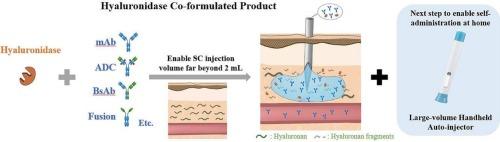
To deliver biopharmaceutics, subcutaneous (SC) route surpasses intravenous (IV) route unequivocally in time and cost savings, but it has been limited by the injection volume of no greater than 2 mL for a long time. Recently, the adoption of hyaluronidase has become a plausible method to realize high-dose high-volume biopharmaceutical products for SC injection. Among the hyaluronidase family, the recombinant human PH20 appears to be the most reliable candidate with excellent efficacy and safety for co-formulation development. As of 2024, a total of eight hyaluronidase co-formulated biological products have been approved by regulatory authorities. This review article systematically summarized the commercial hyaluronidase co-formulated biopharmaceutics and highlighted the critical aspects of the development of future products regarding selection of hyaluronidase, formulation and process development, non-clinical evaluation, and clinical investigation. Of note, considering the uniqueness of each therapeutic agent, early and effective communication with regulatory authorities is of vital importance to successful development. Discussions were further Expanded to cover the combination of hyaluronidase co-formulations with large-volume handheld autoinjectors. The ultimate goal of this review is to provide a practical and comprehensive reference that will substantially contribute to the development of hyaluronidase co-formulated biopharmaceuticals, thereby advancing the field and benefiting patients worldwide.
期刊介绍:
The Journal of Controlled Release (JCR) proudly serves as the Official Journal of the Controlled Release Society and the Japan Society of Drug Delivery System.
Dedicated to the broad field of delivery science and technology, JCR publishes high-quality research articles covering drug delivery systems and all facets of formulations. This includes the physicochemical and biological properties of drugs, design and characterization of dosage forms, release mechanisms, in vivo testing, and formulation research and development across pharmaceutical, diagnostic, agricultural, environmental, cosmetic, and food industries.
Priority is given to manuscripts that contribute to the fundamental understanding of principles or demonstrate the advantages of novel technologies in terms of safety and efficacy over current clinical standards. JCR strives to be a leading platform for advancements in delivery science and technology.




 京公网安备 11010802042870号
京ICP备2023020795号-1
京公网安备 11010802042870号
京ICP备2023020795号-1

 分享
分享
 求助内容:
求助内容: 应助结果提醒方式:
 扫码关注我们
