For most insect herbivores, where females decide to lay their eggs has a significant impact on offspring survival. Although females’ behavior is essential for oviposition site selection, it is unclear what role the egg itself has in this process.
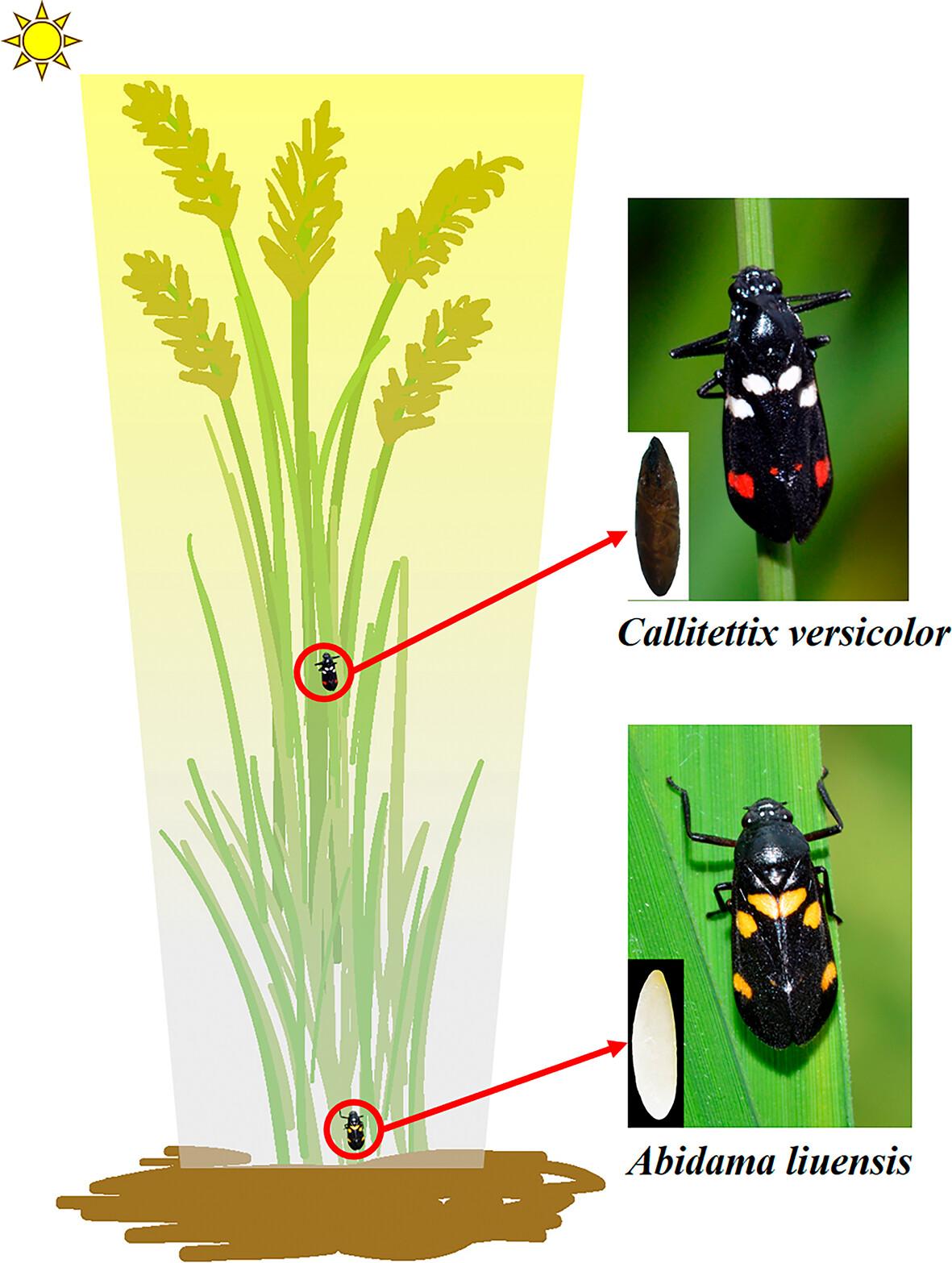
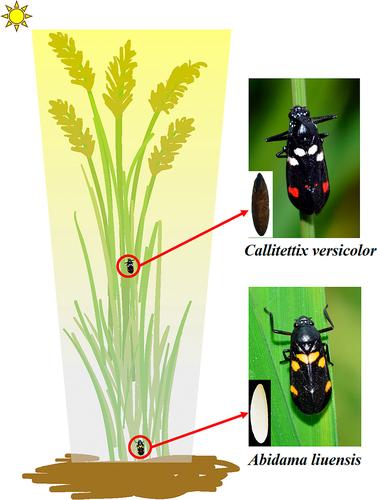
Two closely related spittlebugs, Callitettix versicolor and Abidama liuensis, with diametrically opposite egg colors, were selected to investigate whether egg color has a vital role in oviposition site selection. Both spittlebugs preferred to lay eggs on the side of the substrate that had more light. Eggs laid by C. versicolor on the substrates were positioned significantly higher than eggs laid by A. liuensis. A higher position meant more light and more ultraviolet (UV) radiation. Accordingly, the different egg colors of these two spittlebugs resulted in different resistance abilities toward UV radiation. C. versicolor eggs, which are black, were more tolerant of UV radiation than the white eggs of A. liuensis. The color difference between the two spittlebugs’ eggs is caused by their melanin compositions. The UV tolerance of C. versicolor eggs allows females to occupy more space to lay eggs than A. liuensis. Consequently, the egg density of A. liuensis was higher than that of C. versicolor.
This study revealed that closely related species use different egg colors to segregate their eggs on the same host plant, ensuring their coexistence in the same habitat. The results also provide a behavioral and ecological basis for prevention and control strategies for these two pests. © 2025 Society of Chemical Industry.






 京公网安备 11010802042870号
京ICP备2023020795号-1
京公网安备 11010802042870号
京ICP备2023020795号-1

 分享
分享
 求助内容:
求助内容: 应助结果提醒方式:
 扫码关注我们
