Zhenjie Li;Xianzhen Li;Dechun Yuan;Jiawei Zhang;Yiqi Liu
{"title":"Optimization of Magnetic Couplers in Wireless Charging Systems Using the Surrogate Model","authors":"Zhenjie Li;Xianzhen Li;Dechun Yuan;Jiawei Zhang;Yiqi Liu","doi":"10.1109/JESTPE.2025.3544868","DOIUrl":null,"url":null,"abstract":"This article proposes a general and efficient surrogate model-based parameter optimization method, consisting of the Taguchi method, finite element method (FEM) simulation, genetic algorithm-backpropagation (GA-BP) neural network, and grid search, to optimize various magnetic coupler with multiple design objectives in wireless charging systems (WCSs). First, the WCS with hub-type multiple circular coil coupler (HMTC) is used as an example to validate the necessity of parameter optimization for the magnetic coupler. Then, the HMTC’s structure and principles are analyzed. Three design objectives with function expressions are used as examples for designing an HMTC: the rated mutual inductance, high misalignment tolerance, and lightweight receiver. Second, a detailed workflow of the proposed method is analyzed, especially the basic working principles of the Taguchi method and GA-BP neural network-based surrogate model. Third, the HMTC optimization process and the proposed method’s main parameter determination are analyzed. Then, simulation results verify the proposed method’s feasibility on HMTC and two other magnetic couplers. Numerical results prove that the proposed method has higher optimization efficiency and accuracy. Finally, a prototype is built. Experimental results confirm that the rated mutual inductance is <inline-formula> <tex-math>$20.2~\\mu $ </tex-math></inline-formula>H, and its fluctuation within ±5% is circular (radius is 34% of the transmitter diameter).","PeriodicalId":13093,"journal":{"name":"IEEE Journal of Emerging and Selected Topics in Power Electronics","volume":"13 4","pages":"5406-5420"},"PeriodicalIF":4.9000,"publicationDate":"2025-02-24","publicationTypes":"Journal Article","fieldsOfStudy":null,"isOpenAccess":false,"openAccessPdf":"","citationCount":"0","resultStr":null,"platform":"Semanticscholar","paperid":null,"PeriodicalName":"IEEE Journal of Emerging and Selected Topics in Power Electronics","FirstCategoryId":"5","ListUrlMain":"https://ieeexplore.ieee.org/document/10900469/","RegionNum":2,"RegionCategory":"工程技术","ArticlePicture":[],"TitleCN":null,"AbstractTextCN":null,"PMCID":null,"EPubDate":"","PubModel":"","JCR":"Q1","JCRName":"ENGINEERING, ELECTRICAL & ELECTRONIC","Score":null,"Total":0}
引用次数: 0
Abstract
This article proposes a general and efficient surrogate model-based parameter optimization method, consisting of the Taguchi method, finite element method (FEM) simulation, genetic algorithm-backpropagation (GA-BP) neural network, and grid search, to optimize various magnetic coupler with multiple design objectives in wireless charging systems (WCSs). First, the WCS with hub-type multiple circular coil coupler (HMTC) is used as an example to validate the necessity of parameter optimization for the magnetic coupler. Then, the HMTC’s structure and principles are analyzed. Three design objectives with function expressions are used as examples for designing an HMTC: the rated mutual inductance, high misalignment tolerance, and lightweight receiver. Second, a detailed workflow of the proposed method is analyzed, especially the basic working principles of the Taguchi method and GA-BP neural network-based surrogate model. Third, the HMTC optimization process and the proposed method’s main parameter determination are analyzed. Then, simulation results verify the proposed method’s feasibility on HMTC and two other magnetic couplers. Numerical results prove that the proposed method has higher optimization efficiency and accuracy. Finally, a prototype is built. Experimental results confirm that the rated mutual inductance is $20.2~\mu $ H, and its fluctuation within ±5% is circular (radius is 34% of the transmitter diameter).
期刊介绍:
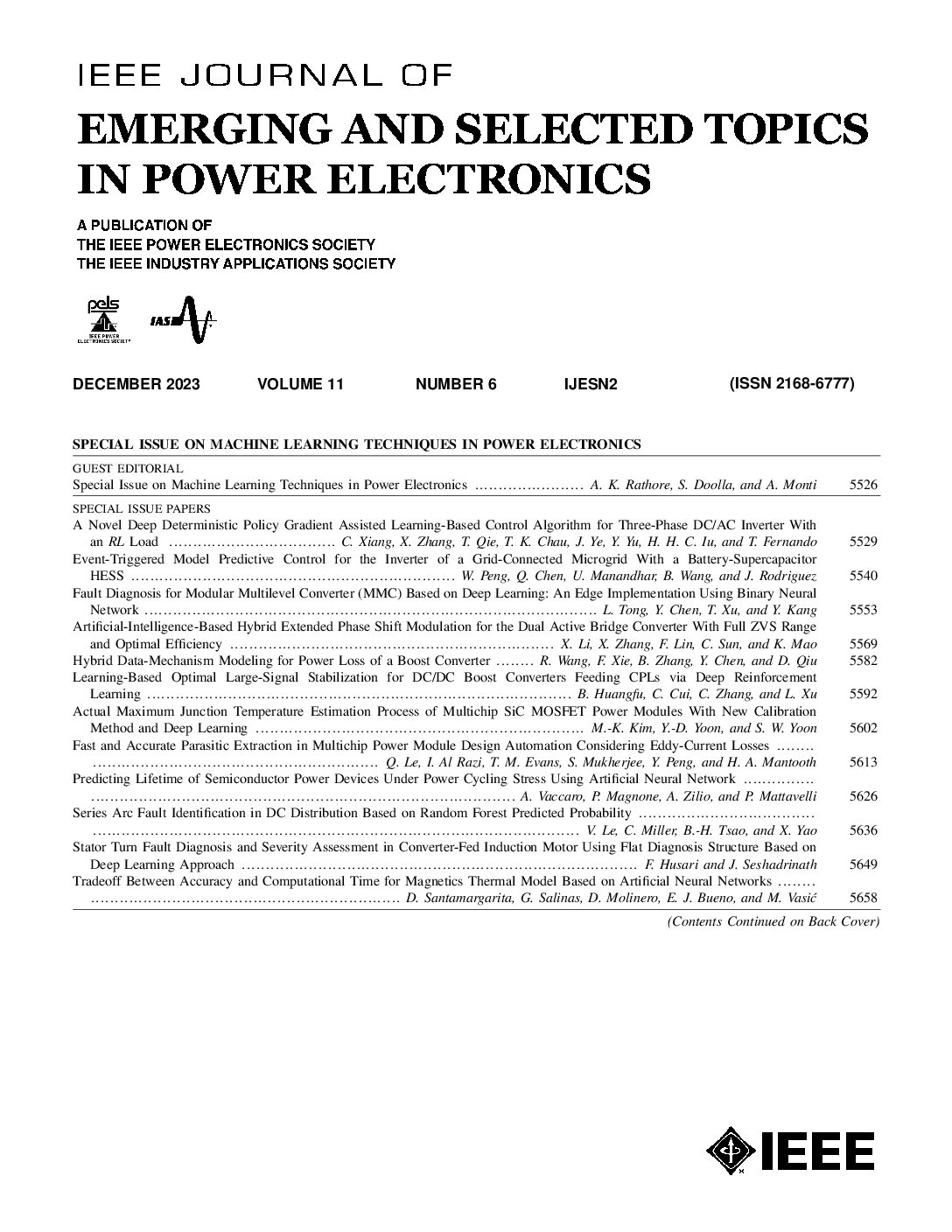
The aim of the journal is to enable the power electronics community to address the emerging and selected topics in power electronics in an agile fashion. It is a forum where multidisciplinary and discriminating technologies and applications are discussed by and for both practitioners and researchers on timely topics in power electronics from components to systems.



 京公网安备 11010802042870号
京ICP备2023020795号-1
京公网安备 11010802042870号
京ICP备2023020795号-1

 分享
分享
 求助内容:
求助内容: 应助结果提醒方式:
 扫码关注我们
