{"title":"Cu-catalyzed alkynylation of thiosulfonate-based peptide: an efficient approach to S-alkynyl-containing cyclic peptides†","authors":"Zhou Zhang , Junjie Ying , Qingqing Lu , Qinshuo Zhang , Chunfa Xu","doi":"10.1039/d5qo00152h","DOIUrl":null,"url":null,"abstract":"<div><div>Cyclic peptides are highly valued in drug discovery due to their enhanced biological properties. Despite their potential, the construction of an <em>S</em>-alkynyl moiety in a cyclic peptide remains challenging due to limited synthetic strategies. Herein, we describe a copper-catalyzed alkynylation of thiosulfonate-based peptides, enabling efficient and selective synthesis of <em>S</em>-alkynylated cysteines and peptides. The adjustment of the amount of base could significantly increase the efficiency. This method features a broad substrate scope, operational simplicity and compatibility with complex peptide structures.</div></div>","PeriodicalId":94379,"journal":{"name":"Organic chemistry frontiers : an international journal of organic chemistry","volume":"12 8","pages":"Pages 2752-2758"},"PeriodicalIF":0.0000,"publicationDate":"2025-02-12","publicationTypes":"Journal Article","fieldsOfStudy":null,"isOpenAccess":false,"openAccessPdf":"","citationCount":"0","resultStr":null,"platform":"Semanticscholar","paperid":null,"PeriodicalName":"Organic chemistry frontiers : an international journal of organic chemistry","FirstCategoryId":"1085","ListUrlMain":"https://www.sciencedirect.com/org/science/article/pii/S2052412925001068","RegionNum":0,"RegionCategory":null,"ArticlePicture":[],"TitleCN":null,"AbstractTextCN":null,"PMCID":null,"EPubDate":"2025/2/25 0:00:00","PubModel":"Epub","JCR":"","JCRName":"","Score":null,"Total":0}
引用次数: 0
Abstract
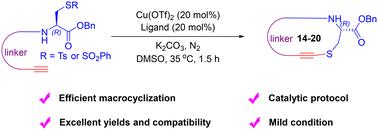
Cyclic peptides are highly valued in drug discovery due to their enhanced biological properties. Despite their potential, the construction of an S-alkynyl moiety in a cyclic peptide remains challenging due to limited synthetic strategies. Herein, we describe a copper-catalyzed alkynylation of thiosulfonate-based peptides, enabling efficient and selective synthesis of S-alkynylated cysteines and peptides. The adjustment of the amount of base could significantly increase the efficiency. This method features a broad substrate scope, operational simplicity and compatibility with complex peptide structures.




 京公网安备 11010802042870号
京ICP备2023020795号-1
京公网安备 11010802042870号
京ICP备2023020795号-1

 分享
分享

 求助内容:
求助内容: 应助结果提醒方式:
 扫码关注我们
