Mao He, Xiaoying Peng, Suqin Wu, Bin Lei, Shuai Xiong, Qin Luo, Zongxing Tu, Xiaoxue Lin and Guiming Peng
{"title":"Gas/solid/liquid triphase interface of carbon nitride for efficient photocatalytic H2O2 production†","authors":"Mao He, Xiaoying Peng, Suqin Wu, Bin Lei, Shuai Xiong, Qin Luo, Zongxing Tu, Xiaoxue Lin and Guiming Peng","doi":"10.1039/D4QI03352C","DOIUrl":null,"url":null,"abstract":"<p >Photocatalytic two-electron oxygen reduction offers a sustainable method to produce hydrogen peroxide (H<small><sub>2</sub></small>O<small><sub>2</sub></small>). However, the efficiency of carbon nitride (CN) in this process is hindered by serious charge recombination and slow diffusion of oxygen. This work reports the thermal vapor-assisted surface chemical modification of CN by 4-aminobenzoyl groups (PABA/CN), which alters the conjugation system, extends the light absorption range, and enhances charge separation and electron transfer. Besides, it tunes the CN surface to be hydrophobic, which forms a gas/solid/liquid triphase interface in photocatalytic H<small><sub>2</sub></small>O<small><sub>2</sub></small> production, and thus significantly improves O<small><sub>2</sub></small> diffusion and proton supply for photosynthesis of H<small><sub>2</sub></small>O<small><sub>2</sub></small>. Photocatalytic experiments revealed that PABA/CN delivered an H<small><sub>2</sub></small>O<small><sub>2</sub></small> yield of up to 745 μmol g<small><sup>−1</sup></small> h<small><sup>−1</sup></small> in pure water, 8 times that of pristine CN, ranking among the top performances of CN-based photocatalysts. Moreover, its selectivity reached 70%. Mechanism studies identified a two-step one-electron oxygen reduction reaction pathway for H<small><sub>2</sub></small>O<small><sub>2</sub></small> photoproduction. Overall, this work simultaneously addresses the issues of mass transfer of O<small><sub>2</sub></small>, light harvesting, and charge separation of CN in photosynthesis of H<small><sub>2</sub></small>O<small><sub>2</sub></small><em>via</em> surface chemical modification with 4-aminobenzoyl moieties, which extends π-conjugation and imparts surface hydrophobicity.</p>","PeriodicalId":79,"journal":{"name":"Inorganic Chemistry Frontiers","volume":" 8","pages":" 3237-3245"},"PeriodicalIF":6.4000,"publicationDate":"2025-02-25","publicationTypes":"Journal Article","fieldsOfStudy":null,"isOpenAccess":false,"openAccessPdf":"","citationCount":"0","resultStr":null,"platform":"Semanticscholar","paperid":null,"PeriodicalName":"Inorganic Chemistry Frontiers","FirstCategoryId":"92","ListUrlMain":"https://pubs.rsc.org/en/content/articlelanding/2025/qi/d4qi03352c","RegionNum":1,"RegionCategory":"化学","ArticlePicture":[],"TitleCN":null,"AbstractTextCN":null,"PMCID":null,"EPubDate":"","PubModel":"","JCR":"Q1","JCRName":"CHEMISTRY, INORGANIC & NUCLEAR","Score":null,"Total":0}
引用次数: 0
Abstract
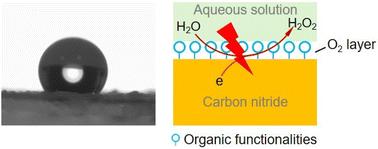
Photocatalytic two-electron oxygen reduction offers a sustainable method to produce hydrogen peroxide (H2O2). However, the efficiency of carbon nitride (CN) in this process is hindered by serious charge recombination and slow diffusion of oxygen. This work reports the thermal vapor-assisted surface chemical modification of CN by 4-aminobenzoyl groups (PABA/CN), which alters the conjugation system, extends the light absorption range, and enhances charge separation and electron transfer. Besides, it tunes the CN surface to be hydrophobic, which forms a gas/solid/liquid triphase interface in photocatalytic H2O2 production, and thus significantly improves O2 diffusion and proton supply for photosynthesis of H2O2. Photocatalytic experiments revealed that PABA/CN delivered an H2O2 yield of up to 745 μmol g−1 h−1 in pure water, 8 times that of pristine CN, ranking among the top performances of CN-based photocatalysts. Moreover, its selectivity reached 70%. Mechanism studies identified a two-step one-electron oxygen reduction reaction pathway for H2O2 photoproduction. Overall, this work simultaneously addresses the issues of mass transfer of O2, light harvesting, and charge separation of CN in photosynthesis of H2O2via surface chemical modification with 4-aminobenzoyl moieties, which extends π-conjugation and imparts surface hydrophobicity.



 京公网安备 11010802042870号
京ICP备2023020795号-1
京公网安备 11010802042870号
京ICP备2023020795号-1

 分享
分享
 求助内容:
求助内容: 应助结果提醒方式:
 扫码关注我们
