{"title":"Scalable access to functional nylon 6 via ring-opening copolymerization of biobased δ-valerolactam with ε-caprolactam†","authors":"Yahui Mao , Maosheng Li , Youhua Tao","doi":"10.1039/d4py01406e","DOIUrl":null,"url":null,"abstract":"<div><div>Copolymerization of ε-caprolactam with functional lactam monomers was an effective strategy to introduce pendent substituents into nylon 6, which might endow these materials with improved processing properties, solubility, elasticity, and adhesion, while not compromising their inherent thermal and mechanical properties. However, the scalable synthesis of functional lactams remained extremely difficult due to their high raw material cost and/or cumbersome synthesis steps, making it difficult to meet the enormous market demand for nylon 6 materials. Herein, we introduced a new biobased δ-valerolactam monomer (3-(dimethylamino)-piperidone, ) derived from ornithine, which could efficiently copolymerize with ε-caprolactam to deliver functional nylon 6 polymers. Both monomer and copolymer synthesis proved straightforward and readily scalable. The resulting nylon 6 polymers exhibited comparable properties relative to their well-known commercial counterpart, including high thermal stability and crystallinity, suggesting that the incorporation of exerted minimal influence on the polymers’ inherent properties. Remarkably, the pendant dimethylamino group at the polyamide backbone could further convert into various functional structures by reacting with electrophiles, thereby providing a simple and versatile platform for the preparation of diverse functional nylon 6 materials towards broader applications.</div></div>","PeriodicalId":100,"journal":{"name":"Polymer Chemistry","volume":"16 12","pages":"Pages 1409-1417"},"PeriodicalIF":3.9000,"publicationDate":"2025-02-13","publicationTypes":"Journal Article","fieldsOfStudy":null,"isOpenAccess":false,"openAccessPdf":"","citationCount":"0","resultStr":null,"platform":"Semanticscholar","paperid":null,"PeriodicalName":"Polymer Chemistry","FirstCategoryId":"92","ListUrlMain":"https://www.sciencedirect.com/org/science/article/pii/S1759995425000622","RegionNum":2,"RegionCategory":"化学","ArticlePicture":[],"TitleCN":null,"AbstractTextCN":null,"PMCID":null,"EPubDate":"2025/2/25 0:00:00","PubModel":"Epub","JCR":"Q2","JCRName":"POLYMER SCIENCE","Score":null,"Total":0}
引用次数: 0
Abstract
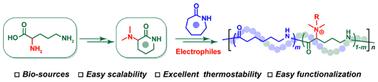
Copolymerization of ε-caprolactam with functional lactam monomers was an effective strategy to introduce pendent substituents into nylon 6, which might endow these materials with improved processing properties, solubility, elasticity, and adhesion, while not compromising their inherent thermal and mechanical properties. However, the scalable synthesis of functional lactams remained extremely difficult due to their high raw material cost and/or cumbersome synthesis steps, making it difficult to meet the enormous market demand for nylon 6 materials. Herein, we introduced a new biobased δ-valerolactam monomer (3-(dimethylamino)-piperidone, ) derived from ornithine, which could efficiently copolymerize with ε-caprolactam to deliver functional nylon 6 polymers. Both monomer and copolymer synthesis proved straightforward and readily scalable. The resulting nylon 6 polymers exhibited comparable properties relative to their well-known commercial counterpart, including high thermal stability and crystallinity, suggesting that the incorporation of exerted minimal influence on the polymers’ inherent properties. Remarkably, the pendant dimethylamino group at the polyamide backbone could further convert into various functional structures by reacting with electrophiles, thereby providing a simple and versatile platform for the preparation of diverse functional nylon 6 materials towards broader applications.
期刊介绍:
Polymer Chemistry welcomes submissions in all areas of polymer science that have a strong focus on macromolecular chemistry. Manuscripts may cover a broad range of fields, yet no direct application focus is required.




 京公网安备 11010802042870号
京ICP备2023020795号-1
京公网安备 11010802042870号
京ICP备2023020795号-1

 分享
分享
 求助内容:
求助内容: 应助结果提醒方式:
 扫码关注我们
