Chaoyi Cai , Jiaming Ma , Xiuzhu Liang , Shuyan Zhang , Heng Zhang , Congyun Zhang , Shuidong Zhang
{"title":"An efficient “depolymerization–polymerization” closed-loop recycling strategy for selective degradation of polycaprolactone†","authors":"Chaoyi Cai , Jiaming Ma , Xiuzhu Liang , Shuyan Zhang , Heng Zhang , Congyun Zhang , Shuidong Zhang","doi":"10.1039/d5py00097a","DOIUrl":null,"url":null,"abstract":"<div><div>Unlike landfill biodegradation, thermal recycling, and downcycling, the adopted “depolymerization–polymerization” closed-loop recycling strategy offers a more sustainable, resource-efficient, and environmentally protective solution for waste polymer treatment. However, selective depolymerization of aliphatic polyesters remains challenging due to their unclear depolymerization kinetic characteristics and mechanisms. In this study, polycaprolactone (PCL) was thermally depolymerized into ε-caprolactone (ε-CL) monomers catalyzed using stannous octanoate (Sn(Oct)<sub>2</sub>), and the ε-CL was subsequently repolymerized through ring-opening polymerization to regenerate PCL. Notably, the depolymerization conversion for ε-CL monomers reached 98.1% in 4.5 hours, with a linear decrease of the PCL macromolecule. Density functional theory (DFT) calculations revealed that the relaxed force constant of the C–O bond in the ester group decreased from 5.46 to 5.08 N cm<sup>−1</sup> due to electron density redistribution by Sn(Oct)<sub>2</sub> coordination, facilitating efficient first-order depolymerization through a “chain-end backbiting” strategy. Furthermore, the regenerated PCL (re-PCL) retained comparable molecular weight, mechanical, thermal, and crystallization properties to those of pristine PCL, with a tensile strength of 28.4 MPa and 913% elongation at break. This closed-loop recycling strategy provides an innovative approach for the sustainable recycling of waste polymers.</div></div>","PeriodicalId":100,"journal":{"name":"Polymer Chemistry","volume":"16 14","pages":"Pages 1568-1577"},"PeriodicalIF":3.9000,"publicationDate":"2025-02-26","publicationTypes":"Journal Article","fieldsOfStudy":null,"isOpenAccess":false,"openAccessPdf":"","citationCount":"0","resultStr":null,"platform":"Semanticscholar","paperid":null,"PeriodicalName":"Polymer Chemistry","FirstCategoryId":"92","ListUrlMain":"https://www.sciencedirect.com/org/science/article/pii/S1759995425000816","RegionNum":2,"RegionCategory":"化学","ArticlePicture":[],"TitleCN":null,"AbstractTextCN":null,"PMCID":null,"EPubDate":"","PubModel":"","JCR":"Q2","JCRName":"POLYMER SCIENCE","Score":null,"Total":0}
引用次数: 0
Abstract
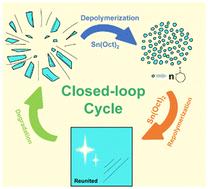
Unlike landfill biodegradation, thermal recycling, and downcycling, the adopted “depolymerization–polymerization” closed-loop recycling strategy offers a more sustainable, resource-efficient, and environmentally protective solution for waste polymer treatment. However, selective depolymerization of aliphatic polyesters remains challenging due to their unclear depolymerization kinetic characteristics and mechanisms. In this study, polycaprolactone (PCL) was thermally depolymerized into ε-caprolactone (ε-CL) monomers catalyzed using stannous octanoate (Sn(Oct)2), and the ε-CL was subsequently repolymerized through ring-opening polymerization to regenerate PCL. Notably, the depolymerization conversion for ε-CL monomers reached 98.1% in 4.5 hours, with a linear decrease of the PCL macromolecule. Density functional theory (DFT) calculations revealed that the relaxed force constant of the C–O bond in the ester group decreased from 5.46 to 5.08 N cm−1 due to electron density redistribution by Sn(Oct)2 coordination, facilitating efficient first-order depolymerization through a “chain-end backbiting” strategy. Furthermore, the regenerated PCL (re-PCL) retained comparable molecular weight, mechanical, thermal, and crystallization properties to those of pristine PCL, with a tensile strength of 28.4 MPa and 913% elongation at break. This closed-loop recycling strategy provides an innovative approach for the sustainable recycling of waste polymers.
期刊介绍:
Polymer Chemistry welcomes submissions in all areas of polymer science that have a strong focus on macromolecular chemistry. Manuscripts may cover a broad range of fields, yet no direct application focus is required.



 京公网安备 11010802042870号
京ICP备2023020795号-1
京公网安备 11010802042870号
京ICP备2023020795号-1

 分享
分享
 求助内容:
求助内容: 应助结果提醒方式:
 扫码关注我们
