Jia Wang , Bo Xu , Meiling Liu , Jiagen Yu , Mengzhong Chen , Guixian Tian
{"title":"How technological heterogeneity in FDI shapes entrepreneurial structures","authors":"Jia Wang , Bo Xu , Meiling Liu , Jiagen Yu , Mengzhong Chen , Guixian Tian","doi":"10.1016/j.irfa.2025.103986","DOIUrl":null,"url":null,"abstract":"<div><div>Drawing upon the principles of new structural economics, this study formulates a comprehensive entrepreneurial industry, technological, and capital structures. We explore the mechanisms of how overall foreign direct investment (FDI) and technologically heterogeneous FDI shape the entrepreneurial landscape of the host country. Using panel data from 31 provinces in China spanning 2011 to 2021, we empirically investigate the impact of these FDI types on China's entrepreneurial structure. Our findings reveal a nuanced relationship. At the index level, the influence of overall FDI on China's entrepreneurial industry structure exhibits a distinct “U-shape” curve, whereas a clear “inverted U-shape” curve is observed in case of China's entrepreneurial technology and capital structures. When considering absolute terms, overall FDI refines China's entrepreneurial structure through its varied effects across different industries. Furthermore, in the context of technological heterogeneity, technology-intensive FDI has a significant negative effect on the technology and capital structure of firms, capital-intensive FDI has an insignificant positive effect on entrepreneurial capital structure and a significant positive effect on entrepreneurial industry structure, and labor-intensive FDI has no notable effect on the entrepreneurial industry, technology, or capital structure.</div></div>","PeriodicalId":48226,"journal":{"name":"International Review of Financial Analysis","volume":"101 ","pages":"Article 103986"},"PeriodicalIF":9.8000,"publicationDate":"2025-05-01","publicationTypes":"Journal Article","fieldsOfStudy":null,"isOpenAccess":false,"openAccessPdf":"","citationCount":"0","resultStr":null,"platform":"Semanticscholar","paperid":null,"PeriodicalName":"International Review of Financial Analysis","FirstCategoryId":"96","ListUrlMain":"https://www.sciencedirect.com/science/article/pii/S1057521925000730","RegionNum":1,"RegionCategory":"经济学","ArticlePicture":[],"TitleCN":null,"AbstractTextCN":null,"PMCID":null,"EPubDate":"2025/2/17 0:00:00","PubModel":"Epub","JCR":"Q1","JCRName":"BUSINESS, FINANCE","Score":null,"Total":0}
引用次数: 0
Abstract
Drawing upon the principles of new structural economics, this study formulates a comprehensive entrepreneurial industry, technological, and capital structures. We explore the mechanisms of how overall foreign direct investment (FDI) and technologically heterogeneous FDI shape the entrepreneurial landscape of the host country. Using panel data from 31 provinces in China spanning 2011 to 2021, we empirically investigate the impact of these FDI types on China's entrepreneurial structure. Our findings reveal a nuanced relationship. At the index level, the influence of overall FDI on China's entrepreneurial industry structure exhibits a distinct “U-shape” curve, whereas a clear “inverted U-shape” curve is observed in case of China's entrepreneurial technology and capital structures. When considering absolute terms, overall FDI refines China's entrepreneurial structure through its varied effects across different industries. Furthermore, in the context of technological heterogeneity, technology-intensive FDI has a significant negative effect on the technology and capital structure of firms, capital-intensive FDI has an insignificant positive effect on entrepreneurial capital structure and a significant positive effect on entrepreneurial industry structure, and labor-intensive FDI has no notable effect on the entrepreneurial industry, technology, or capital structure.
期刊介绍:
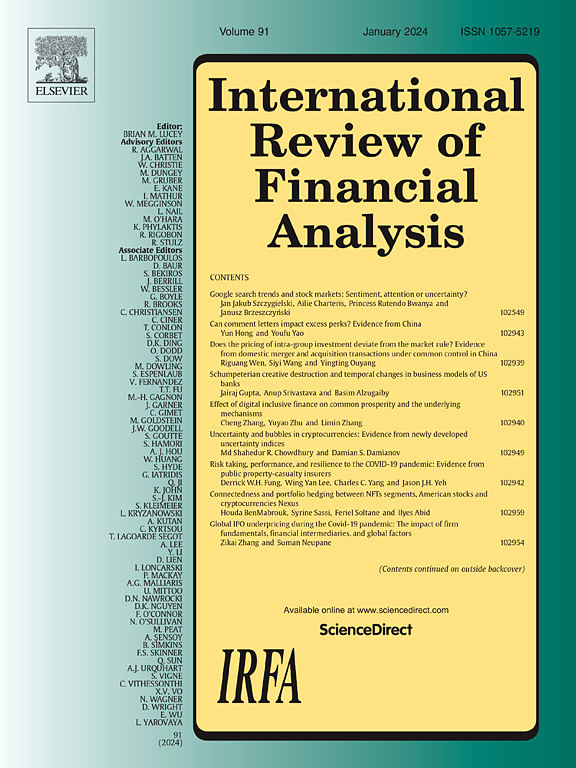
The International Review of Financial Analysis (IRFA) is an impartial refereed journal designed to serve as a platform for high-quality financial research. It welcomes a diverse range of financial research topics and maintains an unbiased selection process. While not limited to U.S.-centric subjects, IRFA, as its title suggests, is open to valuable research contributions from around the world.



 京公网安备 11010802042870号
京ICP备2023020795号-1
京公网安备 11010802042870号
京ICP备2023020795号-1

 分享
分享
 求助内容:
求助内容: 应助结果提醒方式:
 扫码关注我们
