{"title":"Investigation of Fe(III) Complexes with Aminoguanidine Schiff Base Ligands as Biomimetic Catalysts and Sulphide Sensors","authors":"Anwesha Ghosh, Antu Mondal, Swaraj Sengupta, Zvonko Jagličić, Antonio Frontera, Shyamal Kumar Chattopadhyay","doi":"10.1002/ejic.202400537","DOIUrl":null,"url":null,"abstract":"<p>Two high spin Fe(III) complexes, <b>[Fe(L</b><sup>1</sup><b>)<sub>2</sub>]Cl</b> ⋅ <b>H<sub>2</sub>O (1)</b> and <b>[Fe(L</b><sup>2</sup><b>)<sub>2</sub>]Cl</b> ⋅ <b>4H<sub>2</sub>O</b> ⋅ <b>0.5MeOH (2)</b>, of Schiff base ligands of aminoguanidine with salicylaldehyde and pyridoxal (isolated as the hydrochloride salts <b>L</b><sup>1</sup><b>H<sub>2</sub></b><sup><b>+</b></sup><b>Cl<sup>−</sup></b> and <b>L</b><sup>2</sup><b>H<sub>3</sub></b><sup><b>2+</b></sup><b>Cl<sup>−</sup></b><sub><b>2</b></sub> respectively) are reported. X-ray crystal structure of both the complexes along with their spectroscopic and variable temperature magnetic properties are also investigated. It is found that complex <b>2</b> shows stronger zero field splitting (D=9.5 cm<sup>−1</sup>) than complex <b>1</b> (D=5.5 cm<sup>−1</sup>), probably due to greater distortion of the Fe(III) coordination polyhedron in complex <b>2</b>. TD-DFT calculations are used to assign the electronic spectra of the complexes. Both the ligands show fluorescence at 450–460 nm with lifetime of nanosecond order and quantum yield of 0.04–0.07 at room temperature. Both the Fe(III) complexes are found to efficiently catalyze the aerial oxidation of DTBC to DTBQ with the turn over numbers 100–155 h<sup>−1</sup>, which is among the highest for mononuclear Fe(III) complexes. The complexes also act as very good fluorometric sensor for S<sup>2−</sup>, and the limit of detection (LOD) is in the octa-molar region. The pH and temperature dependences of the sensing are also investigated.</p>","PeriodicalId":38,"journal":{"name":"European Journal of Inorganic Chemistry","volume":"28 6","pages":""},"PeriodicalIF":2.0000,"publicationDate":"2025-01-27","publicationTypes":"Journal Article","fieldsOfStudy":null,"isOpenAccess":false,"openAccessPdf":"","citationCount":"0","resultStr":null,"platform":"Semanticscholar","paperid":null,"PeriodicalName":"European Journal of Inorganic Chemistry","FirstCategoryId":"1","ListUrlMain":"https://chemistry-europe.onlinelibrary.wiley.com/doi/10.1002/ejic.202400537","RegionNum":4,"RegionCategory":"化学","ArticlePicture":[],"TitleCN":null,"AbstractTextCN":null,"PMCID":null,"EPubDate":"","PubModel":"","JCR":"Q3","JCRName":"CHEMISTRY, INORGANIC & NUCLEAR","Score":null,"Total":0}
引用次数: 0
Abstract
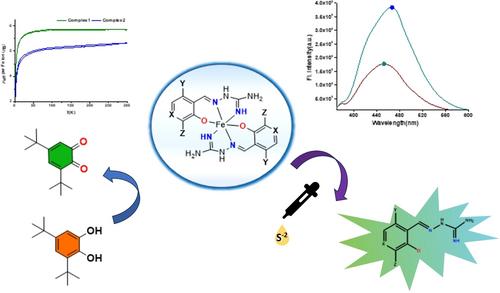
Two high spin Fe(III) complexes, [Fe(L1)2]Cl ⋅ H2O (1) and [Fe(L2)2]Cl ⋅ 4H2O ⋅ 0.5MeOH (2), of Schiff base ligands of aminoguanidine with salicylaldehyde and pyridoxal (isolated as the hydrochloride salts L1H2+Cl− and L2H32+Cl−2 respectively) are reported. X-ray crystal structure of both the complexes along with their spectroscopic and variable temperature magnetic properties are also investigated. It is found that complex 2 shows stronger zero field splitting (D=9.5 cm−1) than complex 1 (D=5.5 cm−1), probably due to greater distortion of the Fe(III) coordination polyhedron in complex 2. TD-DFT calculations are used to assign the electronic spectra of the complexes. Both the ligands show fluorescence at 450–460 nm with lifetime of nanosecond order and quantum yield of 0.04–0.07 at room temperature. Both the Fe(III) complexes are found to efficiently catalyze the aerial oxidation of DTBC to DTBQ with the turn over numbers 100–155 h−1, which is among the highest for mononuclear Fe(III) complexes. The complexes also act as very good fluorometric sensor for S2−, and the limit of detection (LOD) is in the octa-molar region. The pH and temperature dependences of the sensing are also investigated.
期刊介绍:
The European Journal of Inorganic Chemistry (2019 ISI Impact Factor: 2.529) publishes Full Papers, Communications, and Minireviews from the entire spectrum of inorganic, organometallic, bioinorganic, and solid-state chemistry. It is published on behalf of Chemistry Europe, an association of 16 European chemical societies.
The following journals have been merged to form the two leading journals, European Journal of Inorganic Chemistry and European Journal of Organic Chemistry:
Chemische Berichte
Bulletin des Sociétés Chimiques Belges
Bulletin de la Société Chimique de France
Gazzetta Chimica Italiana
Recueil des Travaux Chimiques des Pays-Bas
Anales de Química
Chimika Chronika
Revista Portuguesa de Química
ACH—Models in Chemistry
Polish Journal of Chemistry
The European Journal of Inorganic Chemistry continues to keep you up-to-date with important inorganic chemistry research results.






 京公网安备 11010802042870号
京ICP备2023020795号-1
京公网安备 11010802042870号
京ICP备2023020795号-1

 分享
分享
 求助内容:
求助内容: 应助结果提醒方式:
 扫码关注我们
