Muhammad L. Fajri, Anna Capitaine, Lionel Santinacci, Beniamino Sciacca
{"title":"Silver Nanocube Epitaxy via Nanogap-Induced Electrostatics","authors":"Muhammad L. Fajri, Anna Capitaine, Lionel Santinacci, Beniamino Sciacca","doi":"10.1002/smtd.202401304","DOIUrl":null,"url":null,"abstract":"<p>Silver nanostructures are highly valued in nanophotonic devices due to their appealing plasmonic properties and affordability relative to gold. Yet, fabricating high-quality, monocrystalline silver nanostructures, with full control over the shape, is challenging. A mild, liquid-phase method for the epitaxial welding of adjacent monocrystalline silver nanocubes in reductant-free conditions is introduced to prevent the formation of detrimental nuclei on the surface that can degrade the nanostructures' optical qualities. The mechanism is thoroughly investigated and it is found that the nanocubes themselves can act as reducing agents, promoting growth preferentially into the gap as a result of electrostatic interactions. By controlling experimental parameters such as temperature, pH, and the introduction of capping agents, a balance between nanocube epitaxy and shape retention is achieved. Finally, by applying this procedure to nanoparticle assembled in predefined meta-atoms, the feasibility of creating intricate silver nanostructures, that are monocrystalline as verified by transmission electron microscopy (TEM), is demonstrated. This advancement paves the way for bottom-up fabrication of optical metasurfaces that can be swiftly integrated in devices.</p>","PeriodicalId":229,"journal":{"name":"Small Methods","volume":"9 4","pages":""},"PeriodicalIF":9.1000,"publicationDate":"2025-02-25","publicationTypes":"Journal Article","fieldsOfStudy":null,"isOpenAccess":false,"openAccessPdf":"https://onlinelibrary.wiley.com/doi/epdf/10.1002/smtd.202401304","citationCount":"0","resultStr":null,"platform":"Semanticscholar","paperid":null,"PeriodicalName":"Small Methods","FirstCategoryId":"88","ListUrlMain":"https://onlinelibrary.wiley.com/doi/10.1002/smtd.202401304","RegionNum":2,"RegionCategory":"材料科学","ArticlePicture":[],"TitleCN":null,"AbstractTextCN":null,"PMCID":null,"EPubDate":"","PubModel":"","JCR":"Q1","JCRName":"CHEMISTRY, PHYSICAL","Score":null,"Total":0}
引用次数: 0
Abstract
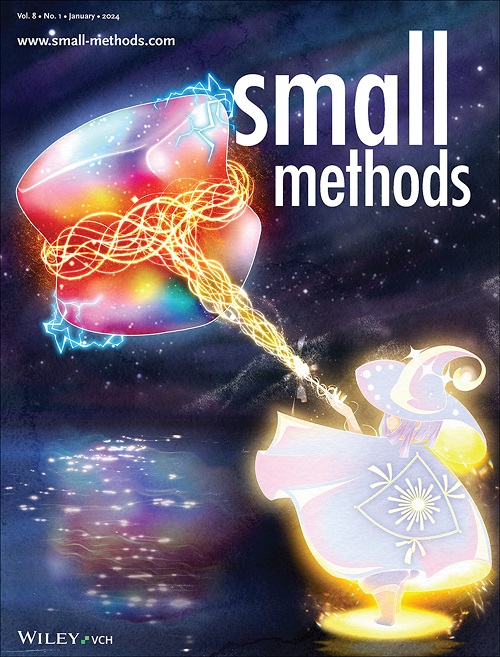
Silver nanostructures are highly valued in nanophotonic devices due to their appealing plasmonic properties and affordability relative to gold. Yet, fabricating high-quality, monocrystalline silver nanostructures, with full control over the shape, is challenging. A mild, liquid-phase method for the epitaxial welding of adjacent monocrystalline silver nanocubes in reductant-free conditions is introduced to prevent the formation of detrimental nuclei on the surface that can degrade the nanostructures' optical qualities. The mechanism is thoroughly investigated and it is found that the nanocubes themselves can act as reducing agents, promoting growth preferentially into the gap as a result of electrostatic interactions. By controlling experimental parameters such as temperature, pH, and the introduction of capping agents, a balance between nanocube epitaxy and shape retention is achieved. Finally, by applying this procedure to nanoparticle assembled in predefined meta-atoms, the feasibility of creating intricate silver nanostructures, that are monocrystalline as verified by transmission electron microscopy (TEM), is demonstrated. This advancement paves the way for bottom-up fabrication of optical metasurfaces that can be swiftly integrated in devices.
Small MethodsMaterials Science-General Materials Science
CiteScore
17.40
自引率
1.60%
发文量
347
期刊介绍:
Small Methods is a multidisciplinary journal that publishes groundbreaking research on methods relevant to nano- and microscale research. It welcomes contributions from the fields of materials science, biomedical science, chemistry, and physics, showcasing the latest advancements in experimental techniques.
With a notable 2022 Impact Factor of 12.4 (Journal Citation Reports, Clarivate Analytics, 2023), Small Methods is recognized for its significant impact on the scientific community.
The online ISSN for Small Methods is 2366-9608.




 京公网安备 11010802042870号
京ICP备2023020795号-1
京公网安备 11010802042870号
京ICP备2023020795号-1

 分享
分享
 求助内容:
求助内容: 应助结果提醒方式:
 扫码关注我们
