Oussama Er-Raji, Stefan Lange, Carl Eric Hartwig, Adi Prasetio, Martin Bivour, Martin Hermle, Marko Turek, Stefaan De Wolf, Stefan W. Glunz, Juliane Borchert, Patricia S. C. Schulze
{"title":"Tuning Self-Assembly of Hole-Selective Monolayers for Reproducible Perovskite/Silicon Tandem Solar Cells","authors":"Oussama Er-Raji, Stefan Lange, Carl Eric Hartwig, Adi Prasetio, Martin Bivour, Martin Hermle, Marko Turek, Stefaan De Wolf, Stefan W. Glunz, Juliane Borchert, Patricia S. C. Schulze","doi":"10.1002/smtd.202401758","DOIUrl":null,"url":null,"abstract":"<p>Self-assemble monolayers (SAMs) have become state-of-the-art hole-selective contacts for high-efficiency perovskite-based solar cells due to their easy processing, passivation capability, and low parasitic absorption. Nevertheless, for the deposition of SAMs with a monolayer thickness and a high packing density on metal oxide substrates, critical challenges persist. To overcome these, the study focuses on the impact of annealing temperature – an intrinsic yet so far unexplored process parameter – during the formation of SAMs. By performing in situ angle-resolved X-ray photoelectron spectroscopy combined with advanced data analysis routines, it is revealed that increasing the annealing temperature reduces the formed SAM layer thickness from a multilayer stack of ≈5 nm at 100 °C (conventional temperature employed in literature) to a monolayer at 150 °C. Furthermore, denser adsorption of the SAM to the metal oxide surface is promoted at high temperatures, which enhances the interfacial SAM/perovskite passivation quality. With this strategy, a 1.3%<sub>abs</sub> power conversion efficiency (<i>PCE</i>) increment is obtained in fully-textured perovskite/silicon tandem solar cells, with improved reproducibility, and a champion device approaching 30% <i>PCE</i>. This study advances the understanding of SAMs formation and presents a promising strategy for further progress in high-efficiency perovskite-based solar cells.</p>","PeriodicalId":229,"journal":{"name":"Small Methods","volume":"9 7","pages":""},"PeriodicalIF":9.1000,"publicationDate":"2025-02-25","publicationTypes":"Journal Article","fieldsOfStudy":null,"isOpenAccess":false,"openAccessPdf":"https://onlinelibrary.wiley.com/doi/epdf/10.1002/smtd.202401758","citationCount":"0","resultStr":null,"platform":"Semanticscholar","paperid":null,"PeriodicalName":"Small Methods","FirstCategoryId":"88","ListUrlMain":"https://onlinelibrary.wiley.com/doi/10.1002/smtd.202401758","RegionNum":2,"RegionCategory":"材料科学","ArticlePicture":[],"TitleCN":null,"AbstractTextCN":null,"PMCID":null,"EPubDate":"","PubModel":"","JCR":"Q1","JCRName":"CHEMISTRY, PHYSICAL","Score":null,"Total":0}
引用次数: 0
Abstract
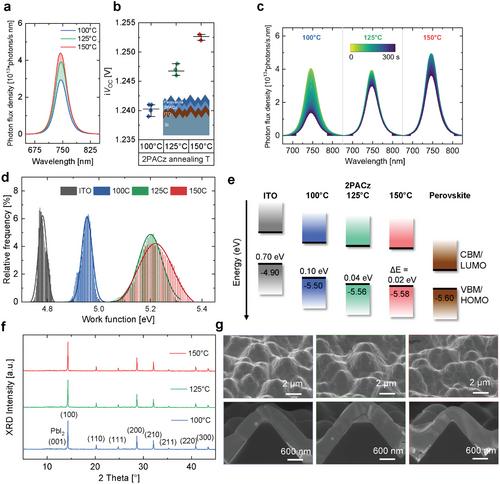
Self-assemble monolayers (SAMs) have become state-of-the-art hole-selective contacts for high-efficiency perovskite-based solar cells due to their easy processing, passivation capability, and low parasitic absorption. Nevertheless, for the deposition of SAMs with a monolayer thickness and a high packing density on metal oxide substrates, critical challenges persist. To overcome these, the study focuses on the impact of annealing temperature – an intrinsic yet so far unexplored process parameter – during the formation of SAMs. By performing in situ angle-resolved X-ray photoelectron spectroscopy combined with advanced data analysis routines, it is revealed that increasing the annealing temperature reduces the formed SAM layer thickness from a multilayer stack of ≈5 nm at 100 °C (conventional temperature employed in literature) to a monolayer at 150 °C. Furthermore, denser adsorption of the SAM to the metal oxide surface is promoted at high temperatures, which enhances the interfacial SAM/perovskite passivation quality. With this strategy, a 1.3%abs power conversion efficiency (PCE) increment is obtained in fully-textured perovskite/silicon tandem solar cells, with improved reproducibility, and a champion device approaching 30% PCE. This study advances the understanding of SAMs formation and presents a promising strategy for further progress in high-efficiency perovskite-based solar cells.
Small MethodsMaterials Science-General Materials Science
CiteScore
17.40
自引率
1.60%
发文量
347
期刊介绍:
Small Methods is a multidisciplinary journal that publishes groundbreaking research on methods relevant to nano- and microscale research. It welcomes contributions from the fields of materials science, biomedical science, chemistry, and physics, showcasing the latest advancements in experimental techniques.
With a notable 2022 Impact Factor of 12.4 (Journal Citation Reports, Clarivate Analytics, 2023), Small Methods is recognized for its significant impact on the scientific community.
The online ISSN for Small Methods is 2366-9608.



 京公网安备 11010802042870号
京ICP备2023020795号-1
京公网安备 11010802042870号
京ICP备2023020795号-1

 分享
分享
 求助内容:
求助内容: 应助结果提醒方式:
 扫码关注我们
