Hans-Christen Husum, Ole Rahbek, Per Hviid Gundtoft, Hans Christian Bang, Søren Kold, Jan Duedal Rölfing, Ahmed Abood
{"title":"The risk of refracture and malunion in children treated for diaphyseal forearm fractures: a retrospective cohort study.","authors":"Hans-Christen Husum, Ole Rahbek, Per Hviid Gundtoft, Hans Christian Bang, Søren Kold, Jan Duedal Rölfing, Ahmed Abood","doi":"10.2340/17453674.2025.42851","DOIUrl":null,"url":null,"abstract":"<p><strong>Background and purpose: </strong>The optimal treatment modality for pediatric diaphyseal forearm fractures is debated. While nonoperative treatment and closed reduction reduces the need for surgery and surgical complications, flexible intramedullary nailing (FIN) may reduce refracture and malunion rates. We aimed to compare the relative risk (RR) of refracture and malunion between nonoperative, closed reduction (CR), and surgical treatment in children treated for diaphyseal forearm fractures.</p><p><strong>Methods: </strong>We performed a retrospective cohort study of children treated for a primary diaphyseal forearm fracture over a 9-year period at 2 university hospitals. Risk of refracture and malunion in the year following the fracture across treatment modalities was assessed by a modified Poisson regression while adjusting for the age of the patient at the time of fracture.</p><p><strong>Results: </strong>We included 837 patients for analysis, of whom 4% were treated nonoperatively, 6% were treated with closed reduction, and 90% with FIN. Compared with FIN, the RR of refracture was higher for the nonoperative group (9.8, 95% confidence interval [CI] 5.9-16.3) and CR group (2.5, CI 1.2-5.3). Compared with the FIN group, the nonoperative and CR groups had higher risk of malunion with RR of 15.3 (CI 11.0-21.4) and 8.5 (CI 5.8-12.5) respectively. Of those treated non-surgically, 84% remained without any surgery. In FIN patients, surgical revision due to infection was seen in 1.4% of patients.</p><p><strong>Conclusion: </strong>The risk of refracture and malunion in children treated for diaphyseal forearm fractures was significantly higher for closed reduction and nonoperative treatment compared with FIN treatment.</p>","PeriodicalId":6916,"journal":{"name":"Acta Orthopaedica","volume":"96 ","pages":"189-194"},"PeriodicalIF":2.4000,"publicationDate":"2025-02-24","publicationTypes":"Journal Article","fieldsOfStudy":null,"isOpenAccess":false,"openAccessPdf":"https://www.ncbi.nlm.nih.gov/pmc/articles/PMC11851337/pdf/","citationCount":"0","resultStr":null,"platform":"Semanticscholar","paperid":null,"PeriodicalName":"Acta Orthopaedica","FirstCategoryId":"3","ListUrlMain":"https://doi.org/10.2340/17453674.2025.42851","RegionNum":2,"RegionCategory":"医学","ArticlePicture":[],"TitleCN":null,"AbstractTextCN":null,"PMCID":null,"EPubDate":"","PubModel":"","JCR":"Q1","JCRName":"ORTHOPEDICS","Score":null,"Total":0}
引用次数: 0
Abstract
Background and purpose: The optimal treatment modality for pediatric diaphyseal forearm fractures is debated. While nonoperative treatment and closed reduction reduces the need for surgery and surgical complications, flexible intramedullary nailing (FIN) may reduce refracture and malunion rates. We aimed to compare the relative risk (RR) of refracture and malunion between nonoperative, closed reduction (CR), and surgical treatment in children treated for diaphyseal forearm fractures.
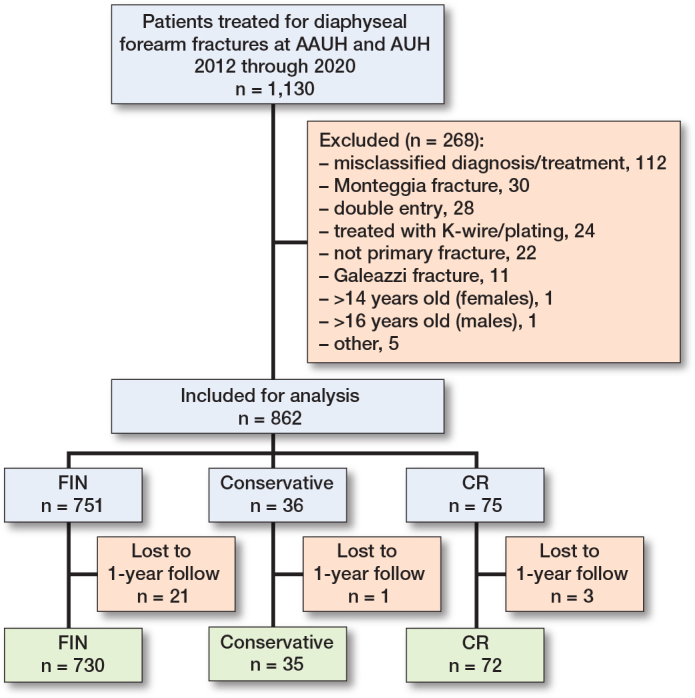
Methods: We performed a retrospective cohort study of children treated for a primary diaphyseal forearm fracture over a 9-year period at 2 university hospitals. Risk of refracture and malunion in the year following the fracture across treatment modalities was assessed by a modified Poisson regression while adjusting for the age of the patient at the time of fracture.
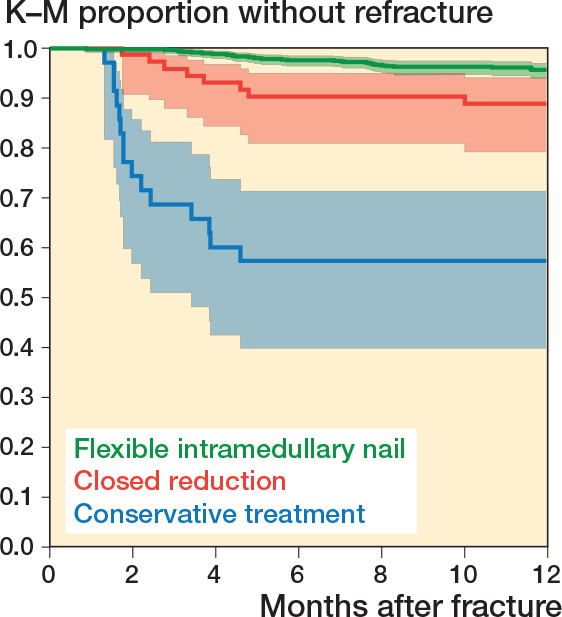
Results: We included 837 patients for analysis, of whom 4% were treated nonoperatively, 6% were treated with closed reduction, and 90% with FIN. Compared with FIN, the RR of refracture was higher for the nonoperative group (9.8, 95% confidence interval [CI] 5.9-16.3) and CR group (2.5, CI 1.2-5.3). Compared with the FIN group, the nonoperative and CR groups had higher risk of malunion with RR of 15.3 (CI 11.0-21.4) and 8.5 (CI 5.8-12.5) respectively. Of those treated non-surgically, 84% remained without any surgery. In FIN patients, surgical revision due to infection was seen in 1.4% of patients.
Conclusion: The risk of refracture and malunion in children treated for diaphyseal forearm fractures was significantly higher for closed reduction and nonoperative treatment compared with FIN treatment.
期刊介绍:
Acta Orthopaedica (previously Acta Orthopaedica Scandinavica) presents original articles of basic research interest, as well as clinical studies in the field of orthopedics and related sub disciplines. Ever since the journal was founded in 1930, by a group of Scandinavian orthopedic surgeons, the journal has been published for an international audience. Acta Orthopaedica is owned by the Nordic Orthopaedic Federation and is the official publication of this federation.



 京公网安备 11010802042870号
京ICP备2023020795号-1
京公网安备 11010802042870号
京ICP备2023020795号-1

 分享
分享
 求助内容:
求助内容: 应助结果提醒方式:
 扫码关注我们
