{"title":"Metabolic outcomes in non-alcoholic and alcoholic steatotic liver disease among Korean and American adults.","authors":"Yeongmin Kim, Tae Sic Lee, Chang-Myung Oh","doi":"10.1186/s12876-025-03687-4","DOIUrl":null,"url":null,"abstract":"<p><strong>Background: </strong>This study investigated the prevalence and causal relationships of chronic metabolic diseases (diabetes, hypertension, and dyslipidemia) with steatotic liver disease (SLD), specifically metabolically associated alcoholic liver disease (MetALD).</p><p><strong>Methods: </strong>We conducted a comprehensive analysis using cross-sectional data from the KNHANES from 2011 to 2021 and the NHANES from 1999 to 2020. Longitudinal data from 2001 to 2014 from the KoGES were used. Participants were categorized into the metabolic dysfunction-associated SLD(MASLD), MetALD, and ALD groups based on their hepatic steatosis index (HSI), including liver profiles, body composition, and diabetes, and alcohol consumption. Multivariable, including age and smoking status, logistic and Cox regression analyses were performed to assess the prevalence and incidence of chronic diseases.</p><p><strong>Results: </strong>In both the KNHANES and NHANES cohorts, an increased HSI was significantly associated with a higher prevalence of chronic metabolic diseases. Longitudinal data from the KoGES cohort showed that MASLD and MetALD were significant predictors of chronic metabolic disease in both men and women. MetALD showed a higher hazard ratio for the development of chronic metabolic diseases than MASLD in Cox regression analysis.</p><p><strong>Conclusions: </strong>This study highlighted the intertwined nature of SLD and metabolic health, with an emphasis on the role of MetALD. The significant association between MetALD and chronic metabolic diseases underscores the need for integrated management strategies that address both liver health and metabolic risk factors.</p>","PeriodicalId":9129,"journal":{"name":"BMC Gastroenterology","volume":"25 1","pages":"110"},"PeriodicalIF":2.5000,"publicationDate":"2025-02-24","publicationTypes":"Journal Article","fieldsOfStudy":null,"isOpenAccess":false,"openAccessPdf":"https://www.ncbi.nlm.nih.gov/pmc/articles/PMC11853905/pdf/","citationCount":"0","resultStr":null,"platform":"Semanticscholar","paperid":null,"PeriodicalName":"BMC Gastroenterology","FirstCategoryId":"3","ListUrlMain":"https://doi.org/10.1186/s12876-025-03687-4","RegionNum":3,"RegionCategory":"医学","ArticlePicture":[],"TitleCN":null,"AbstractTextCN":null,"PMCID":null,"EPubDate":"","PubModel":"","JCR":"Q2","JCRName":"GASTROENTEROLOGY & HEPATOLOGY","Score":null,"Total":0}
引用次数: 0
Abstract
Background: This study investigated the prevalence and causal relationships of chronic metabolic diseases (diabetes, hypertension, and dyslipidemia) with steatotic liver disease (SLD), specifically metabolically associated alcoholic liver disease (MetALD).
Methods: We conducted a comprehensive analysis using cross-sectional data from the KNHANES from 2011 to 2021 and the NHANES from 1999 to 2020. Longitudinal data from 2001 to 2014 from the KoGES were used. Participants were categorized into the metabolic dysfunction-associated SLD(MASLD), MetALD, and ALD groups based on their hepatic steatosis index (HSI), including liver profiles, body composition, and diabetes, and alcohol consumption. Multivariable, including age and smoking status, logistic and Cox regression analyses were performed to assess the prevalence and incidence of chronic diseases.
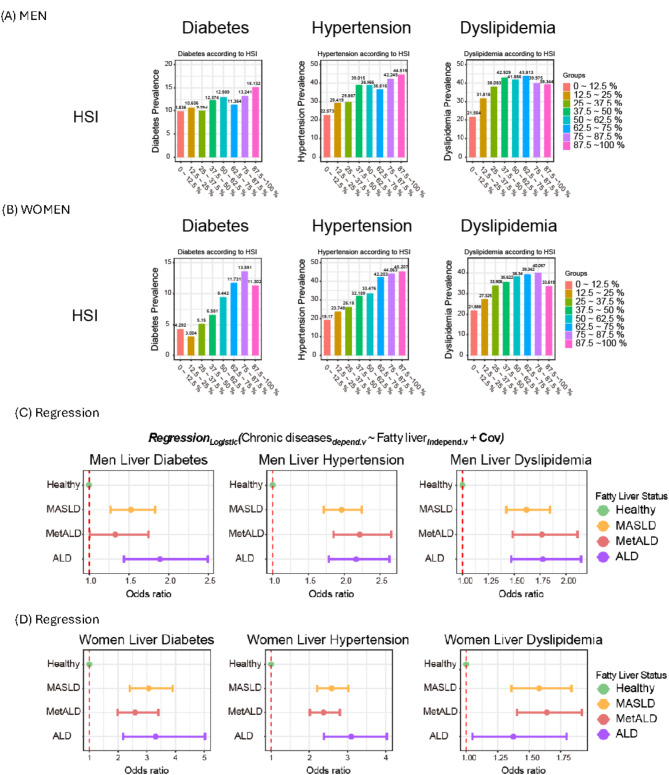
Results: In both the KNHANES and NHANES cohorts, an increased HSI was significantly associated with a higher prevalence of chronic metabolic diseases. Longitudinal data from the KoGES cohort showed that MASLD and MetALD were significant predictors of chronic metabolic disease in both men and women. MetALD showed a higher hazard ratio for the development of chronic metabolic diseases than MASLD in Cox regression analysis.
Conclusions: This study highlighted the intertwined nature of SLD and metabolic health, with an emphasis on the role of MetALD. The significant association between MetALD and chronic metabolic diseases underscores the need for integrated management strategies that address both liver health and metabolic risk factors.
期刊介绍:
BMC Gastroenterology is an open access, peer-reviewed journal that considers articles on all aspects of the prevention, diagnosis and management of gastrointestinal and hepatobiliary disorders, as well as related molecular genetics, pathophysiology, and epidemiology.





 京公网安备 11010802042870号
京ICP备2023020795号-1
京公网安备 11010802042870号
京ICP备2023020795号-1

 分享
分享
 求助内容:
求助内容: 应助结果提醒方式:
 扫码关注我们
