Dynamic changes in immune repertoire profiles in patients with stage III unresectable non-small cell lung cancer during consolidation treatment with immunotherapy.
{"title":"Dynamic changes in immune repertoire profiles in patients with stage III unresectable non-small cell lung cancer during consolidation treatment with immunotherapy.","authors":"Nareenart Iemwimangsa, Dulyathat Anantaya, Songporn Oranratnachai, Thanaporn Thamrongjirapat, Putthapoom Lumjiaktase, View-Hune Teoh, Khantong Khiewngam, Nanamon Monnamo, Pimtip Sanvarinda, Pimpin Incharoen, Angkana Charoenyingwattan, Insee Sensorn, Thitiya Dejthevaporn, Ekaphop Sirachainan, Wasun Chantratita, Thanyanan Reungwetwattana, Narumol Trachu","doi":"10.1186/s12885-025-13716-w","DOIUrl":null,"url":null,"abstract":"<p><strong>Background: </strong>One-year of immune checkpoint inhibitor (ICI) treatment after concurrent chemoradiation (CCRT) in unresectable stage III non-small cell lung cancer (NSCLC) is a standard of care. The precise predictive biomarkers are under investigations either immunological markers or clinical characteristics. Here, we explored immune repertoire of T cell receptor β-chain (TCRβ) during ICI treatment.</p><p><strong>Methods: </strong>During August 2019 and September 2021, stage III NSCLC, post CCRT patients from Ramathibodi Hospital was enrolled. All patients were treated by durvalumab after CCRT. Blood samples were collected together with clinical data and tumor assessment every 3-4 months until disease progression or discontinuation of treatment due to adverse events. CDR3 region and TCRΒ polymorphisms was explored by RNA sequencing using Next-Generation Sequencing (NGS) TCR beta short-read assay. Bioinformatic analysis was performed to analyze clonal diversity, TCR convergence frequency and the Shannon diversity from each timepoint. Immune repertoire and clinical correlation were explored using Spearman's correlation and Pearson's correlation. RStudio software version 2021 build 372 was used for analyses. A significance level was at P < 0.05.</p><p><strong>Results: </strong>Forty-four blood samples from 12 patients were analyzed. Mean duration of durvalumab treatment was 284 days. After durvalumab treatment, increasing of TCR convergence frequency was found compared to baseline (R = 0.36). Interestingly, it was also significantly higher in non-progressive disease (non-PD) patients compared with progressive disease (PD) patients (P = 0.011). Furthermore, Shannon diversity was higher increasing in PD patients compared with non-PD patients. Taken together, our study found that increasing of TCR convergence with less T-cell diversity in non-PD patients probably demonstrated a T cell-specific clonal expansion response to durvalumab treatment in this population.</p><p><strong>Conclusions: </strong>TCRβ repertoire is the potential biomarker for predicting durvalumab treatment response in post CCRT stage III NSCLC patients. However, a larger cohort with long-read assay should be explored.</p>","PeriodicalId":9131,"journal":{"name":"BMC Cancer","volume":"25 1","pages":"333"},"PeriodicalIF":3.4000,"publicationDate":"2025-02-24","publicationTypes":"Journal Article","fieldsOfStudy":null,"isOpenAccess":false,"openAccessPdf":"https://www.ncbi.nlm.nih.gov/pmc/articles/PMC11853222/pdf/","citationCount":"0","resultStr":null,"platform":"Semanticscholar","paperid":null,"PeriodicalName":"BMC Cancer","FirstCategoryId":"3","ListUrlMain":"https://doi.org/10.1186/s12885-025-13716-w","RegionNum":2,"RegionCategory":"医学","ArticlePicture":[],"TitleCN":null,"AbstractTextCN":null,"PMCID":null,"EPubDate":"","PubModel":"","JCR":"Q2","JCRName":"ONCOLOGY","Score":null,"Total":0}
引用次数: 0
Abstract
Background: One-year of immune checkpoint inhibitor (ICI) treatment after concurrent chemoradiation (CCRT) in unresectable stage III non-small cell lung cancer (NSCLC) is a standard of care. The precise predictive biomarkers are under investigations either immunological markers or clinical characteristics. Here, we explored immune repertoire of T cell receptor β-chain (TCRβ) during ICI treatment.
Methods: During August 2019 and September 2021, stage III NSCLC, post CCRT patients from Ramathibodi Hospital was enrolled. All patients were treated by durvalumab after CCRT. Blood samples were collected together with clinical data and tumor assessment every 3-4 months until disease progression or discontinuation of treatment due to adverse events. CDR3 region and TCRΒ polymorphisms was explored by RNA sequencing using Next-Generation Sequencing (NGS) TCR beta short-read assay. Bioinformatic analysis was performed to analyze clonal diversity, TCR convergence frequency and the Shannon diversity from each timepoint. Immune repertoire and clinical correlation were explored using Spearman's correlation and Pearson's correlation. RStudio software version 2021 build 372 was used for analyses. A significance level was at P < 0.05.
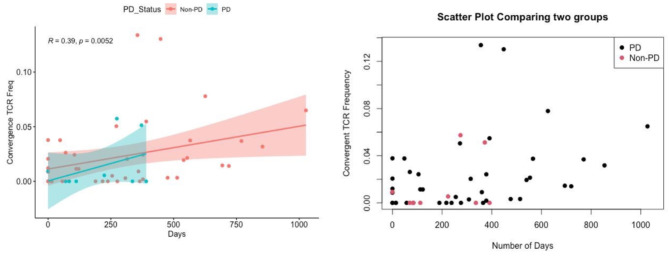
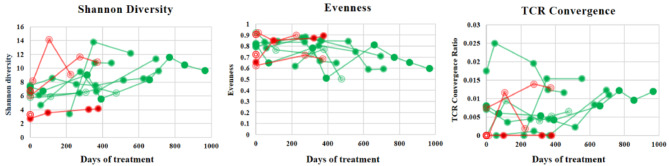
Results: Forty-four blood samples from 12 patients were analyzed. Mean duration of durvalumab treatment was 284 days. After durvalumab treatment, increasing of TCR convergence frequency was found compared to baseline (R = 0.36). Interestingly, it was also significantly higher in non-progressive disease (non-PD) patients compared with progressive disease (PD) patients (P = 0.011). Furthermore, Shannon diversity was higher increasing in PD patients compared with non-PD patients. Taken together, our study found that increasing of TCR convergence with less T-cell diversity in non-PD patients probably demonstrated a T cell-specific clonal expansion response to durvalumab treatment in this population.
Conclusions: TCRβ repertoire is the potential biomarker for predicting durvalumab treatment response in post CCRT stage III NSCLC patients. However, a larger cohort with long-read assay should be explored.
期刊介绍:
BMC Cancer is an open access, peer-reviewed journal that considers articles on all aspects of cancer research, including the pathophysiology, prevention, diagnosis and treatment of cancers. The journal welcomes submissions concerning molecular and cellular biology, genetics, epidemiology, and clinical trials.




 京公网安备 11010802042870号
京ICP备2023020795号-1
京公网安备 11010802042870号
京ICP备2023020795号-1

 分享
分享
 求助内容:
求助内容: 应助结果提醒方式:
 扫码关注我们
