Li Wang, Si-Yu Chen, Shun Wan, Kun-Peng Li, Xiao-Ran Li, Li Yang
{"title":"Vasectomy and prostate cancer risk: a pooled of cohort studies and Mendelian randomization analysis.","authors":"Li Wang, Si-Yu Chen, Shun Wan, Kun-Peng Li, Xiao-Ran Li, Li Yang","doi":"10.1186/s12885-025-13750-8","DOIUrl":null,"url":null,"abstract":"<p><strong>Background: </strong>The relationship between vasectomy and the risk of prostate cancer (PCa) remains unclear, with observational studies reporting inconsistent results. To clarify this ambiguity, we embarked on a comprehensive investigation comprising both a meta-analysis and a Mendelian randomization (MR) study. This dual approach aimed to thoroughly examine not only the association but also the causality between undergoing a vasectomy and the subsequent risk of PCa.</p><p><strong>Methods: </strong>Our systematic review meticulously examined cohort studies published until January 2024, employing a random effects model for the computation of relative risks (RR) and their 95% confidence intervals (CI). For MR Analysis, we leveraged aggregated data from the IEU Open GWAS database, investigating the correlation between genetic predisposition to vasectomy and PCa. We chose single nucleotide polymorphisms (SNPs) of European descent as instrumental variables (IVs) for this analysis. The primary method for calculating the odds ratios (ORs) and their 95% CIs was inverse variance weighting (IVW). Through sensitivity analysis, we confirmed the robustness of our findings.</p><p><strong>Results: </strong>Our investigation synthesized data from 19 cohort studies, encompassing over four million participants. The combined analysis revealed a statistically significant link between vasectomy and an elevated risk of PCa across any grade (RR = 1.09; 95%CI: 1.05-1.14; P = 0.001; I² = 83.3%). This association was observed for both localized PCa (RR = 1.08; 95% CI: 1.04-1.13; P < 0.001; I² = 48.8%) and advanced PCa (RR = 1.07; 95% CI: 1.01-1.13; P = 0.016; I² = 0%). Nonetheless, the discovery cohort MR Analysis indicated no genetic causal link between vasectomy and PCa (OR = 0.067; 95%CI = 0.002-1.535; P = 0.09). A validation set in the Finnish population confirmed the robustness of the results. This conclusion remained consistent even after controlling for variables such as prostate-specific antigen (PSA) testing and body mass index (BMI), suggesting that while a statistical association exists, the genetic evidence does not support a causal relationship.</p><p><strong>Conclusion: </strong>The cumulative analysis indicates a possible elevated risk of PCa in patients who have had a vasectomy. However, MR Analysis has not confirmed a direct causal link between vasectomy and PCa. This suggests that the association observed may not stem from direct causation, allowing for the continued consideration of vasectomy as a viable long-term contraceptive choice. Further research is imperative to uncover any factors that could potentially link vasectomy to an increased risk of prostate cancer, aiming to provide a more comprehensive understanding of the implications.</p>","PeriodicalId":9131,"journal":{"name":"BMC Cancer","volume":"25 1","pages":"332"},"PeriodicalIF":3.4000,"publicationDate":"2025-02-24","publicationTypes":"Journal Article","fieldsOfStudy":null,"isOpenAccess":false,"openAccessPdf":"https://www.ncbi.nlm.nih.gov/pmc/articles/PMC11853223/pdf/","citationCount":"0","resultStr":null,"platform":"Semanticscholar","paperid":null,"PeriodicalName":"BMC Cancer","FirstCategoryId":"3","ListUrlMain":"https://doi.org/10.1186/s12885-025-13750-8","RegionNum":2,"RegionCategory":"医学","ArticlePicture":[],"TitleCN":null,"AbstractTextCN":null,"PMCID":null,"EPubDate":"","PubModel":"","JCR":"Q2","JCRName":"ONCOLOGY","Score":null,"Total":0}
引用次数: 0
Abstract
Background: The relationship between vasectomy and the risk of prostate cancer (PCa) remains unclear, with observational studies reporting inconsistent results. To clarify this ambiguity, we embarked on a comprehensive investigation comprising both a meta-analysis and a Mendelian randomization (MR) study. This dual approach aimed to thoroughly examine not only the association but also the causality between undergoing a vasectomy and the subsequent risk of PCa.
Methods: Our systematic review meticulously examined cohort studies published until January 2024, employing a random effects model for the computation of relative risks (RR) and their 95% confidence intervals (CI). For MR Analysis, we leveraged aggregated data from the IEU Open GWAS database, investigating the correlation between genetic predisposition to vasectomy and PCa. We chose single nucleotide polymorphisms (SNPs) of European descent as instrumental variables (IVs) for this analysis. The primary method for calculating the odds ratios (ORs) and their 95% CIs was inverse variance weighting (IVW). Through sensitivity analysis, we confirmed the robustness of our findings.
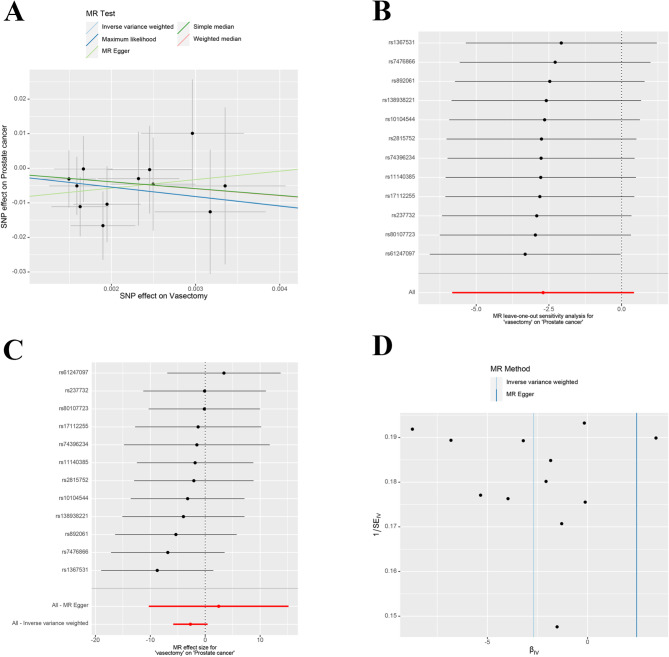
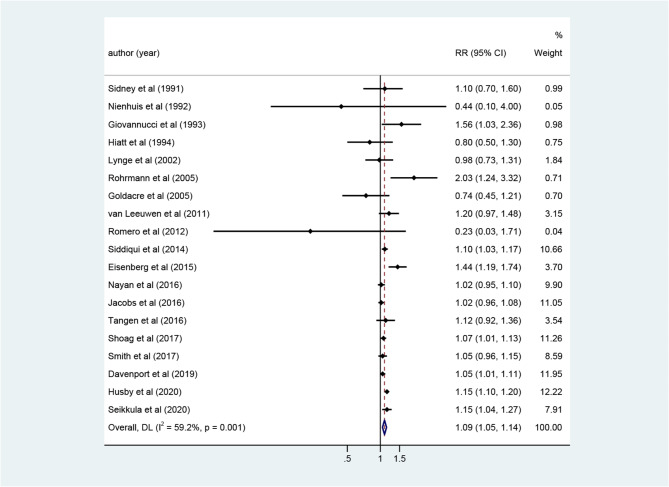
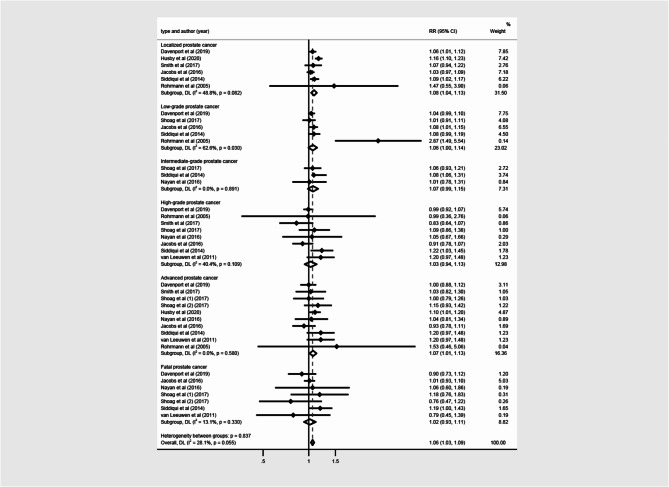
Results: Our investigation synthesized data from 19 cohort studies, encompassing over four million participants. The combined analysis revealed a statistically significant link between vasectomy and an elevated risk of PCa across any grade (RR = 1.09; 95%CI: 1.05-1.14; P = 0.001; I² = 83.3%). This association was observed for both localized PCa (RR = 1.08; 95% CI: 1.04-1.13; P < 0.001; I² = 48.8%) and advanced PCa (RR = 1.07; 95% CI: 1.01-1.13; P = 0.016; I² = 0%). Nonetheless, the discovery cohort MR Analysis indicated no genetic causal link between vasectomy and PCa (OR = 0.067; 95%CI = 0.002-1.535; P = 0.09). A validation set in the Finnish population confirmed the robustness of the results. This conclusion remained consistent even after controlling for variables such as prostate-specific antigen (PSA) testing and body mass index (BMI), suggesting that while a statistical association exists, the genetic evidence does not support a causal relationship.
Conclusion: The cumulative analysis indicates a possible elevated risk of PCa in patients who have had a vasectomy. However, MR Analysis has not confirmed a direct causal link between vasectomy and PCa. This suggests that the association observed may not stem from direct causation, allowing for the continued consideration of vasectomy as a viable long-term contraceptive choice. Further research is imperative to uncover any factors that could potentially link vasectomy to an increased risk of prostate cancer, aiming to provide a more comprehensive understanding of the implications.
期刊介绍:
BMC Cancer is an open access, peer-reviewed journal that considers articles on all aspects of cancer research, including the pathophysiology, prevention, diagnosis and treatment of cancers. The journal welcomes submissions concerning molecular and cellular biology, genetics, epidemiology, and clinical trials.



 京公网安备 11010802042870号
京ICP备2023020795号-1
京公网安备 11010802042870号
京ICP备2023020795号-1

 分享
分享
 求助内容:
求助内容: 应助结果提醒方式:
 扫码关注我们
