{"title":"Advanced lung cancer inflammation index: a key predictor of hepatic steatosis and fibrosis severity.","authors":"Yajie Liu, Ruilin Wang","doi":"10.1186/s12876-024-03544-w","DOIUrl":null,"url":null,"abstract":"<p><strong>Background: </strong>The Advanced Lung Cancer Inflammation Index (ALI) reflects levels of systemic inflammation and nutrient metabolism in patients. However, The connection between ALI and hepatic steatosis and fibrosis remains unclear. This study aims to explore the potential association between ALI, the Controlled Attenuation Parameter (CAP), and Liver Stiffness Measurement (LSM), offering new perspectives for the prevention of hepatic steatosis and fibrosis.</p><p><strong>Methods: </strong>Using data from the National Health and Nutrition Examination Survey database spanning from 2017 to 2020, a cross-sectional study of 6591 participants aged 20 years and older was performed to assess the relationship between ALI and hepatic steatosis and hepatic fibrosis. Smooth curve fitting and generalized additive models were used to further evaluate whether there was a nonlinear association between ALI, CAP, and LSM, and threshold effect analysis was used to find the inflection point. A two-part linear regression model was applied to estimate threshold effects. Subgroup analysis and interaction were used to evaluate the potential association between ALI, CAP, and LSM. Furthermore, to verify the efficacy of ALI, we used ROC curves to compare ALI with fibrosis and nutritional markers (FIB-4 index, GNRI) that have been reported to be associated with liver disease.</p><p><strong>Results: </strong>The ALI levels in the MASLD and fibrosis 4 groups were considerably elevated than the control group, with statistical significance (P<sub>MASLD</sub><0.001, P<sub>AHF</sub> =0.013). Multiple linear regression analyses indicated significant positive associations between ALI and its quartiles with both CAP[b(95%CI) <sub>ALI</sub>=0.510(0.465,0.555), P<0.001] and LSM levels [b(95%CI) <sub>ALI</sub>=0.011(0.009,0.013), P<0.001). There was a positive smooth curve fitting relationship between ALI and the levels of CAP and LSM, with threshold effect inflection points at 88.287 and 98.420 (P<sub>Log likelihood ratio</sub><0.001), respectively. ALI interacts with CAP in relation to gender [OR(95%CI)<sub>female</sub>=0.095(0.039-0.150), OR(95%CI)<sub>male</sub>=0.174(0.118-0.230), P<sub>for interaction</sub>=0.044] and smoking [OR(95% CI)<sub><100cigarettes in life</sub>=0.086(0.035-0.137), OR(95% CI)<sub>>100cigarettes in life</sub>=0.177(0.115-0.240), P<sub>for interaction</sub>=0.023], and with LSM in patients with HL [OR(95% CI)<sub>HL</sub>=0.014(0.008-0.019), P<sub>for interaction</sub><0.001].</p><p><strong>Conclusion: </strong>The findings suggest a positive correlation between elevated ALI levels and the levels of CAP and LSM. Maintaining ALI within an appropriate range may help mitigate the prevalence of hepatic steatosis and hepatic fibrosis.</p>","PeriodicalId":9129,"journal":{"name":"BMC Gastroenterology","volume":"25 1","pages":"106"},"PeriodicalIF":2.5000,"publicationDate":"2025-02-24","publicationTypes":"Journal Article","fieldsOfStudy":null,"isOpenAccess":false,"openAccessPdf":"https://www.ncbi.nlm.nih.gov/pmc/articles/PMC11849289/pdf/","citationCount":"0","resultStr":null,"platform":"Semanticscholar","paperid":null,"PeriodicalName":"BMC Gastroenterology","FirstCategoryId":"3","ListUrlMain":"https://doi.org/10.1186/s12876-024-03544-w","RegionNum":3,"RegionCategory":"医学","ArticlePicture":[],"TitleCN":null,"AbstractTextCN":null,"PMCID":null,"EPubDate":"","PubModel":"","JCR":"Q2","JCRName":"GASTROENTEROLOGY & HEPATOLOGY","Score":null,"Total":0}
引用次数: 0
Abstract
Background: The Advanced Lung Cancer Inflammation Index (ALI) reflects levels of systemic inflammation and nutrient metabolism in patients. However, The connection between ALI and hepatic steatosis and fibrosis remains unclear. This study aims to explore the potential association between ALI, the Controlled Attenuation Parameter (CAP), and Liver Stiffness Measurement (LSM), offering new perspectives for the prevention of hepatic steatosis and fibrosis.
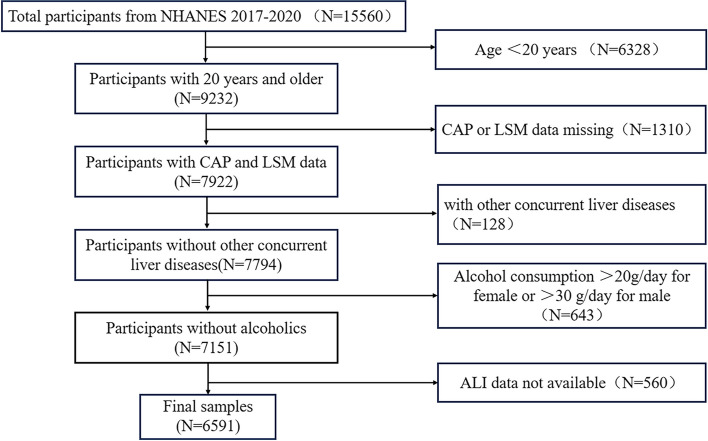
Methods: Using data from the National Health and Nutrition Examination Survey database spanning from 2017 to 2020, a cross-sectional study of 6591 participants aged 20 years and older was performed to assess the relationship between ALI and hepatic steatosis and hepatic fibrosis. Smooth curve fitting and generalized additive models were used to further evaluate whether there was a nonlinear association between ALI, CAP, and LSM, and threshold effect analysis was used to find the inflection point. A two-part linear regression model was applied to estimate threshold effects. Subgroup analysis and interaction were used to evaluate the potential association between ALI, CAP, and LSM. Furthermore, to verify the efficacy of ALI, we used ROC curves to compare ALI with fibrosis and nutritional markers (FIB-4 index, GNRI) that have been reported to be associated with liver disease.
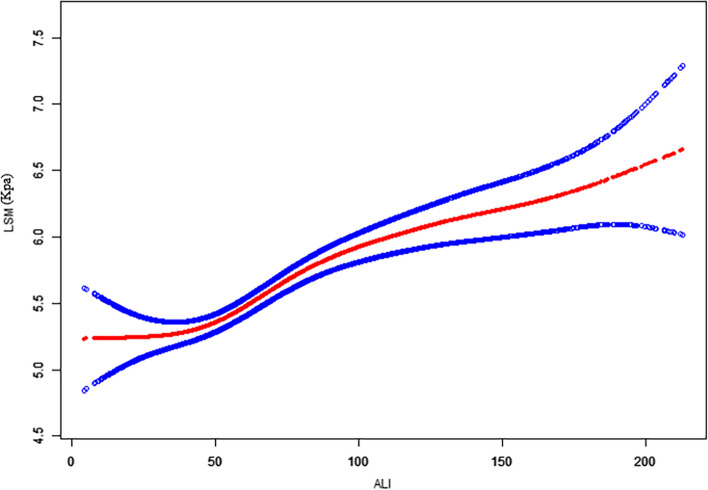
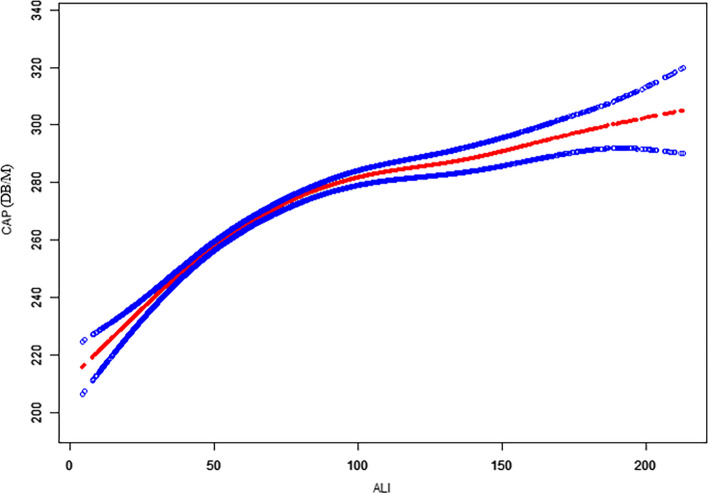
Results: The ALI levels in the MASLD and fibrosis 4 groups were considerably elevated than the control group, with statistical significance (PMASLD<0.001, PAHF =0.013). Multiple linear regression analyses indicated significant positive associations between ALI and its quartiles with both CAP[b(95%CI) ALI=0.510(0.465,0.555), P<0.001] and LSM levels [b(95%CI) ALI=0.011(0.009,0.013), P<0.001). There was a positive smooth curve fitting relationship between ALI and the levels of CAP and LSM, with threshold effect inflection points at 88.287 and 98.420 (PLog likelihood ratio<0.001), respectively. ALI interacts with CAP in relation to gender [OR(95%CI)female=0.095(0.039-0.150), OR(95%CI)male=0.174(0.118-0.230), Pfor interaction=0.044] and smoking [OR(95% CI)<100cigarettes in life=0.086(0.035-0.137), OR(95% CI)>100cigarettes in life=0.177(0.115-0.240), Pfor interaction=0.023], and with LSM in patients with HL [OR(95% CI)HL=0.014(0.008-0.019), Pfor interaction<0.001].
Conclusion: The findings suggest a positive correlation between elevated ALI levels and the levels of CAP and LSM. Maintaining ALI within an appropriate range may help mitigate the prevalence of hepatic steatosis and hepatic fibrosis.
期刊介绍:
BMC Gastroenterology is an open access, peer-reviewed journal that considers articles on all aspects of the prevention, diagnosis and management of gastrointestinal and hepatobiliary disorders, as well as related molecular genetics, pathophysiology, and epidemiology.



 京公网安备 11010802042870号
京ICP备2023020795号-1
京公网安备 11010802042870号
京ICP备2023020795号-1

 分享
分享
 求助内容:
求助内容: 应助结果提醒方式:
 扫码关注我们
