Atypical Hemolytic Uremic Syndrome Associated with BNT162b2 mRNA COVID-19 Vaccine in a Kidney Transplant Recipient: A Case Report and Literature Review.
{"title":"Atypical Hemolytic Uremic Syndrome Associated with BNT162b2 mRNA COVID-19 Vaccine in a Kidney Transplant Recipient: A Case Report and Literature Review.","authors":"Eleonora Francesca Pattonieri, Marilena Gregorini, Maria Antonietta Grignano, Tefik Islami, Gioacchino D'Ambrosio, Gianluigi Ardissino, Teresa Rampino","doi":"10.3390/idr17010014","DOIUrl":null,"url":null,"abstract":"<p><p><b>Case Report:</b> We report a case of a 37-year-old female with kidney transplant, who was admitted at our hospital due to worsening renal function, nephrotic proteinuria, and anemia developed 21 days after the second dose of BNT162b2 COVID-19 vaccine (Pfizer-BioNTech). Laboratory tests revealed hemolytic anemia, thrombocytopenia, and acute kidney injury. Given the clinical picture of Thrombotic Micro-angiopathy (TMA) and severe renal impairment, plasma exchange (PEX) and dialysis were immediately started. Laboratory workup showed low C3 and C4 levels, normal activity of ADAMTS13, and the absence of anti-factor H antibodies. Molecular biology investigations revealed a heterozygous variant in exon 22 (<i>SCR20</i>) of the <i>CFH</i> gene (<i>c.3628C</i>><i>T</i>; <i>p.Arg1210Cys</i>) described as an atypical Hemolytic Uremic Syndrome (aHUS) causative mutation. Our patient completed two sessions of PEX followed by eculizumab treatment with hematological improvement but no recovery of renal function. This is the first reported case of aHUS triggered by SARS-CoV-2 vaccination in a kidney transplant patient without recovery of renal function. <b>Conclusion:</b> Although rare, clinicians should be aware of possible nephrological complications that may appear after vaccination.</p>","PeriodicalId":13579,"journal":{"name":"Infectious Disease Reports","volume":"17 1","pages":""},"PeriodicalIF":2.4000,"publicationDate":"2025-02-11","publicationTypes":"Journal Article","fieldsOfStudy":null,"isOpenAccess":false,"openAccessPdf":"https://www.ncbi.nlm.nih.gov/pmc/articles/PMC11855336/pdf/","citationCount":"0","resultStr":null,"platform":"Semanticscholar","paperid":null,"PeriodicalName":"Infectious Disease Reports","FirstCategoryId":"1085","ListUrlMain":"https://doi.org/10.3390/idr17010014","RegionNum":0,"RegionCategory":null,"ArticlePicture":[],"TitleCN":null,"AbstractTextCN":null,"PMCID":null,"EPubDate":"","PubModel":"","JCR":"Q2","JCRName":"INFECTIOUS DISEASES","Score":null,"Total":0}
引用次数: 0
Abstract
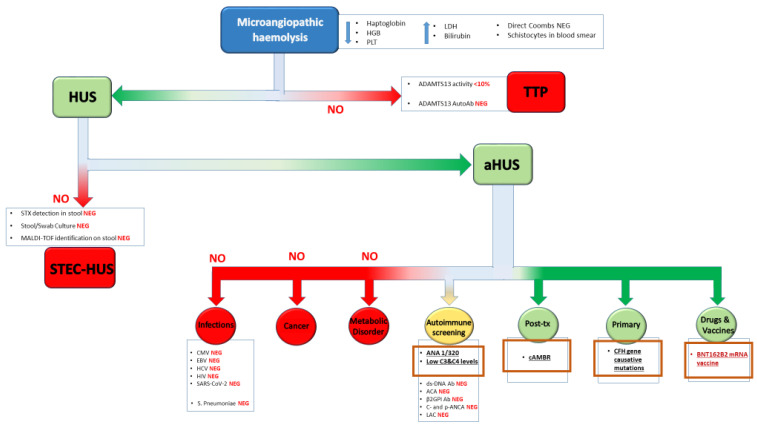
Case Report: We report a case of a 37-year-old female with kidney transplant, who was admitted at our hospital due to worsening renal function, nephrotic proteinuria, and anemia developed 21 days after the second dose of BNT162b2 COVID-19 vaccine (Pfizer-BioNTech). Laboratory tests revealed hemolytic anemia, thrombocytopenia, and acute kidney injury. Given the clinical picture of Thrombotic Micro-angiopathy (TMA) and severe renal impairment, plasma exchange (PEX) and dialysis were immediately started. Laboratory workup showed low C3 and C4 levels, normal activity of ADAMTS13, and the absence of anti-factor H antibodies. Molecular biology investigations revealed a heterozygous variant in exon 22 (SCR20) of the CFH gene (c.3628C>T; p.Arg1210Cys) described as an atypical Hemolytic Uremic Syndrome (aHUS) causative mutation. Our patient completed two sessions of PEX followed by eculizumab treatment with hematological improvement but no recovery of renal function. This is the first reported case of aHUS triggered by SARS-CoV-2 vaccination in a kidney transplant patient without recovery of renal function. Conclusion: Although rare, clinicians should be aware of possible nephrological complications that may appear after vaccination.





 京公网安备 11010802042870号
京ICP备2023020795号-1
京公网安备 11010802042870号
京ICP备2023020795号-1

 分享
分享
 求助内容:
求助内容: 应助结果提醒方式:
 扫码关注我们
