Shaoguan Zhao, Yan Sun, Lanxi Su, Lin Yan, Xingjun Lin, Yuzhou Long, Ang Zhang, Qingyun Zhao
{"title":"Significant Enrichment of Potential Pathogenic Fungi in Soil Mediated by Flavonoids, Phenolic Acids, and Organic Acids.","authors":"Shaoguan Zhao, Yan Sun, Lanxi Su, Lin Yan, Xingjun Lin, Yuzhou Long, Ang Zhang, Qingyun Zhao","doi":"10.3390/jof11020154","DOIUrl":null,"url":null,"abstract":"<p><p>It is well established that root exudates play a crucial role in shaping the assembly of plant rhizosphere microbial communities. Nonetheless, our understanding of how different types of exudates influence the abundance of potential pathogens in soil remains insufficient. Investigating the effects of root exudates on soil-dwelling pathogenic fungi is imperative for a comprehensive understanding of plant-fungal interactions within soil ecosystems and for maintaining soil health. This study aimed to elucidate the effects of the principal components of root exudates-flavonoids (FLA), phenolic acids (PA), and organic acids (OA)-on soil microbial communities and soil properties, as well as to investigate their mechanisms of action on soil potential pathogenic fungi. The results demonstrated that the addition of these components significantly modified the composition and diversity of soil microbial communities, with OA treatment notably altering the composition of dominant microbial taxa. Furthermore, the introduction of these substances facilitated the proliferation of saprophytic fungi. Additionally, the incorporation of flavonoids, phenolic acids, and organic acids led to an increased abundance of potential pathogenic fungi in the soil, particularly in the FLA and PA treatments. It was observed that the addition of these substances enhanced soil fertility, pH, and antioxidant enzyme activity. Specifically, FLA and PA treatments reduced the abundance of dominant microbial taxa, whereas OA treatment altered the composition of these taxa. These findings suggest that the inclusion of flavonoids, phenolic acids, and organic acids could potentially augment the enrichment of soil potential pathogenic fungi by modulating soil properties and enzymatic activities. These results offer valuable insights into the interactions between plants and fungal communities in soil ecosystems and provide a scientific foundation for the management and maintenance of soil health.</p>","PeriodicalId":15878,"journal":{"name":"Journal of Fungi","volume":"11 2","pages":""},"PeriodicalIF":4.2000,"publicationDate":"2025-02-17","publicationTypes":"Journal Article","fieldsOfStudy":null,"isOpenAccess":false,"openAccessPdf":"https://www.ncbi.nlm.nih.gov/pmc/articles/PMC11856650/pdf/","citationCount":"0","resultStr":null,"platform":"Semanticscholar","paperid":null,"PeriodicalName":"Journal of Fungi","FirstCategoryId":"99","ListUrlMain":"https://doi.org/10.3390/jof11020154","RegionNum":2,"RegionCategory":"生物学","ArticlePicture":[],"TitleCN":null,"AbstractTextCN":null,"PMCID":null,"EPubDate":"","PubModel":"","JCR":"Q2","JCRName":"MICROBIOLOGY","Score":null,"Total":0}
引用次数: 0
Abstract
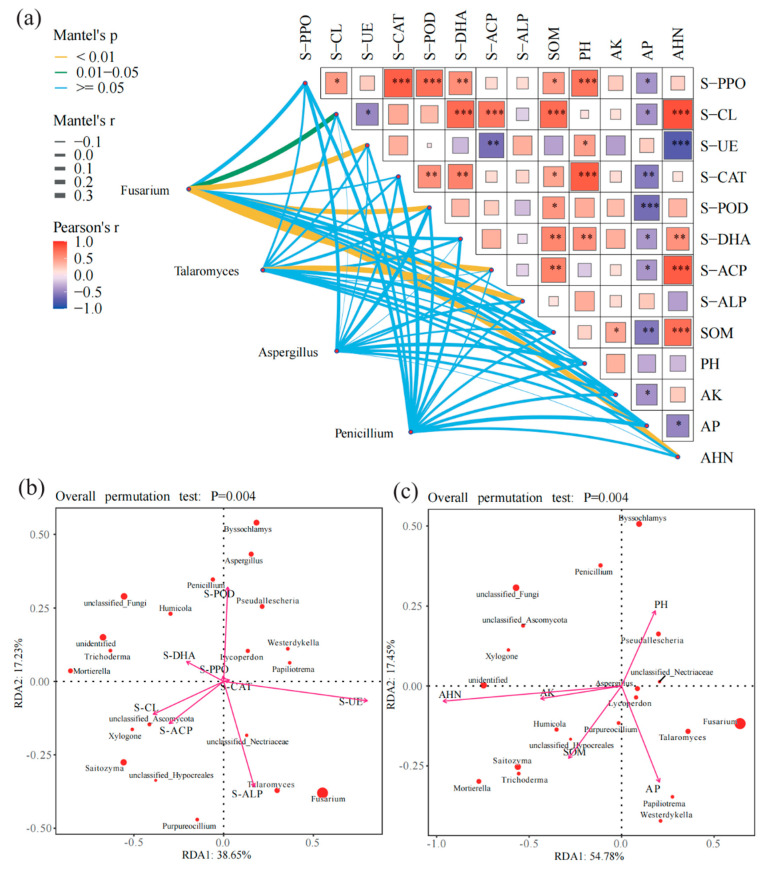
It is well established that root exudates play a crucial role in shaping the assembly of plant rhizosphere microbial communities. Nonetheless, our understanding of how different types of exudates influence the abundance of potential pathogens in soil remains insufficient. Investigating the effects of root exudates on soil-dwelling pathogenic fungi is imperative for a comprehensive understanding of plant-fungal interactions within soil ecosystems and for maintaining soil health. This study aimed to elucidate the effects of the principal components of root exudates-flavonoids (FLA), phenolic acids (PA), and organic acids (OA)-on soil microbial communities and soil properties, as well as to investigate their mechanisms of action on soil potential pathogenic fungi. The results demonstrated that the addition of these components significantly modified the composition and diversity of soil microbial communities, with OA treatment notably altering the composition of dominant microbial taxa. Furthermore, the introduction of these substances facilitated the proliferation of saprophytic fungi. Additionally, the incorporation of flavonoids, phenolic acids, and organic acids led to an increased abundance of potential pathogenic fungi in the soil, particularly in the FLA and PA treatments. It was observed that the addition of these substances enhanced soil fertility, pH, and antioxidant enzyme activity. Specifically, FLA and PA treatments reduced the abundance of dominant microbial taxa, whereas OA treatment altered the composition of these taxa. These findings suggest that the inclusion of flavonoids, phenolic acids, and organic acids could potentially augment the enrichment of soil potential pathogenic fungi by modulating soil properties and enzymatic activities. These results offer valuable insights into the interactions between plants and fungal communities in soil ecosystems and provide a scientific foundation for the management and maintenance of soil health.
期刊介绍:
Journal of Fungi (ISSN 2309-608X) is an international, peer-reviewed scientific open access journal that provides an advanced forum for studies related to pathogenic fungi, fungal biology, and all other aspects of fungal research. The journal publishes reviews, regular research papers, and communications in quarterly issues. Our aim is to encourage scientists to publish their experimental and theoretical results in as much detail as possible. Therefore, there is no restriction on paper length. Full experimental details must be provided so that the results can be reproduced.





 京公网安备 11010802042870号
京ICP备2023020795号-1
京公网安备 11010802042870号
京ICP备2023020795号-1

 分享
分享
 求助内容:
求助内容: 应助结果提醒方式:
 扫码关注我们
