Hwa Jun Kang, Sivakumar Allur Subramanian, Si Young Song, Jihyun Hwang, Collin Lee, Sung Jae Kim
{"title":"Epigallocatechin-3-Gallate (EGCG)-Loaded Hyaluronic Acid Hydrogel Seems to Be Effective in a Rat Model of Collagenase-Induced Achilles Tendinopathy.","authors":"Hwa Jun Kang, Sivakumar Allur Subramanian, Si Young Song, Jihyun Hwang, Collin Lee, Sung Jae Kim","doi":"10.3390/jfb16020055","DOIUrl":null,"url":null,"abstract":"<p><p>Tendon injuries account for 45% of musculoskeletal injuries. However, research on the occurrence and pathogenesis of tendinopathy is insufficient, and there is still much debate regarding treatment methods. It is important to understand the molecular mechanisms of oxidative stress and inflammatory responses because oxidative stress in tendon tissue is induced by various factors, including inflammatory cytokines, drug exposure, and metabolic abnormalities. In this study, 28 rats were divided into four groups (7 rats assigned to each group): control group (CON), collagenase injection group (CL), collagenase injection and hyaluronic acid injection group (CL + HA), and collagenase injection and EGCG-loaded hyaluronic acid injection group (CL + HA + EGCG). Seven weeks after the start of the study, all rats underwent histochemical analysis, immunofluorescence staining, and Western blot. The results showed increased inflammatory cells, disarray of collagen matrix, and degradation of the collagen matrix in the CL group. However, in the EGCG-treated group, there was a significant increase in type I collagen expression and a significant decrease in type III collagen expression, compared to the CL group. Additionally, there was an increase in the expression of antioxidant markers SOD (Superoxide Dismutase) and CAT (Catalase), tenogenic markers COLL-1 (collagen type I), and SCX (Scleraxis), and a downregulated expression of apoptosis markers cas-3 and cas-7. Our findings suggest that EGCG-loaded hyaluronic acid hydrogel exhibits potential in preventing tendon damage and promoting the regeneration process in a rat model of Achilles tendinopathy. The insights gained from our histological and molecular investigations highlight the future potential for testing novel tendinopathy treatments in human subjects.</p>","PeriodicalId":15767,"journal":{"name":"Journal of Functional Biomaterials","volume":"16 2","pages":""},"PeriodicalIF":5.2000,"publicationDate":"2025-02-10","publicationTypes":"Journal Article","fieldsOfStudy":null,"isOpenAccess":false,"openAccessPdf":"https://www.ncbi.nlm.nih.gov/pmc/articles/PMC11856759/pdf/","citationCount":"0","resultStr":null,"platform":"Semanticscholar","paperid":null,"PeriodicalName":"Journal of Functional Biomaterials","FirstCategoryId":"5","ListUrlMain":"https://doi.org/10.3390/jfb16020055","RegionNum":3,"RegionCategory":"医学","ArticlePicture":[],"TitleCN":null,"AbstractTextCN":null,"PMCID":null,"EPubDate":"","PubModel":"","JCR":"Q1","JCRName":"ENGINEERING, BIOMEDICAL","Score":null,"Total":0}
引用次数: 0
Abstract
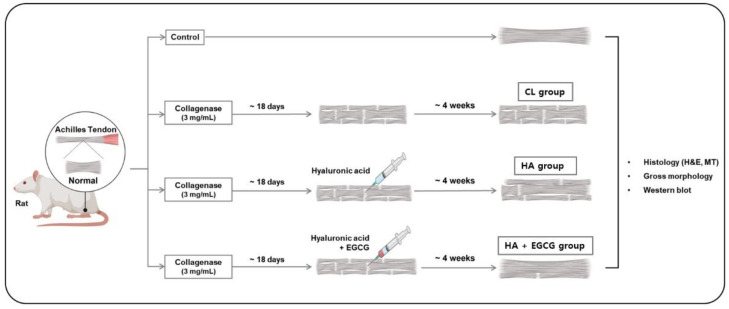
Tendon injuries account for 45% of musculoskeletal injuries. However, research on the occurrence and pathogenesis of tendinopathy is insufficient, and there is still much debate regarding treatment methods. It is important to understand the molecular mechanisms of oxidative stress and inflammatory responses because oxidative stress in tendon tissue is induced by various factors, including inflammatory cytokines, drug exposure, and metabolic abnormalities. In this study, 28 rats were divided into four groups (7 rats assigned to each group): control group (CON), collagenase injection group (CL), collagenase injection and hyaluronic acid injection group (CL + HA), and collagenase injection and EGCG-loaded hyaluronic acid injection group (CL + HA + EGCG). Seven weeks after the start of the study, all rats underwent histochemical analysis, immunofluorescence staining, and Western blot. The results showed increased inflammatory cells, disarray of collagen matrix, and degradation of the collagen matrix in the CL group. However, in the EGCG-treated group, there was a significant increase in type I collagen expression and a significant decrease in type III collagen expression, compared to the CL group. Additionally, there was an increase in the expression of antioxidant markers SOD (Superoxide Dismutase) and CAT (Catalase), tenogenic markers COLL-1 (collagen type I), and SCX (Scleraxis), and a downregulated expression of apoptosis markers cas-3 and cas-7. Our findings suggest that EGCG-loaded hyaluronic acid hydrogel exhibits potential in preventing tendon damage and promoting the regeneration process in a rat model of Achilles tendinopathy. The insights gained from our histological and molecular investigations highlight the future potential for testing novel tendinopathy treatments in human subjects.
期刊介绍:
Journal of Functional Biomaterials (JFB, ISSN 2079-4983) is an international and interdisciplinary scientific journal that publishes regular research papers (articles), reviews and short communications about applications of materials for biomedical use. JFB covers subjects from chemistry, pharmacy, biology, physics over to engineering. The journal focuses on the preparation, performance and use of functional biomaterials in biomedical devices and their behaviour in physiological environments. Our aim is to encourage scientists to publish their results in as much detail as possible. Therefore, there is no restriction on the length of the papers. The full experimental details must be provided so that the results can be reproduced. Several topical special issues will be published. Scope: adhesion, adsorption, biocompatibility, biohybrid materials, bio-inert materials, biomaterials, biomedical devices, biomimetic materials, bone repair, cardiovascular devices, ceramics, composite materials, dental implants, dental materials, drug delivery systems, functional biopolymers, glasses, hyper branched polymers, molecularly imprinted polymers (MIPs), nanomedicine, nanoparticles, nanotechnology, natural materials, self-assembly smart materials, stimuli responsive materials, surface modification, tissue devices, tissue engineering, tissue-derived materials, urological devices.





 京公网安备 11010802042870号
京ICP备2023020795号-1
京公网安备 11010802042870号
京ICP备2023020795号-1

 分享
分享
 求助内容:
求助内容: 应助结果提醒方式:
 扫码关注我们
