Reevaluating the Value of (1,3)-β-D-Glucan for the Diagnosis of Intra-Abdominal Candidiasis in Critically Ill Patients: Current Evidence and Future Directions.
Emmanuel Novy, Mathieu Esposito, Anne Debourgogne, Claire Roger
{"title":"Reevaluating the Value of (1,3)-β-D-Glucan for the Diagnosis of Intra-Abdominal Candidiasis in Critically Ill Patients: Current Evidence and Future Directions.","authors":"Emmanuel Novy, Mathieu Esposito, Anne Debourgogne, Claire Roger","doi":"10.3390/jof11020091","DOIUrl":null,"url":null,"abstract":"<p><p>Intra-abdominal candidiasis (IAC) is associated with significant diagnostic and therapeutic challenges in critically ill patients. Traditional fungal cultures are slow, delaying appropriate antifungal treatment. (1,3)-β-D-glucan (BDG), a component of the fungal cell wall, has emerged as a potential biomarker for IAC, but its use in ICU settings is complicated by frequent false-positives results from invasive procedures and underlying conditions. This review examines the diagnostic value of BDG when present in serum and peritoneal fluid. While serum BDG is effective for excluding invasive fungal infections like candidemia, its specificity for IAC remains low in critically ill patients. Recent studies suggest that BDG levels in peritoneal fluid may provide better diagnostic accuracy, distinguishing IAC from bacterial peritonitis with higher specificity. We discuss the advantages, limitations, and practical aspects of BDG testing, emphasizing the potential of peritoneal BDG as a complementary tool. Further research is needed to refine diagnostic thresholds, validate its clinical utility, and establish the role of peritoneal BDG in improving timely, targeted antifungal treatment for IAC.</p>","PeriodicalId":15878,"journal":{"name":"Journal of Fungi","volume":"11 2","pages":""},"PeriodicalIF":4.2000,"publicationDate":"2025-01-24","publicationTypes":"Journal Article","fieldsOfStudy":null,"isOpenAccess":false,"openAccessPdf":"https://www.ncbi.nlm.nih.gov/pmc/articles/PMC11856068/pdf/","citationCount":"0","resultStr":null,"platform":"Semanticscholar","paperid":null,"PeriodicalName":"Journal of Fungi","FirstCategoryId":"99","ListUrlMain":"https://doi.org/10.3390/jof11020091","RegionNum":2,"RegionCategory":"生物学","ArticlePicture":[],"TitleCN":null,"AbstractTextCN":null,"PMCID":null,"EPubDate":"","PubModel":"","JCR":"Q2","JCRName":"MICROBIOLOGY","Score":null,"Total":0}
引用次数: 0
Abstract
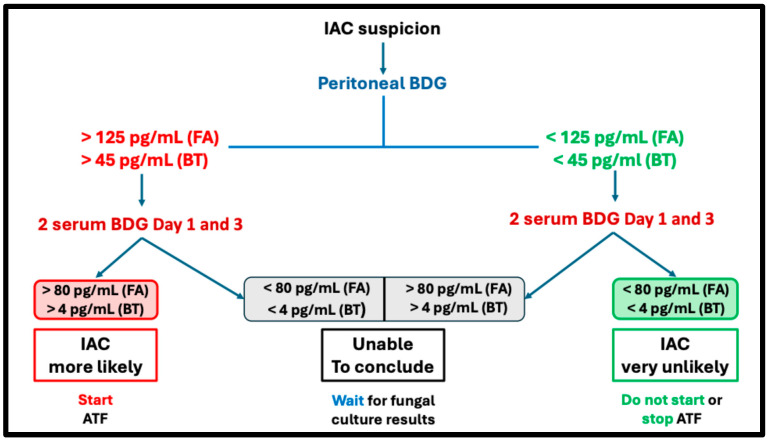
Intra-abdominal candidiasis (IAC) is associated with significant diagnostic and therapeutic challenges in critically ill patients. Traditional fungal cultures are slow, delaying appropriate antifungal treatment. (1,3)-β-D-glucan (BDG), a component of the fungal cell wall, has emerged as a potential biomarker for IAC, but its use in ICU settings is complicated by frequent false-positives results from invasive procedures and underlying conditions. This review examines the diagnostic value of BDG when present in serum and peritoneal fluid. While serum BDG is effective for excluding invasive fungal infections like candidemia, its specificity for IAC remains low in critically ill patients. Recent studies suggest that BDG levels in peritoneal fluid may provide better diagnostic accuracy, distinguishing IAC from bacterial peritonitis with higher specificity. We discuss the advantages, limitations, and practical aspects of BDG testing, emphasizing the potential of peritoneal BDG as a complementary tool. Further research is needed to refine diagnostic thresholds, validate its clinical utility, and establish the role of peritoneal BDG in improving timely, targeted antifungal treatment for IAC.
腹内念珠菌病(IAC)在危重患者中具有重要的诊断和治疗挑战。传统的真菌培养是缓慢的,延误了适当的抗真菌治疗。(1,3)-β- d -葡聚糖(BDG)是真菌细胞壁的一种成分,已成为IAC的潜在生物标志物,但其在ICU环境中的使用由于侵入性手术和潜在条件的频繁假阳性结果而变得复杂。本文综述了血清和腹膜液中BDG的诊断价值。虽然血清BDG对排除侵袭性真菌感染(如念珠菌)有效,但在危重患者中,其对IAC的特异性仍然较低。最近的研究表明,腹膜液中BDG水平可以提供更好的诊断准确性,以更高的特异性区分IAC和细菌性腹膜炎。我们讨论了BDG检测的优点、局限性和实践方面,强调了腹膜BDG作为补充工具的潜力。需要进一步的研究来完善诊断阈值,验证其临床应用,并确定腹膜BDG在改善IAC的及时、靶向抗真菌治疗中的作用。
期刊介绍:
Journal of Fungi (ISSN 2309-608X) is an international, peer-reviewed scientific open access journal that provides an advanced forum for studies related to pathogenic fungi, fungal biology, and all other aspects of fungal research. The journal publishes reviews, regular research papers, and communications in quarterly issues. Our aim is to encourage scientists to publish their experimental and theoretical results in as much detail as possible. Therefore, there is no restriction on paper length. Full experimental details must be provided so that the results can be reproduced.



 京公网安备 11010802042870号
京ICP备2023020795号-1
京公网安备 11010802042870号
京ICP备2023020795号-1

 分享
分享
 求助内容:
求助内容: 应助结果提醒方式:
 扫码关注我们
