Renan N Barbosa, Maria Tamara C Felipe, Leticia F Silva, Edna A Silva, Sabrina A Silva, Polyanna N Herculano, José F S A Prazeres, Joenny M S Lima, Jadson D P Bezerra, Keila A Moreira, Oliane M C Magalhães, Cristina M Souza-Motta
{"title":"A Review of the Biotechnological Potential of Cave Fungi: A Toolbox for the Future.","authors":"Renan N Barbosa, Maria Tamara C Felipe, Leticia F Silva, Edna A Silva, Sabrina A Silva, Polyanna N Herculano, José F S A Prazeres, Joenny M S Lima, Jadson D P Bezerra, Keila A Moreira, Oliane M C Magalhães, Cristina M Souza-Motta","doi":"10.3390/jof11020145","DOIUrl":null,"url":null,"abstract":"<p><p>The study of the intersection between biodiversity and biotechnology has revealed a rich source of innovations. Fungi, with their vast range of morphologies and lifestyles, thrive in various habitats, including caves. With impressive metabolic characteristics, they play a key role in producing essential biotechnological compounds for various economic sectors. This paper aims to consolidate evidence on the biotechnological potential of fungi isolated from caves, highlighting the urgency of conserving and exploring these ecosystems. For this purpose, we conducted a comprehensive literature search using scientific databases (SciELO, Medline Complete, Medline/PubMed, Web of Science, Scopus (Elsevier), and Google Scholar). We adopted an interdisciplinary approach by collecting information from 22 papers published between 2013 and 2024. Based on these data, our survey revealed broad potential, including antimicrobial compounds, antioxidants, antitumor agents, enzymes, and organic acids. We emphasize that accurately identifying and depositing fungal isolates in reference collections are crucial for reliable research and effective industrial applications, driving metabolic bioactivity and the production of substances with the potential to inhibit pathogens. Conserving and protecting the cave environment is imperative, considering its continuous potential for discovery and contribution to scientific advancement.</p>","PeriodicalId":15878,"journal":{"name":"Journal of Fungi","volume":"11 2","pages":""},"PeriodicalIF":4.2000,"publicationDate":"2025-02-14","publicationTypes":"Journal Article","fieldsOfStudy":null,"isOpenAccess":false,"openAccessPdf":"https://www.ncbi.nlm.nih.gov/pmc/articles/PMC11856267/pdf/","citationCount":"0","resultStr":null,"platform":"Semanticscholar","paperid":null,"PeriodicalName":"Journal of Fungi","FirstCategoryId":"99","ListUrlMain":"https://doi.org/10.3390/jof11020145","RegionNum":2,"RegionCategory":"生物学","ArticlePicture":[],"TitleCN":null,"AbstractTextCN":null,"PMCID":null,"EPubDate":"","PubModel":"","JCR":"Q2","JCRName":"MICROBIOLOGY","Score":null,"Total":0}
引用次数: 0
Abstract
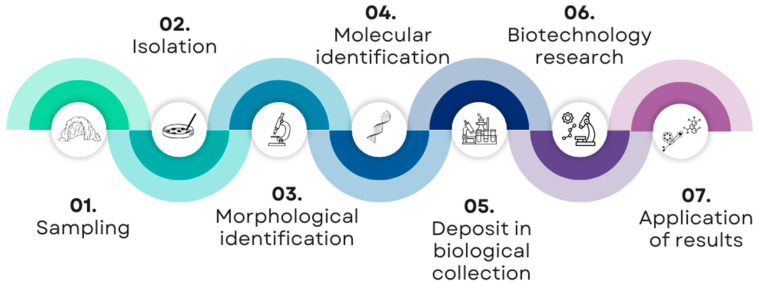
The study of the intersection between biodiversity and biotechnology has revealed a rich source of innovations. Fungi, with their vast range of morphologies and lifestyles, thrive in various habitats, including caves. With impressive metabolic characteristics, they play a key role in producing essential biotechnological compounds for various economic sectors. This paper aims to consolidate evidence on the biotechnological potential of fungi isolated from caves, highlighting the urgency of conserving and exploring these ecosystems. For this purpose, we conducted a comprehensive literature search using scientific databases (SciELO, Medline Complete, Medline/PubMed, Web of Science, Scopus (Elsevier), and Google Scholar). We adopted an interdisciplinary approach by collecting information from 22 papers published between 2013 and 2024. Based on these data, our survey revealed broad potential, including antimicrobial compounds, antioxidants, antitumor agents, enzymes, and organic acids. We emphasize that accurately identifying and depositing fungal isolates in reference collections are crucial for reliable research and effective industrial applications, driving metabolic bioactivity and the production of substances with the potential to inhibit pathogens. Conserving and protecting the cave environment is imperative, considering its continuous potential for discovery and contribution to scientific advancement.
生物多样性和生物技术之间的交叉研究揭示了丰富的创新来源。真菌有着多种多样的形态和生活方式,在包括洞穴在内的各种栖息地中茁壮成长。它们具有令人印象深刻的代谢特性,在为各种经济部门生产必要的生物技术化合物方面发挥着关键作用。本文旨在巩固从洞穴中分离的真菌的生物技术潜力的证据,强调保护和探索这些生态系统的紧迫性。为此,我们使用科学数据库(SciELO、Medline Complete、Medline/PubMed、Web of Science、Scopus (Elsevier)和谷歌Scholar)进行了全面的文献检索。我们采用跨学科的方法,收集了2013年至2024年间发表的22篇论文的信息。基于这些数据,我们的调查揭示了广泛的潜力,包括抗菌化合物,抗氧化剂,抗肿瘤剂,酶和有机酸。我们强调,准确识别和存放参考馆藏中的真菌分离物对于可靠的研究和有效的工业应用,推动代谢生物活性和具有抑制病原体潜力的物质的生产至关重要。考虑到洞穴环境的持续发现潜力和对科学进步的贡献,保存和保护洞穴环境势在必行。
期刊介绍:
Journal of Fungi (ISSN 2309-608X) is an international, peer-reviewed scientific open access journal that provides an advanced forum for studies related to pathogenic fungi, fungal biology, and all other aspects of fungal research. The journal publishes reviews, regular research papers, and communications in quarterly issues. Our aim is to encourage scientists to publish their experimental and theoretical results in as much detail as possible. Therefore, there is no restriction on paper length. Full experimental details must be provided so that the results can be reproduced.





 京公网安备 11010802042870号
京ICP备2023020795号-1
京公网安备 11010802042870号
京ICP备2023020795号-1

 分享
分享
 求助内容:
求助内容: 应助结果提醒方式:
 扫码关注我们
