{"title":"The Susceptibility of Two <i>Beauveria bassiana</i> Strains on Rice Pests <i>Nilaparvata lugens</i> and <i>Sogatella furcifera</i>.","authors":"Zhongwei Chen, Hanqing Mu, Yifan Peng, Rui Huo, Jiaqin Xie","doi":"10.3390/jof11020128","DOIUrl":null,"url":null,"abstract":"<p><p>Entomopathogenic fungi represent a valuable natural resource with significant potential as biological agents for pest management. However, different species or strains of fungi demonstrate varying effectiveness against specific targets. In this study, we assessed the impact of two fungal strains, <i>Beauveria bassiana</i> KN801 and KN802, on the rice planthoppers <i>Ninaparvata lugens</i> and <i>Sogatella furcifera</i>, in combination with insecticides. Our findings indicate that both <i>B. bassiana</i> strains can effectively infect the nymphs and adults of <i>N. lugens</i> and <i>S. furcifera</i>, resulting in a significantly higher mortality rate compared to the control groups. Notably, the <i>B. bassiana</i> strain KN801 demonstrated greater virulence than <i>B. bassiana</i> KN802 against these pests. However, no significant differences were observed when using different concentrations of the same fungal strain (<i>B. bassiana</i> KN801 or <i>B. bassiana</i> KN802) against these targets. Additionally, both fungi showed a germination rate of over 90% after treatment when combined with several common insecticides like chlorfenapyr and dinotefuran. The combined application of <i>B. bassiana</i> with chlorfenapyr or dinotefuran could improve pest control efficacy for these two pests. This study suggests that the two <i>B. bassiana</i> strains have the potential to infect rice planthoppers <i>N. lugens</i> and <i>S. furcifera</i>, indicating their promise as agents for the control of these pests.</p>","PeriodicalId":15878,"journal":{"name":"Journal of Fungi","volume":"11 2","pages":""},"PeriodicalIF":4.2000,"publicationDate":"2025-02-08","publicationTypes":"Journal Article","fieldsOfStudy":null,"isOpenAccess":false,"openAccessPdf":"https://www.ncbi.nlm.nih.gov/pmc/articles/PMC11857057/pdf/","citationCount":"0","resultStr":null,"platform":"Semanticscholar","paperid":null,"PeriodicalName":"Journal of Fungi","FirstCategoryId":"99","ListUrlMain":"https://doi.org/10.3390/jof11020128","RegionNum":2,"RegionCategory":"生物学","ArticlePicture":[],"TitleCN":null,"AbstractTextCN":null,"PMCID":null,"EPubDate":"","PubModel":"","JCR":"Q2","JCRName":"MICROBIOLOGY","Score":null,"Total":0}
引用次数: 0
Abstract
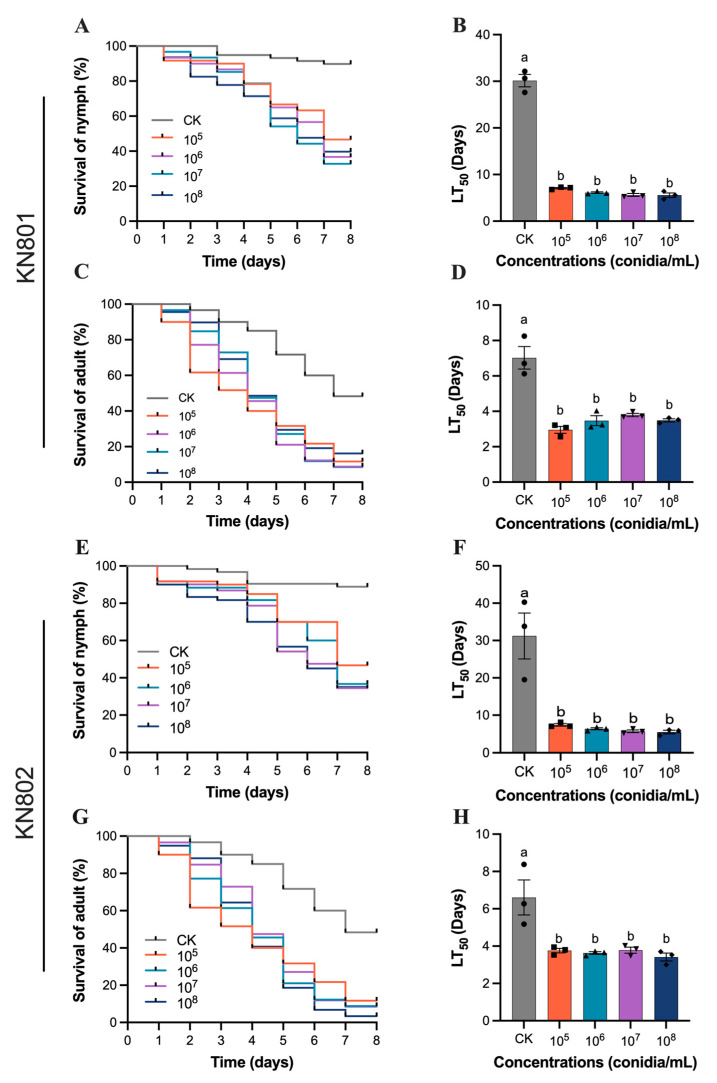
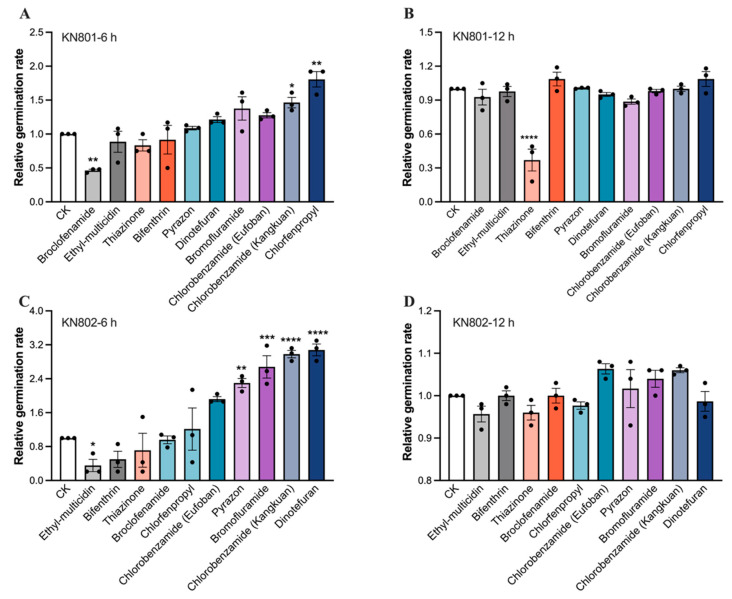
Entomopathogenic fungi represent a valuable natural resource with significant potential as biological agents for pest management. However, different species or strains of fungi demonstrate varying effectiveness against specific targets. In this study, we assessed the impact of two fungal strains, Beauveria bassiana KN801 and KN802, on the rice planthoppers Ninaparvata lugens and Sogatella furcifera, in combination with insecticides. Our findings indicate that both B. bassiana strains can effectively infect the nymphs and adults of N. lugens and S. furcifera, resulting in a significantly higher mortality rate compared to the control groups. Notably, the B. bassiana strain KN801 demonstrated greater virulence than B. bassiana KN802 against these pests. However, no significant differences were observed when using different concentrations of the same fungal strain (B. bassiana KN801 or B. bassiana KN802) against these targets. Additionally, both fungi showed a germination rate of over 90% after treatment when combined with several common insecticides like chlorfenapyr and dinotefuran. The combined application of B. bassiana with chlorfenapyr or dinotefuran could improve pest control efficacy for these two pests. This study suggests that the two B. bassiana strains have the potential to infect rice planthoppers N. lugens and S. furcifera, indicating their promise as agents for the control of these pests.
期刊介绍:
Journal of Fungi (ISSN 2309-608X) is an international, peer-reviewed scientific open access journal that provides an advanced forum for studies related to pathogenic fungi, fungal biology, and all other aspects of fungal research. The journal publishes reviews, regular research papers, and communications in quarterly issues. Our aim is to encourage scientists to publish their experimental and theoretical results in as much detail as possible. Therefore, there is no restriction on paper length. Full experimental details must be provided so that the results can be reproduced.





 京公网安备 11010802042870号
京ICP备2023020795号-1
京公网安备 11010802042870号
京ICP备2023020795号-1

 分享
分享
 求助内容:
求助内容: 应助结果提醒方式:
 扫码关注我们
