Teerapong Rattananukrom, Isaías Uh-Sánchez, Carlos Atoche-Dieguez, Nixma Eljure, Carlos Garcia-Rementeria, Roberto Arenas
{"title":"Erythema Nodosum Associated with Kerion: A Case Series and Narrative Review of the Literature.","authors":"Teerapong Rattananukrom, Isaías Uh-Sánchez, Carlos Atoche-Dieguez, Nixma Eljure, Carlos Garcia-Rementeria, Roberto Arenas","doi":"10.3390/jof11020103","DOIUrl":null,"url":null,"abstract":"<p><p>Kerion is a form of inflammatory tinea capitis, a fungal infection caused by various zoophilic, geophilic, and anthropophilic pathogens. Erythema nodosum (EN), a form of septal panniculitis, can be considered a dermatophyte id reaction that occurs outside the primary site of dermatophyte infection. The association between EN and kerion is rarely reported, with most cases following <i>Trichophyton mentagrophytes</i> scalp infections. Here, we describe three cases of EN associated with kerion caused by <i>T. mentagrophytes</i>, successfully treated with itraconazole or griseofulvin plus prednisone. Additionally, we conducted a narrative review of the literature, identifying 23 reported cases of EN associated with kerion on PubMed. The most commonly reported fungus was <i>T. mentagrophytes</i> (78.25%). In 52.17% of cases, patients developed EN after initiating antifungal treatment, with a mean onset time of 11.58 days (SD 7.3). Griseofulvin remains a mainstay treatment. The mean time for EN resolution was 8.31 days (SD 4.15), and the median duration of treatment for kerion leading to a complete response was 6 weeks (IQR 6-8). Scarring alopecia is a common sequela following kerion, and the use of corticosteroids has been recommended as adjunct therapy to minimize the risk of scarring.</p>","PeriodicalId":15878,"journal":{"name":"Journal of Fungi","volume":"11 2","pages":""},"PeriodicalIF":4.2000,"publicationDate":"2025-01-29","publicationTypes":"Journal Article","fieldsOfStudy":null,"isOpenAccess":false,"openAccessPdf":"https://www.ncbi.nlm.nih.gov/pmc/articles/PMC11855983/pdf/","citationCount":"0","resultStr":null,"platform":"Semanticscholar","paperid":null,"PeriodicalName":"Journal of Fungi","FirstCategoryId":"99","ListUrlMain":"https://doi.org/10.3390/jof11020103","RegionNum":2,"RegionCategory":"生物学","ArticlePicture":[],"TitleCN":null,"AbstractTextCN":null,"PMCID":null,"EPubDate":"","PubModel":"","JCR":"Q2","JCRName":"MICROBIOLOGY","Score":null,"Total":0}
引用次数: 0
Abstract
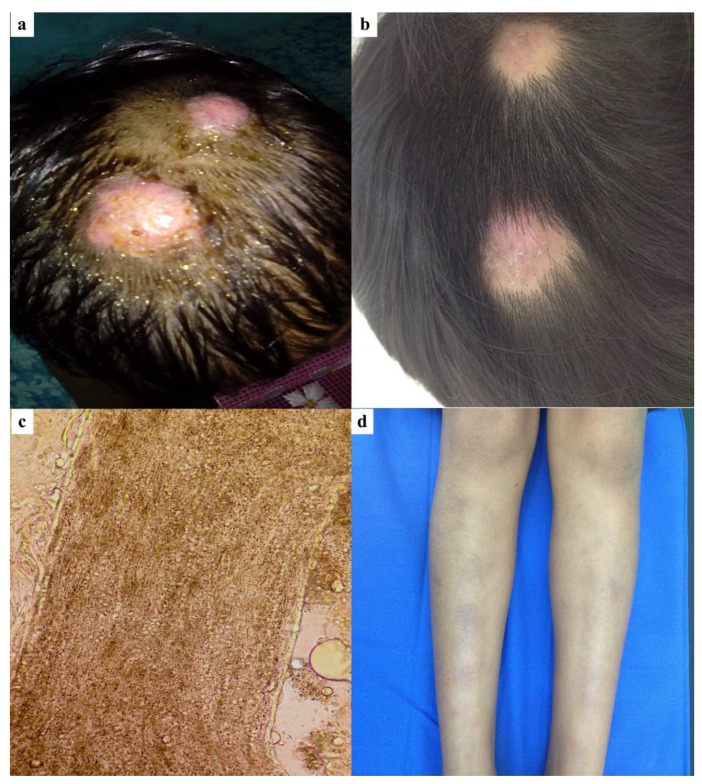
Kerion is a form of inflammatory tinea capitis, a fungal infection caused by various zoophilic, geophilic, and anthropophilic pathogens. Erythema nodosum (EN), a form of septal panniculitis, can be considered a dermatophyte id reaction that occurs outside the primary site of dermatophyte infection. The association between EN and kerion is rarely reported, with most cases following Trichophyton mentagrophytes scalp infections. Here, we describe three cases of EN associated with kerion caused by T. mentagrophytes, successfully treated with itraconazole or griseofulvin plus prednisone. Additionally, we conducted a narrative review of the literature, identifying 23 reported cases of EN associated with kerion on PubMed. The most commonly reported fungus was T. mentagrophytes (78.25%). In 52.17% of cases, patients developed EN after initiating antifungal treatment, with a mean onset time of 11.58 days (SD 7.3). Griseofulvin remains a mainstay treatment. The mean time for EN resolution was 8.31 days (SD 4.15), and the median duration of treatment for kerion leading to a complete response was 6 weeks (IQR 6-8). Scarring alopecia is a common sequela following kerion, and the use of corticosteroids has been recommended as adjunct therapy to minimize the risk of scarring.
期刊介绍:
Journal of Fungi (ISSN 2309-608X) is an international, peer-reviewed scientific open access journal that provides an advanced forum for studies related to pathogenic fungi, fungal biology, and all other aspects of fungal research. The journal publishes reviews, regular research papers, and communications in quarterly issues. Our aim is to encourage scientists to publish their experimental and theoretical results in as much detail as possible. Therefore, there is no restriction on paper length. Full experimental details must be provided so that the results can be reproduced.





 京公网安备 11010802042870号
京ICP备2023020795号-1
京公网安备 11010802042870号
京ICP备2023020795号-1

 分享
分享
 求助内容:
求助内容: 应助结果提醒方式:
 扫码关注我们
