Ji-Young Byun, Thi Thuy Nguyen, Byung-Kwan Cho, Soo-Hoon Park, Sun-Chang Kim
{"title":"Rap1 overexpression boosts triterpenoid saponin production in yeast by enhancing precursor supply and heterologous gene expression.","authors":"Ji-Young Byun, Thi Thuy Nguyen, Byung-Kwan Cho, Soo-Hoon Park, Sun-Chang Kim","doi":"10.1186/s12934-025-02667-3","DOIUrl":null,"url":null,"abstract":"<p><strong>Background: </strong>Metabolic engineering to increase the supply of precursors, such as 2,3-oxidosqualene (OSQ), and manipulate heterologous biosynthetic pathways through the strategic overexpression of multiple genes is promising for increasing the microbial production of triterpenoid saponins. However, the multiple use of constitutive promoters, typically derived from glycolytic or ribosomal protein promoters, can cause transcription factor competition, reducing the expression of each gene. To avoid this issue, we overexpressed transcriptional factor repressor activator protein 1 (Rap1), known to upregulate glycolytic gene expression and be involved in various metabolic pathways, including pyruvate dehydrogenase (PDH) bypass, the mevalonate (MVA) pathway, and sterol synthesis.</p><p><strong>Results: </strong>Transcriptome analysis of a wild-type yeast strain revealed that Rap1 overexpression significantly upregulated several central carbon metabolism (CCM)-related genes for OSQ production, including glycolytic genes, particularly after the diauxic shift phase. To validate the effect on triterpenoid saponin production, we engineered a Saccharomyces cerevisiae strain capable of producing ginsenoside compound K (CK). Notably, compared with the control strain, the CK-producing strain with Rap1 overexpression showed upregulation of heterologous genes controlled by TDH3 promoter, and a continuous supply of precursors to the CK synthesis pathway, resulting in a 4.5-fold increase in CK production.</p><p><strong>Conclusion: </strong>These results highlight Rap1 overexpression as a robust strategy to increase triterpenoid production in yeast cell factories. Additionally, this approach provides a versatile framework for enhancing both precursor supply and heterologous gene expression.</p>","PeriodicalId":18582,"journal":{"name":"Microbial Cell Factories","volume":"24 1","pages":"47"},"PeriodicalIF":4.9000,"publicationDate":"2025-02-24","publicationTypes":"Journal Article","fieldsOfStudy":null,"isOpenAccess":false,"openAccessPdf":"https://www.ncbi.nlm.nih.gov/pmc/articles/PMC11849169/pdf/","citationCount":"0","resultStr":null,"platform":"Semanticscholar","paperid":null,"PeriodicalName":"Microbial Cell Factories","FirstCategoryId":"5","ListUrlMain":"https://doi.org/10.1186/s12934-025-02667-3","RegionNum":2,"RegionCategory":"生物学","ArticlePicture":[],"TitleCN":null,"AbstractTextCN":null,"PMCID":null,"EPubDate":"","PubModel":"","JCR":"Q1","JCRName":"BIOTECHNOLOGY & APPLIED MICROBIOLOGY","Score":null,"Total":0}
引用次数: 0
Abstract
Background: Metabolic engineering to increase the supply of precursors, such as 2,3-oxidosqualene (OSQ), and manipulate heterologous biosynthetic pathways through the strategic overexpression of multiple genes is promising for increasing the microbial production of triterpenoid saponins. However, the multiple use of constitutive promoters, typically derived from glycolytic or ribosomal protein promoters, can cause transcription factor competition, reducing the expression of each gene. To avoid this issue, we overexpressed transcriptional factor repressor activator protein 1 (Rap1), known to upregulate glycolytic gene expression and be involved in various metabolic pathways, including pyruvate dehydrogenase (PDH) bypass, the mevalonate (MVA) pathway, and sterol synthesis.
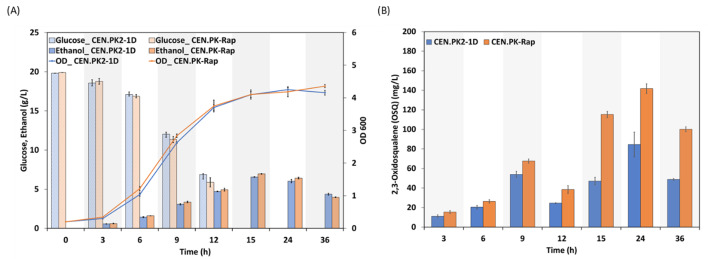
Results: Transcriptome analysis of a wild-type yeast strain revealed that Rap1 overexpression significantly upregulated several central carbon metabolism (CCM)-related genes for OSQ production, including glycolytic genes, particularly after the diauxic shift phase. To validate the effect on triterpenoid saponin production, we engineered a Saccharomyces cerevisiae strain capable of producing ginsenoside compound K (CK). Notably, compared with the control strain, the CK-producing strain with Rap1 overexpression showed upregulation of heterologous genes controlled by TDH3 promoter, and a continuous supply of precursors to the CK synthesis pathway, resulting in a 4.5-fold increase in CK production.
Conclusion: These results highlight Rap1 overexpression as a robust strategy to increase triterpenoid production in yeast cell factories. Additionally, this approach provides a versatile framework for enhancing both precursor supply and heterologous gene expression.
期刊介绍:
Microbial Cell Factories is an open access peer-reviewed journal that covers any topic related to the development, use and investigation of microbial cells as producers of recombinant proteins and natural products, or as catalyzers of biological transformations of industrial interest. Microbial Cell Factories is the world leading, primary research journal fully focusing on Applied Microbiology.
The journal is divided into the following editorial sections:
-Metabolic engineering
-Synthetic biology
-Whole-cell biocatalysis
-Microbial regulations
-Recombinant protein production/bioprocessing
-Production of natural compounds
-Systems biology of cell factories
-Microbial production processes
-Cell-free systems







 京公网安备 11010802042870号
京ICP备2023020795号-1
京公网安备 11010802042870号
京ICP备2023020795号-1

 分享
分享
 求助内容:
求助内容: 应助结果提醒方式:
 扫码关注我们
