Brennan Truman, Linda Ma, Samuel Stewart, Karl Kingsley, Victoria Sullivan
{"title":"Assessment of Endocyn on Dental Pulp Stem Cells (DPSCs): A Pilot Study of Endodontic Irrigant Effects.","authors":"Brennan Truman, Linda Ma, Samuel Stewart, Karl Kingsley, Victoria Sullivan","doi":"10.3390/mps8010018","DOIUrl":null,"url":null,"abstract":"<p><p>Many endodontic procedures within the pediatric population are performed with patients aged 12 years and older, using intracanal irrigants to complement mechanical debridement for the removal of debris and to disinfect the root canal system. The use of antimicrobial irrigants that limit damage to the dental pulp are the goals of endodontic biomaterials research. Using an existing biorepository of dental pulp stem cells (DPSCs), Endocyn was evaluated in varying concentrations in proliferation and viability assays, and compared with positive (sodium hypochlorite or bleach) and negative (phosphate-buffered saline) controls. The DPSC viability was reduced in the range of -8.3% to -15.8%, <i>p</i> = 0.22 to <i>p</i> = 0.042, while the growth inhibition varied between -29.7% and -63%, <i>p</i> = 0.041 to <i>p</i> = 0.022. However, the RNA analysis revealed that no significant changes in biomarker mRNA expression (Nestin, NANOG, Sox2, Oct4, CD73, CD90, and CD105) were observed. These data demonstrated that all of the concentrations of Endocyn inhibited the DPSC viability and growth, although only high concentrations were statistically significant. Moreover, the administration of Endocyn did not alter the DPSC biomarker expression, which are novel and important findings not previously observed or reported that may assist with the development of clinical decision protocols and methods for the treatment of vital pulp tissue.</p>","PeriodicalId":18715,"journal":{"name":"Methods and Protocols","volume":"8 1","pages":""},"PeriodicalIF":2.0000,"publicationDate":"2025-02-11","publicationTypes":"Journal Article","fieldsOfStudy":null,"isOpenAccess":false,"openAccessPdf":"https://www.ncbi.nlm.nih.gov/pmc/articles/PMC11858511/pdf/","citationCount":"0","resultStr":null,"platform":"Semanticscholar","paperid":null,"PeriodicalName":"Methods and Protocols","FirstCategoryId":"1085","ListUrlMain":"https://doi.org/10.3390/mps8010018","RegionNum":0,"RegionCategory":null,"ArticlePicture":[],"TitleCN":null,"AbstractTextCN":null,"PMCID":null,"EPubDate":"","PubModel":"","JCR":"Q3","JCRName":"BIOCHEMICAL RESEARCH METHODS","Score":null,"Total":0}
引用次数: 0
Abstract
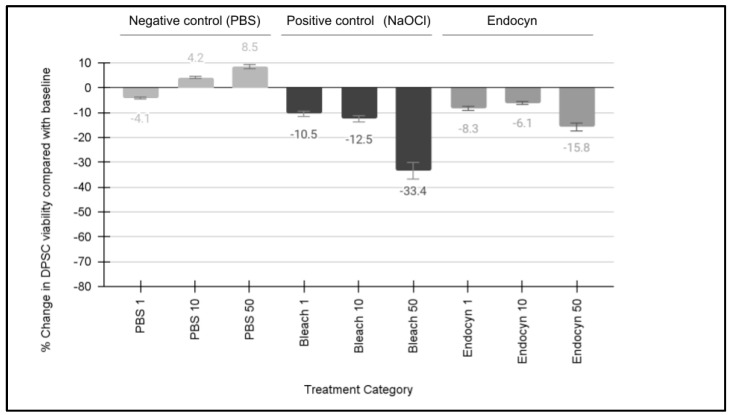
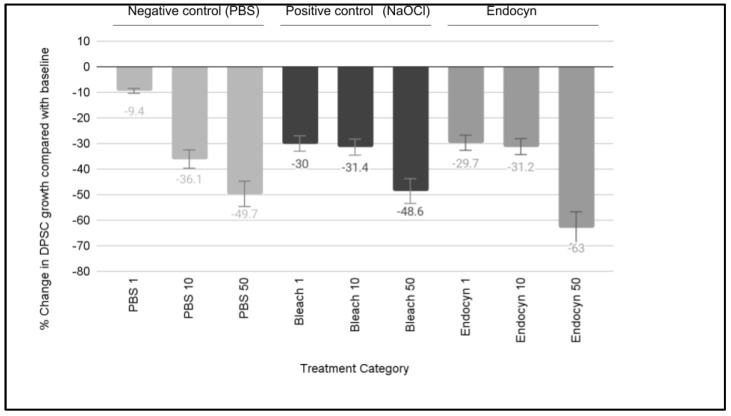
Many endodontic procedures within the pediatric population are performed with patients aged 12 years and older, using intracanal irrigants to complement mechanical debridement for the removal of debris and to disinfect the root canal system. The use of antimicrobial irrigants that limit damage to the dental pulp are the goals of endodontic biomaterials research. Using an existing biorepository of dental pulp stem cells (DPSCs), Endocyn was evaluated in varying concentrations in proliferation and viability assays, and compared with positive (sodium hypochlorite or bleach) and negative (phosphate-buffered saline) controls. The DPSC viability was reduced in the range of -8.3% to -15.8%, p = 0.22 to p = 0.042, while the growth inhibition varied between -29.7% and -63%, p = 0.041 to p = 0.022. However, the RNA analysis revealed that no significant changes in biomarker mRNA expression (Nestin, NANOG, Sox2, Oct4, CD73, CD90, and CD105) were observed. These data demonstrated that all of the concentrations of Endocyn inhibited the DPSC viability and growth, although only high concentrations were statistically significant. Moreover, the administration of Endocyn did not alter the DPSC biomarker expression, which are novel and important findings not previously observed or reported that may assist with the development of clinical decision protocols and methods for the treatment of vital pulp tissue.




 京公网安备 11010802042870号
京ICP备2023020795号-1
京公网安备 11010802042870号
京ICP备2023020795号-1

 分享
分享
 求助内容:
求助内容: 应助结果提醒方式:
 扫码关注我们
