Kishan Saha, Onyinye C Ihearahu, L H Stevenson Naitchede, Supriyo Ray, George Ude
{"title":"Optimized SDS-Based Protocol for High-Quality RNA Extraction from <i>Musa</i> spp.","authors":"Kishan Saha, Onyinye C Ihearahu, L H Stevenson Naitchede, Supriyo Ray, George Ude","doi":"10.3390/mps8010021","DOIUrl":null,"url":null,"abstract":"<p><p>The high quantity of polyphenols and polysaccharides present in the tissues of <i>Musa</i> spp. often leads to the degradation of nucleic acids, which is why all previously established methods resulted in lesser yield and poor quality of RNA. In this study, we present a modified SDS-based RNA extraction method to improve the quality and yield of RNA from different tissues of <i>Musa</i> spp. for downstream applications. The modification of RNA extraction buffer, SDS, heat incubation, and use of LiCl resulted in high-intensity RNA bands and increased RNA yield. The clear ribosomal RNA bands ensured the high quality of intact RNA without genomic DNA contamination, along with A260/A280 and A260/A230 ratios ranging from 1.83 to 2.25, which indicated the high quality of RNA across different banana varieties and tissue types. This method was found to be very effective when RNA was extracted from drought-stressed plants yielding 2.92 to 6.30 µg/100 mg fresh weight with high RNA integrity and quality (RNA IQ) 7.8-9.9 from the different groups of <i>Musa</i> tissues. Additionally, the RNA was successfully applied in PCR and quantitative real-time PCR (qRT-PCR), confirming downstream application in gene expression analysis. This method is a reliable and efficient technique for RNA extraction methods like Trizol, NucleoSpin, RNeasy, and CTAB procedures reported so far.</p>","PeriodicalId":18715,"journal":{"name":"Methods and Protocols","volume":"8 1","pages":""},"PeriodicalIF":2.0000,"publicationDate":"2025-02-19","publicationTypes":"Journal Article","fieldsOfStudy":null,"isOpenAccess":false,"openAccessPdf":"https://www.ncbi.nlm.nih.gov/pmc/articles/PMC11858800/pdf/","citationCount":"0","resultStr":null,"platform":"Semanticscholar","paperid":null,"PeriodicalName":"Methods and Protocols","FirstCategoryId":"1085","ListUrlMain":"https://doi.org/10.3390/mps8010021","RegionNum":0,"RegionCategory":null,"ArticlePicture":[],"TitleCN":null,"AbstractTextCN":null,"PMCID":null,"EPubDate":"","PubModel":"","JCR":"Q3","JCRName":"BIOCHEMICAL RESEARCH METHODS","Score":null,"Total":0}
引用次数: 0
Abstract
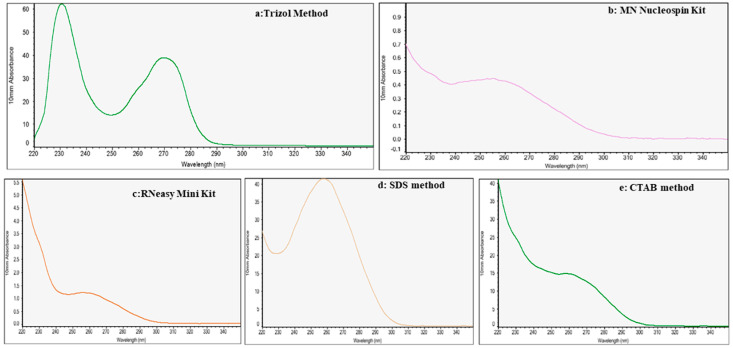
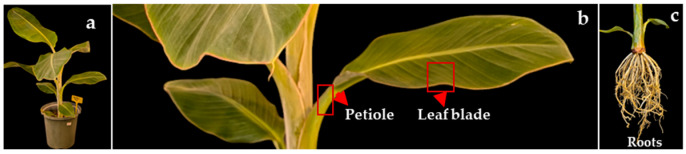
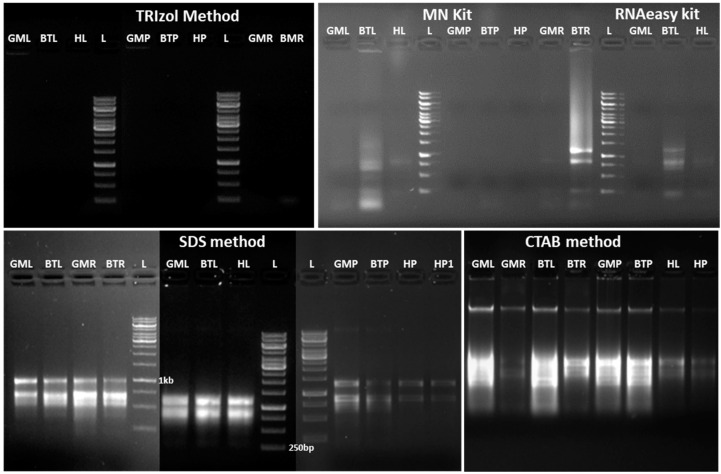
The high quantity of polyphenols and polysaccharides present in the tissues of Musa spp. often leads to the degradation of nucleic acids, which is why all previously established methods resulted in lesser yield and poor quality of RNA. In this study, we present a modified SDS-based RNA extraction method to improve the quality and yield of RNA from different tissues of Musa spp. for downstream applications. The modification of RNA extraction buffer, SDS, heat incubation, and use of LiCl resulted in high-intensity RNA bands and increased RNA yield. The clear ribosomal RNA bands ensured the high quality of intact RNA without genomic DNA contamination, along with A260/A280 and A260/A230 ratios ranging from 1.83 to 2.25, which indicated the high quality of RNA across different banana varieties and tissue types. This method was found to be very effective when RNA was extracted from drought-stressed plants yielding 2.92 to 6.30 µg/100 mg fresh weight with high RNA integrity and quality (RNA IQ) 7.8-9.9 from the different groups of Musa tissues. Additionally, the RNA was successfully applied in PCR and quantitative real-time PCR (qRT-PCR), confirming downstream application in gene expression analysis. This method is a reliable and efficient technique for RNA extraction methods like Trizol, NucleoSpin, RNeasy, and CTAB procedures reported so far.




 京公网安备 11010802042870号
京ICP备2023020795号-1
京公网安备 11010802042870号
京ICP备2023020795号-1

 分享
分享
 求助内容:
求助内容: 应助结果提醒方式:
 扫码关注我们
