Emmanuel John Tabilin, Darren J Gray, Mario A Jiz, Mary Lorraine Mationg, Marianette Inobaya, Eleonor Avenido-Cervantes, Megumi Sato, Marcello Otake Sato, Yasuhito Sako, Yi Mu, Hong You, Matthew Kelly, Pengfei Cai, Catherine A Gordon
{"title":"Schistosomiasis in the Philippines: A Comprehensive Review of Epidemiology and Current Control.","authors":"Emmanuel John Tabilin, Darren J Gray, Mario A Jiz, Mary Lorraine Mationg, Marianette Inobaya, Eleonor Avenido-Cervantes, Megumi Sato, Marcello Otake Sato, Yasuhito Sako, Yi Mu, Hong You, Matthew Kelly, Pengfei Cai, Catherine A Gordon","doi":"10.3390/tropicalmed10020029","DOIUrl":null,"url":null,"abstract":"<p><p><i>Schistosomiasis japonica</i> is an infectious parasitic disease caused by infection with the blood fluke <i>Schistosoma japonicum</i>, which is endemic in China, small pockets of Indonesia, and the Philippines. Of the three countries, the prevalence of infection is the highest in the Philippines, despite decades of mass drug administration (MDA). As a zoonosis with 46 potential mammalian definitive hosts and a snail intermediate host, the control and eventual elimination of <i>S. japonicum</i> requires management of these animal hosts in addition to new interventions for the human hosts, including health education and water, sanitation, and hygiene (WASH) infrastructure. In this review we examine the status and epidemiology of <i>S. japonicum</i> in the Philippines with an overview of the current control program there and what needs to be accomplished in the future to control and eliminate this disease in the country.</p>","PeriodicalId":23330,"journal":{"name":"Tropical Medicine and Infectious Disease","volume":"10 2","pages":""},"PeriodicalIF":2.6000,"publicationDate":"2025-01-21","publicationTypes":"Journal Article","fieldsOfStudy":null,"isOpenAccess":false,"openAccessPdf":"https://www.ncbi.nlm.nih.gov/pmc/articles/PMC11860700/pdf/","citationCount":"0","resultStr":null,"platform":"Semanticscholar","paperid":null,"PeriodicalName":"Tropical Medicine and Infectious Disease","FirstCategoryId":"3","ListUrlMain":"https://doi.org/10.3390/tropicalmed10020029","RegionNum":4,"RegionCategory":"医学","ArticlePicture":[],"TitleCN":null,"AbstractTextCN":null,"PMCID":null,"EPubDate":"","PubModel":"","JCR":"Q2","JCRName":"INFECTIOUS DISEASES","Score":null,"Total":0}
引用次数: 0
Abstract
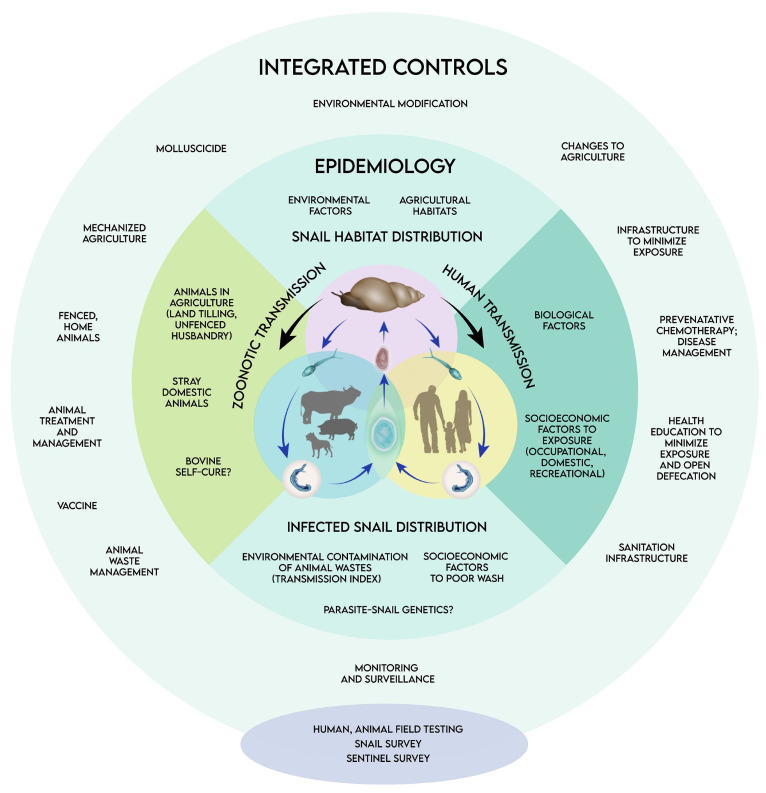
Schistosomiasis japonica is an infectious parasitic disease caused by infection with the blood fluke Schistosoma japonicum, which is endemic in China, small pockets of Indonesia, and the Philippines. Of the three countries, the prevalence of infection is the highest in the Philippines, despite decades of mass drug administration (MDA). As a zoonosis with 46 potential mammalian definitive hosts and a snail intermediate host, the control and eventual elimination of S. japonicum requires management of these animal hosts in addition to new interventions for the human hosts, including health education and water, sanitation, and hygiene (WASH) infrastructure. In this review we examine the status and epidemiology of S. japonicum in the Philippines with an overview of the current control program there and what needs to be accomplished in the future to control and eliminate this disease in the country.





 京公网安备 11010802042870号
京ICP备2023020795号-1
京公网安备 11010802042870号
京ICP备2023020795号-1

 分享
分享
 求助内容:
求助内容: 应助结果提醒方式:
 扫码关注我们
