Roger Pedro Norabuena-Figueroa, Hugo Marino Rodríguez-Orellana, Emerson Damián Norabuena-Figueroa, Angel Deroncele-Acosta
{"title":"Organizational Climate as a Key to Positive Mental Health and Academic Engagement in University Students: A Structural Equation Modeling Approach.","authors":"Roger Pedro Norabuena-Figueroa, Hugo Marino Rodríguez-Orellana, Emerson Damián Norabuena-Figueroa, Angel Deroncele-Acosta","doi":"10.3390/ejihpe15020017","DOIUrl":null,"url":null,"abstract":"<p><p>This study aimed to examine the relationships between mental health, organizational climate, and engagement through a structural equation model, for which a quantitative methodology was developed. A total of 1971 students from a public university in Lima (between 16 and 56 years of age, with a mean age of 21.09 years and standard deviation of 3.2) participated in the study. Three instruments with high internal consistency were used: the Positive Mental Health Scale, the Utrecht Work Engagement Scale, and the FOCUS Organizational Climate Questionnaire. The results show that organizational climate is positively related to mental health and engagement, with life satisfaction being the most significant dimension in mental health (0.768), the vigor the strongest in engagement (0.814), and the innovation climate stood out in organizational climate (0.819). At the same time, mental health directly impacts engagement. The structural model revealed that organizational climate directly influences mental health (0.64) and engagement (0.49), while mental health has a direct impact on engagement (0.43). In addition, this structural model presents an adequate fit. The findings highlight the need to design interventions prioritizing students' psychosocial well-being and managing a positive organizational climate as a premise. Implications of the study are discussed.</p>","PeriodicalId":30631,"journal":{"name":"European Journal of Investigation in Health Psychology and Education","volume":"15 2","pages":""},"PeriodicalIF":2.6000,"publicationDate":"2025-02-02","publicationTypes":"Journal Article","fieldsOfStudy":null,"isOpenAccess":false,"openAccessPdf":"https://www.ncbi.nlm.nih.gov/pmc/articles/PMC11854530/pdf/","citationCount":"0","resultStr":null,"platform":"Semanticscholar","paperid":null,"PeriodicalName":"European Journal of Investigation in Health Psychology and Education","FirstCategoryId":"1085","ListUrlMain":"https://doi.org/10.3390/ejihpe15020017","RegionNum":0,"RegionCategory":null,"ArticlePicture":[],"TitleCN":null,"AbstractTextCN":null,"PMCID":null,"EPubDate":"","PubModel":"","JCR":"Q1","JCRName":"PSYCHOLOGY, CLINICAL","Score":null,"Total":0}
引用次数: 0
Abstract
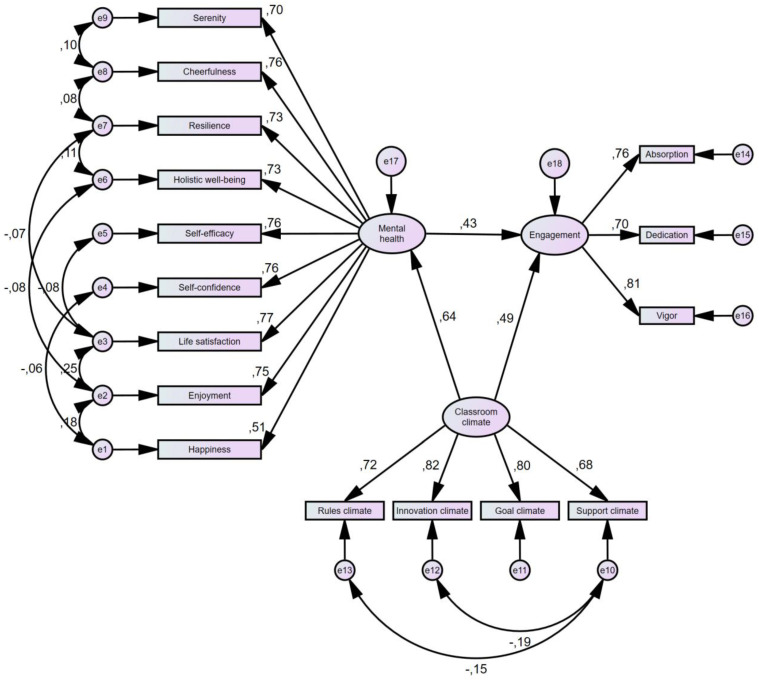
This study aimed to examine the relationships between mental health, organizational climate, and engagement through a structural equation model, for which a quantitative methodology was developed. A total of 1971 students from a public university in Lima (between 16 and 56 years of age, with a mean age of 21.09 years and standard deviation of 3.2) participated in the study. Three instruments with high internal consistency were used: the Positive Mental Health Scale, the Utrecht Work Engagement Scale, and the FOCUS Organizational Climate Questionnaire. The results show that organizational climate is positively related to mental health and engagement, with life satisfaction being the most significant dimension in mental health (0.768), the vigor the strongest in engagement (0.814), and the innovation climate stood out in organizational climate (0.819). At the same time, mental health directly impacts engagement. The structural model revealed that organizational climate directly influences mental health (0.64) and engagement (0.49), while mental health has a direct impact on engagement (0.43). In addition, this structural model presents an adequate fit. The findings highlight the need to design interventions prioritizing students' psychosocial well-being and managing a positive organizational climate as a premise. Implications of the study are discussed.





 京公网安备 11010802042870号
京ICP备2023020795号-1
京公网安备 11010802042870号
京ICP备2023020795号-1

 分享
分享
 求助内容:
求助内容: 应助结果提醒方式:
 扫码关注我们
