{"title":"Dual-Model Synergy for Fingerprint Spoof Detection Using VGG16 and ResNet50.","authors":"Mohamed Cheniti, Zahid Akhtar, Praveen Kumar Chandaliya","doi":"10.3390/jimaging11020042","DOIUrl":null,"url":null,"abstract":"<p><p>In this paper, we address the challenge of fingerprint liveness detection by proposing a dual pre-trained model approach that combines VGG16 and ResNet50 architectures. While existing methods often rely on a single feature extraction model, they may struggle with generalization across diverse spoofing materials and sensor types. To overcome this limitation, our approach leverages the high-resolution feature extraction of VGG16 and the deep layer architecture of ResNet50 to capture a more comprehensive range of features for improved spoof detection. The proposed approach integrates these two models by concatenating their extracted features, which are then used to classify the captured fingerprint as live or spoofed. Evaluated on the Livedet2013 and Livedet2015 datasets, our method achieves state-of-the-art performance, with an accuracy of 99.72% on Livedet2013, surpassing existing methods like the Gram model (98.95%) and Pre-trained CNN (98.45%). On Livedet2015, our method achieves an average accuracy of 96.32%, outperforming several state-of-the-art models, including CNN (95.27%) and LivDet 2015 (95.39%). Error rate analysis reveals consistently low Bonafide Presentation Classification Error Rate (BPCER) scores with 0.28% on LivDet 2013 and 1.45% on LivDet 2015. Similarly, the Attack Presentation Classification Error Rate (APCER) remains low at 0.35% on LivDet 2013 and 3.68% on LivDet 2015. However, higher APCER values are observed for unknown spoof materials, particularly in the Crossmatch subset of Livedet2015, where the APCER rises to 8.12%. These findings highlight the robustness and adaptability of our simple dual-model framework while identifying areas for further optimization in handling unseen spoof materials.</p>","PeriodicalId":37035,"journal":{"name":"Journal of Imaging","volume":"11 2","pages":""},"PeriodicalIF":2.7000,"publicationDate":"2025-02-04","publicationTypes":"Journal Article","fieldsOfStudy":null,"isOpenAccess":false,"openAccessPdf":"https://www.ncbi.nlm.nih.gov/pmc/articles/PMC11856235/pdf/","citationCount":"0","resultStr":null,"platform":"Semanticscholar","paperid":null,"PeriodicalName":"Journal of Imaging","FirstCategoryId":"1085","ListUrlMain":"https://doi.org/10.3390/jimaging11020042","RegionNum":0,"RegionCategory":null,"ArticlePicture":[],"TitleCN":null,"AbstractTextCN":null,"PMCID":null,"EPubDate":"","PubModel":"","JCR":"Q3","JCRName":"IMAGING SCIENCE & PHOTOGRAPHIC TECHNOLOGY","Score":null,"Total":0}
引用次数: 0
Abstract
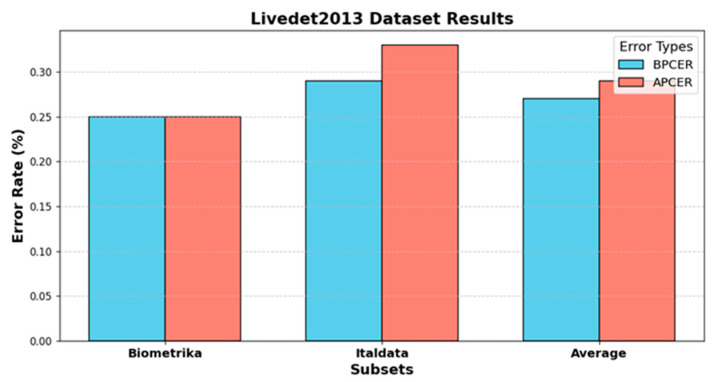
In this paper, we address the challenge of fingerprint liveness detection by proposing a dual pre-trained model approach that combines VGG16 and ResNet50 architectures. While existing methods often rely on a single feature extraction model, they may struggle with generalization across diverse spoofing materials and sensor types. To overcome this limitation, our approach leverages the high-resolution feature extraction of VGG16 and the deep layer architecture of ResNet50 to capture a more comprehensive range of features for improved spoof detection. The proposed approach integrates these two models by concatenating their extracted features, which are then used to classify the captured fingerprint as live or spoofed. Evaluated on the Livedet2013 and Livedet2015 datasets, our method achieves state-of-the-art performance, with an accuracy of 99.72% on Livedet2013, surpassing existing methods like the Gram model (98.95%) and Pre-trained CNN (98.45%). On Livedet2015, our method achieves an average accuracy of 96.32%, outperforming several state-of-the-art models, including CNN (95.27%) and LivDet 2015 (95.39%). Error rate analysis reveals consistently low Bonafide Presentation Classification Error Rate (BPCER) scores with 0.28% on LivDet 2013 and 1.45% on LivDet 2015. Similarly, the Attack Presentation Classification Error Rate (APCER) remains low at 0.35% on LivDet 2013 and 3.68% on LivDet 2015. However, higher APCER values are observed for unknown spoof materials, particularly in the Crossmatch subset of Livedet2015, where the APCER rises to 8.12%. These findings highlight the robustness and adaptability of our simple dual-model framework while identifying areas for further optimization in handling unseen spoof materials.






 京公网安备 11010802042870号
京ICP备2023020795号-1
京公网安备 11010802042870号
京ICP备2023020795号-1

 分享
分享
 求助内容:
求助内容: 应助结果提醒方式:
 扫码关注我们
