{"title":"Challenges of Constipation in People Suffering from Schizophrenia: A Narrative Review.","authors":"Takahiko Nagamine","doi":"10.3390/clinpract15020033","DOIUrl":null,"url":null,"abstract":"<p><p><b>Background/Objectives</b>: Individuals diagnosed with schizophrenia are susceptible to constipation induced by antipsychotic medications. However, research investigating the prevalence of this adverse effect and its underlying mechanisms is limited. <b>Methods</b>: To address this knowledge gap, a narrative review was conducted on the subject of constipation in patients with schizophrenia. A comprehensive electronic search was conducted in the PubMed and J-Stage databases. <b>Results</b>: The prevalence of constipation in individuals with schizophrenia is high, ranging from 30% to 60%. The risk of constipation increases with high doses of antipsychotics and with the concomitant use of anticholinergics and mood stabilizers. The prevalence of constipation varies by sex, with women demonstrating a higher risk compared to men. <b>Conclusions</b>: Constipation is a prevalent complaint among individuals with schizophrenia, with women exhibiting a higher risk. The underlying pathophysiology of sex differences in constipation is attributed to variations in monoamines within the descending pain inhibitory pathway, which governs the neural circuitry associated with defecation. Constipation can lead to significant complications, underscoring the need for a multifaceted approach to treatment that considers the intestinal environment beyond the mere use of laxatives.</p>","PeriodicalId":45306,"journal":{"name":"Clinics and Practice","volume":"15 2","pages":""},"PeriodicalIF":2.2000,"publicationDate":"2025-02-11","publicationTypes":"Journal Article","fieldsOfStudy":null,"isOpenAccess":false,"openAccessPdf":"https://www.ncbi.nlm.nih.gov/pmc/articles/PMC11854845/pdf/","citationCount":"0","resultStr":null,"platform":"Semanticscholar","paperid":null,"PeriodicalName":"Clinics and Practice","FirstCategoryId":"1085","ListUrlMain":"https://doi.org/10.3390/clinpract15020033","RegionNum":0,"RegionCategory":null,"ArticlePicture":[],"TitleCN":null,"AbstractTextCN":null,"PMCID":null,"EPubDate":"","PubModel":"","JCR":"Q2","JCRName":"MEDICINE, GENERAL & INTERNAL","Score":null,"Total":0}
引用次数: 0
Abstract
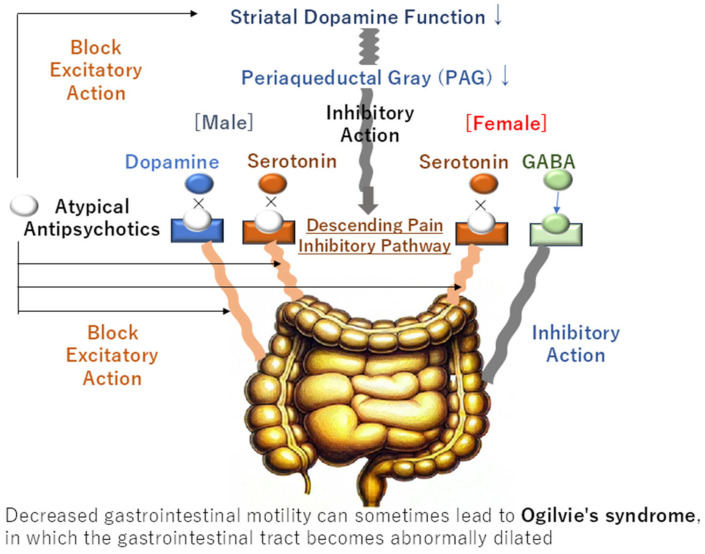
Background/Objectives: Individuals diagnosed with schizophrenia are susceptible to constipation induced by antipsychotic medications. However, research investigating the prevalence of this adverse effect and its underlying mechanisms is limited. Methods: To address this knowledge gap, a narrative review was conducted on the subject of constipation in patients with schizophrenia. A comprehensive electronic search was conducted in the PubMed and J-Stage databases. Results: The prevalence of constipation in individuals with schizophrenia is high, ranging from 30% to 60%. The risk of constipation increases with high doses of antipsychotics and with the concomitant use of anticholinergics and mood stabilizers. The prevalence of constipation varies by sex, with women demonstrating a higher risk compared to men. Conclusions: Constipation is a prevalent complaint among individuals with schizophrenia, with women exhibiting a higher risk. The underlying pathophysiology of sex differences in constipation is attributed to variations in monoamines within the descending pain inhibitory pathway, which governs the neural circuitry associated with defecation. Constipation can lead to significant complications, underscoring the need for a multifaceted approach to treatment that considers the intestinal environment beyond the mere use of laxatives.





 京公网安备 11010802042870号
京ICP备2023020795号-1
京公网安备 11010802042870号
京ICP备2023020795号-1

 分享
分享
 求助内容:
求助内容: 应助结果提醒方式:
 扫码关注我们
