Healthcare resource utilization and costs associated with inadequate initial antibiotic treatment of bacteraemia produced by carbapenem-resistant Gram-negative bacilli (CRGNB): a descriptive, observational study in Spanish hospitals.
José Garnacho-Montero, José María Aguado, Enrique Alemparte, Juan P Horcajada, Francisco López-Medrano, Paula Ramírez, Ariadna Giró-Perafita, Martí Blasco, Borja Suberviola
{"title":"Healthcare resource utilization and costs associated with inadequate initial antibiotic treatment of bacteraemia produced by carbapenem-resistant Gram-negative bacilli (CRGNB): a descriptive, observational study in Spanish hospitals.","authors":"José Garnacho-Montero, José María Aguado, Enrique Alemparte, Juan P Horcajada, Francisco López-Medrano, Paula Ramírez, Ariadna Giró-Perafita, Martí Blasco, Borja Suberviola","doi":"10.37201/req/121.2024","DOIUrl":null,"url":null,"abstract":"<p><strong>Introduction: </strong>Carbapenem-resistant gram-negative bacilli (CRGNB) are one of the main causes of nosocomial infections, posing a major public health challenge. Blood stream infections (BSI) require special attention because of the higher morbidity and mortality associated.</p><p><strong>Objective: </strong>To assess the impact of initial adequate or inadequate antibiotic treatment on the length of stay (LOS) and healthcare resource utilisation of patients with bloodstream infections (BSI) caused by a Carbapenem-resistant gram-negative bacilli (CRGNB) in the Spanish clinical practice.</p><p><strong>Methods: </strong>A descriptive, observational, retrospective chart review study of patients diagnosed with CRGNB bacteriemia in 6 Spanish public hospitals.</p><p><strong>Results: </strong>The overall median LOS of the total population (n=64) was 26.5 days (Q1: 16 days; Q3: 40 days). The median LOS for the initially adequately treated group was 27 days (Q1: 17; Q3: 50), and 24 days (Q1: 15; Q3: 38) for the initially inadequately treated (t-test p= 0.5031). In the Hospital Ward group (n=44), initially adequately treated patients spent hospitalised a median of 6 days less than the initially inadequately treated patients (18 days [Q1: 12; Q3: 27] vs 24 days [Q1: 15; Q3: 38] respectively, p=0.0269). In the total population analysis, initially adequately treated patients had a lower use of resources (20,895.02 [Q1: 11,543.67 ; Q3: 61,773.17 ]) compared to initially inadequately treated patients (24,444.02 [Q1: 11,571.63 ; Q3: 40,790.64 ).</p><p><strong>Conclusion: </strong>Results suggest that inadequate empirical treatment for BSI caused by CRGNB in the hospital ward could be associated with an increase in the LOS and resource utilization of these patients.</p>","PeriodicalId":94198,"journal":{"name":"Revista espanola de quimioterapia : publicacion oficial de la Sociedad Espanola de Quimioterapia","volume":"38 3","pages":"197-207"},"PeriodicalIF":2.2000,"publicationDate":"2025-05-14","publicationTypes":"Journal Article","fieldsOfStudy":null,"isOpenAccess":false,"openAccessPdf":"https://www.ncbi.nlm.nih.gov/pmc/articles/PMC12095935/pdf/","citationCount":"0","resultStr":null,"platform":"Semanticscholar","paperid":null,"PeriodicalName":"Revista espanola de quimioterapia : publicacion oficial de la Sociedad Espanola de Quimioterapia","FirstCategoryId":"1085","ListUrlMain":"https://doi.org/10.37201/req/121.2024","RegionNum":0,"RegionCategory":null,"ArticlePicture":[],"TitleCN":null,"AbstractTextCN":null,"PMCID":null,"EPubDate":"2025/2/25 0:00:00","PubModel":"Epub","JCR":"","JCRName":"","Score":null,"Total":0}
引用次数: 0
Abstract
Introduction: Carbapenem-resistant gram-negative bacilli (CRGNB) are one of the main causes of nosocomial infections, posing a major public health challenge. Blood stream infections (BSI) require special attention because of the higher morbidity and mortality associated.
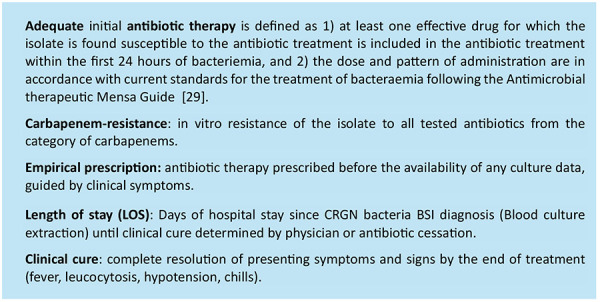
Objective: To assess the impact of initial adequate or inadequate antibiotic treatment on the length of stay (LOS) and healthcare resource utilisation of patients with bloodstream infections (BSI) caused by a Carbapenem-resistant gram-negative bacilli (CRGNB) in the Spanish clinical practice.
Methods: A descriptive, observational, retrospective chart review study of patients diagnosed with CRGNB bacteriemia in 6 Spanish public hospitals.
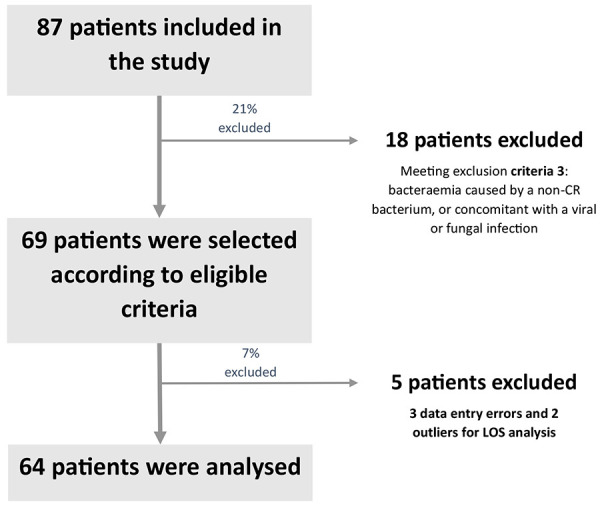
Results: The overall median LOS of the total population (n=64) was 26.5 days (Q1: 16 days; Q3: 40 days). The median LOS for the initially adequately treated group was 27 days (Q1: 17; Q3: 50), and 24 days (Q1: 15; Q3: 38) for the initially inadequately treated (t-test p= 0.5031). In the Hospital Ward group (n=44), initially adequately treated patients spent hospitalised a median of 6 days less than the initially inadequately treated patients (18 days [Q1: 12; Q3: 27] vs 24 days [Q1: 15; Q3: 38] respectively, p=0.0269). In the total population analysis, initially adequately treated patients had a lower use of resources (20,895.02 [Q1: 11,543.67 ; Q3: 61,773.17 ]) compared to initially inadequately treated patients (24,444.02 [Q1: 11,571.63 ; Q3: 40,790.64 ).
Conclusion: Results suggest that inadequate empirical treatment for BSI caused by CRGNB in the hospital ward could be associated with an increase in the LOS and resource utilization of these patients.



 京公网安备 11010802042870号
京ICP备2023020795号-1
京公网安备 11010802042870号
京ICP备2023020795号-1

 分享
分享

 求助内容:
求助内容: 应助结果提醒方式:
 扫码关注我们
