Dominik Moreth, Maria Victoria Cappellari, Andreas Müller, Alex Oster, Dominik Schwab, Nikos L. Doltsinis, Cristian A. Strassert, Ulrich Schatzschneider
{"title":"Luminescent N^C^N Pincer Ni(II), Pd(II), and Pt(II) Complexes with a Pendant Coumarin Group: The Role of Auxiliary Ligands and Environments","authors":"Dominik Moreth, Maria Victoria Cappellari, Andreas Müller, Alex Oster, Dominik Schwab, Nikos L. Doltsinis, Cristian A. Strassert, Ulrich Schatzschneider","doi":"10.1021/acs.inorgchem.4c03773","DOIUrl":null,"url":null,"abstract":"Square-planar <i>d</i><sup>8</sup>-configured metal complexes and their excited states play a key role in photocatalysis, sensing, and optoelectronic devices. However, metal-to-ligand charge-transfer (MLCT) excited states involving transition metals, particularly those with a 3<i>d</i><sup>8</sup> electronic configuration, present challenges due to rapid nonradiative relaxation via low-lying metal-centered (MC) states. In this work, an isoelectronic and isostructural series of cyclometalated complexes [MX(dpb)] with M = Ni(II), Pd(II), and Pt(II), dpb = 1,3-di(2-pyridyl)phenide, and auxiliary ligand X = chlorido, azido, and triazolato were studied by UV/vis absorption, steady-state, and time-resolved photoluminescence spectroscopy in solution and frozen glassy matrix at 77 K, along with DFT calculations. Consistently, the Pd(II) and Pt(II) complexes exhibited a characteristic emission from their triplet ligand-centered (<sup>3</sup>LC) excited states. In contrast, Ni(II) complexes with auxiliary chlorido, azido, and triazolato<sup>COOCH3,COOCH3</sup> ligands were nonemissive at low and room temperatures, due to the presence of low-lying MC-type ligand-field excited states. On the other hand, [Ni(triazolato<sup>Coumarin,COOCH3</sup>)(dpb)] showed phosphorescence from the T<sub>5</sub> state in a frozen glassy matrix at 77 K, since the restrictive environment limits structural relaxation, while at room temperature, the primary emission is due to singlet LC excited states from the coumarin moiety of the free ligand.","PeriodicalId":40,"journal":{"name":"Inorganic Chemistry","volume":"51 1","pages":""},"PeriodicalIF":4.7000,"publicationDate":"2025-02-26","publicationTypes":"Journal Article","fieldsOfStudy":null,"isOpenAccess":false,"openAccessPdf":"","citationCount":"0","resultStr":null,"platform":"Semanticscholar","paperid":null,"PeriodicalName":"Inorganic Chemistry","FirstCategoryId":"92","ListUrlMain":"https://doi.org/10.1021/acs.inorgchem.4c03773","RegionNum":2,"RegionCategory":"化学","ArticlePicture":[],"TitleCN":null,"AbstractTextCN":null,"PMCID":null,"EPubDate":"","PubModel":"","JCR":"Q1","JCRName":"CHEMISTRY, INORGANIC & NUCLEAR","Score":null,"Total":0}
引用次数: 0
Abstract
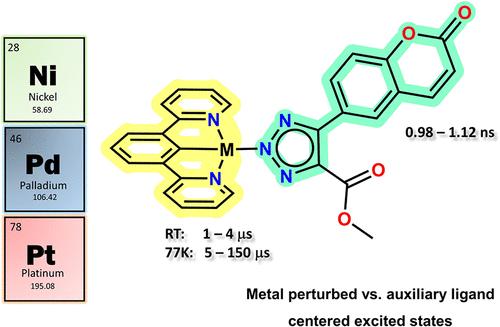
Square-planar d8-configured metal complexes and their excited states play a key role in photocatalysis, sensing, and optoelectronic devices. However, metal-to-ligand charge-transfer (MLCT) excited states involving transition metals, particularly those with a 3d8 electronic configuration, present challenges due to rapid nonradiative relaxation via low-lying metal-centered (MC) states. In this work, an isoelectronic and isostructural series of cyclometalated complexes [MX(dpb)] with M = Ni(II), Pd(II), and Pt(II), dpb = 1,3-di(2-pyridyl)phenide, and auxiliary ligand X = chlorido, azido, and triazolato were studied by UV/vis absorption, steady-state, and time-resolved photoluminescence spectroscopy in solution and frozen glassy matrix at 77 K, along with DFT calculations. Consistently, the Pd(II) and Pt(II) complexes exhibited a characteristic emission from their triplet ligand-centered (3LC) excited states. In contrast, Ni(II) complexes with auxiliary chlorido, azido, and triazolatoCOOCH3,COOCH3 ligands were nonemissive at low and room temperatures, due to the presence of low-lying MC-type ligand-field excited states. On the other hand, [Ni(triazolatoCoumarin,COOCH3)(dpb)] showed phosphorescence from the T5 state in a frozen glassy matrix at 77 K, since the restrictive environment limits structural relaxation, while at room temperature, the primary emission is due to singlet LC excited states from the coumarin moiety of the free ligand.
期刊介绍:
Inorganic Chemistry publishes fundamental studies in all phases of inorganic chemistry. Coverage includes experimental and theoretical reports on quantitative studies of structure and thermodynamics, kinetics, mechanisms of inorganic reactions, bioinorganic chemistry, and relevant aspects of organometallic chemistry, solid-state phenomena, and chemical bonding theory. Emphasis is placed on the synthesis, structure, thermodynamics, reactivity, spectroscopy, and bonding properties of significant new and known compounds.



 京公网安备 11010802042870号
京ICP备2023020795号-1
京公网安备 11010802042870号
京ICP备2023020795号-1

 分享
分享
 求助内容:
求助内容: 应助结果提醒方式:
 扫码关注我们
