Claudio Ordonez, Chengye Dong, Arpit Jain, Li-Syuan Lu, Joshua A. Robinson, Kenneth L. Knappenberger, Jr.
{"title":"High Harmonic Generation from 2D Polar Metal Heterostructures","authors":"Claudio Ordonez, Chengye Dong, Arpit Jain, Li-Syuan Lu, Joshua A. Robinson, Kenneth L. Knappenberger, Jr.","doi":"10.1021/acs.jpcc.4c08773","DOIUrl":null,"url":null,"abstract":"High harmonic generation (HHG) from 2D polar metal heterostructures (PMets) is described. 2D Ag and Ga PMets were formed by confinement heteroepitaxy. High-temperature sublimation of Si atoms from 6H-SiC formed epitaxial bilayer graphene/SiC heterostructures (EG). Metal intercalation generated crystalline films of monolayer Ag and bilayer Ga in the confines of the graphene and SiC interface, forming the PMet heterostructure. HHG using a mid-infrared (5200 nm) laser to transduce the fifth, seventh, and ninth harmonics for both Ag and Ga PMets as well as EG exhibited a second-order dependence on the incident laser power. The quadratic power dependence implicated nonperturbative HHG mechanisms transduced by the graphene component of the heterostructures. The HHG signal intensity and polarization properties were sensitive to the choice of metal intercalant and, in the case of EG, the SiC support. This sensitivity resulted from metal- and SiC-to-graphene charge transfer (i.e., n-doping of graphene). The doping effect created a carrier population in the graphene conduction band, which resulted in an effective Pauli blocking that modulated the HHG response. The results show the potential for using multicomponent heterostructures for tailoring the frequency and polarization properties of photonic materials as well as the effectiveness of HHG for probing interfacial energy transfer.","PeriodicalId":61,"journal":{"name":"The Journal of Physical Chemistry C","volume":"32 1","pages":""},"PeriodicalIF":3.2000,"publicationDate":"2025-02-26","publicationTypes":"Journal Article","fieldsOfStudy":null,"isOpenAccess":false,"openAccessPdf":"","citationCount":"0","resultStr":null,"platform":"Semanticscholar","paperid":null,"PeriodicalName":"The Journal of Physical Chemistry C","FirstCategoryId":"1","ListUrlMain":"https://doi.org/10.1021/acs.jpcc.4c08773","RegionNum":3,"RegionCategory":"化学","ArticlePicture":[],"TitleCN":null,"AbstractTextCN":null,"PMCID":null,"EPubDate":"","PubModel":"","JCR":"Q2","JCRName":"CHEMISTRY, PHYSICAL","Score":null,"Total":0}
引用次数: 0
Abstract
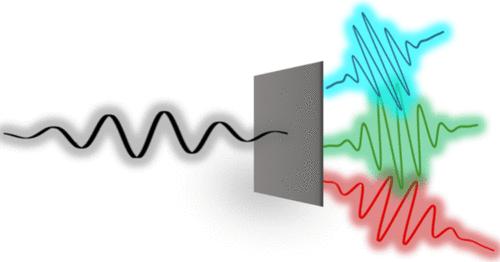
High harmonic generation (HHG) from 2D polar metal heterostructures (PMets) is described. 2D Ag and Ga PMets were formed by confinement heteroepitaxy. High-temperature sublimation of Si atoms from 6H-SiC formed epitaxial bilayer graphene/SiC heterostructures (EG). Metal intercalation generated crystalline films of monolayer Ag and bilayer Ga in the confines of the graphene and SiC interface, forming the PMet heterostructure. HHG using a mid-infrared (5200 nm) laser to transduce the fifth, seventh, and ninth harmonics for both Ag and Ga PMets as well as EG exhibited a second-order dependence on the incident laser power. The quadratic power dependence implicated nonperturbative HHG mechanisms transduced by the graphene component of the heterostructures. The HHG signal intensity and polarization properties were sensitive to the choice of metal intercalant and, in the case of EG, the SiC support. This sensitivity resulted from metal- and SiC-to-graphene charge transfer (i.e., n-doping of graphene). The doping effect created a carrier population in the graphene conduction band, which resulted in an effective Pauli blocking that modulated the HHG response. The results show the potential for using multicomponent heterostructures for tailoring the frequency and polarization properties of photonic materials as well as the effectiveness of HHG for probing interfacial energy transfer.
期刊介绍:
The Journal of Physical Chemistry A/B/C is devoted to reporting new and original experimental and theoretical basic research of interest to physical chemists, biophysical chemists, and chemical physicists.



 京公网安备 11010802042870号
京ICP备2023020795号-1
京公网安备 11010802042870号
京ICP备2023020795号-1

 分享
分享
 求助内容:
求助内容: 应助结果提醒方式:
 扫码关注我们
