Hye Min Song, Seo Hyun Lim, Eun Seo Lee, Dojin Kim, Sang Yup Lee, Ki Jun Jeong, Si Jae Park
{"title":"Biosynthesis of Polyhydroxyalkanoates From Sucrose by Recombinant Pseudomonas putida KT2440","authors":"Hye Min Song, Seo Hyun Lim, Eun Seo Lee, Dojin Kim, Sang Yup Lee, Ki Jun Jeong, Si Jae Park","doi":"10.1002/cbic.202401000","DOIUrl":null,"url":null,"abstract":"<p>A sucrose-utilization pathway was developed in <i>Pseudomonas putida</i> using <i>sacC</i> from <i>Mannheimia succiniciproducens</i>, which encodes a β-fructofuranosidase that hydrolyzes sucrose into glucose and fructose. Excretion of β-fructofuranosidase into the culture medium was confirmed via western blot analysis. In nitrogen-limited cultivation, <i>P. putida</i> expressing SacC produced 10.52 wt % medium-chain-length polyhydroxyalkanoate (MCL-PHA), while <i>P. putida</i> expressing SacC along with poly(3-hydroxybutyrate) [P(3HB)] biosynthesis genes produced 9.16 wt % P(3HB) from sucrose. Batch and fed-batch cultures of recombinant <i>P. putida</i> suggested that the glucose and fructose derived from sucrose can be completely utilized for cell growth and P(3HB) production. In fed-batch cultures, sucrose supplied into the fermentor to maintain its concentration around 20 g/L was rapidly hydrolyzed into glucose and fructose supporting the production of 30.2 g/L P(3HB) with 38.1 wt %. The engineered <i>P. putida</i> reported herein can facilitate the production of PHAs from sucrose, an abundant and inexpensive carbon source.</p>","PeriodicalId":140,"journal":{"name":"ChemBioChem","volume":"26 8","pages":""},"PeriodicalIF":2.8000,"publicationDate":"2025-02-26","publicationTypes":"Journal Article","fieldsOfStudy":null,"isOpenAccess":false,"openAccessPdf":"","citationCount":"0","resultStr":null,"platform":"Semanticscholar","paperid":null,"PeriodicalName":"ChemBioChem","FirstCategoryId":"99","ListUrlMain":"https://chemistry-europe.onlinelibrary.wiley.com/doi/10.1002/cbic.202401000","RegionNum":4,"RegionCategory":"生物学","ArticlePicture":[],"TitleCN":null,"AbstractTextCN":null,"PMCID":null,"EPubDate":"","PubModel":"","JCR":"Q3","JCRName":"BIOCHEMISTRY & MOLECULAR BIOLOGY","Score":null,"Total":0}
引用次数: 0
Abstract
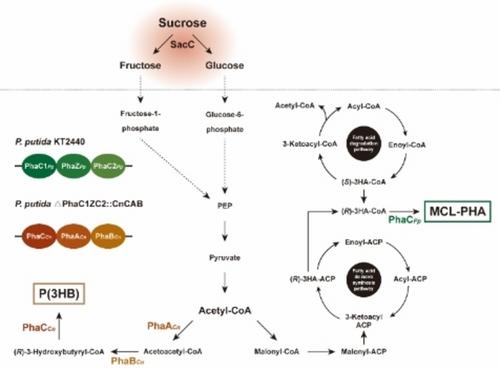
A sucrose-utilization pathway was developed in Pseudomonas putida using sacC from Mannheimia succiniciproducens, which encodes a β-fructofuranosidase that hydrolyzes sucrose into glucose and fructose. Excretion of β-fructofuranosidase into the culture medium was confirmed via western blot analysis. In nitrogen-limited cultivation, P. putida expressing SacC produced 10.52 wt % medium-chain-length polyhydroxyalkanoate (MCL-PHA), while P. putida expressing SacC along with poly(3-hydroxybutyrate) [P(3HB)] biosynthesis genes produced 9.16 wt % P(3HB) from sucrose. Batch and fed-batch cultures of recombinant P. putida suggested that the glucose and fructose derived from sucrose can be completely utilized for cell growth and P(3HB) production. In fed-batch cultures, sucrose supplied into the fermentor to maintain its concentration around 20 g/L was rapidly hydrolyzed into glucose and fructose supporting the production of 30.2 g/L P(3HB) with 38.1 wt %. The engineered P. putida reported herein can facilitate the production of PHAs from sucrose, an abundant and inexpensive carbon source.
期刊介绍:
ChemBioChem (Impact Factor 2018: 2.641) publishes important breakthroughs across all areas at the interface of chemistry and biology, including the fields of chemical biology, bioorganic chemistry, bioinorganic chemistry, synthetic biology, biocatalysis, bionanotechnology, and biomaterials. It is published on behalf of Chemistry Europe, an association of 16 European chemical societies, and supported by the Asian Chemical Editorial Society (ACES).





 京公网安备 11010802042870号
京ICP备2023020795号-1
京公网安备 11010802042870号
京ICP备2023020795号-1

 分享
分享
 求助内容:
求助内容: 应助结果提醒方式:
 扫码关注我们
