Yuki Umeda, Shinya Yamahira, Koki Nakamura, Tomoko Takagi, Tomoko Suzuki, Kae Sato, Yusuke Hirabayashi, Akimitsu Okamoto and Satoshi Yamaguchi
{"title":"Microfluidic cell unroofing for the in situ molecular analysis of organelles without membrane permeabilization†","authors":"Yuki Umeda, Shinya Yamahira, Koki Nakamura, Tomoko Takagi, Tomoko Suzuki, Kae Sato, Yusuke Hirabayashi, Akimitsu Okamoto and Satoshi Yamaguchi","doi":"10.1039/D5LC00102A","DOIUrl":null,"url":null,"abstract":"<p >Molecular networks of organelle membranes are involved in many cell processes. However, the nature of plasma membrane as a barrier to various analytical tools, including antibodies, makes it challenging to examine intact organelle membranes without affecting their structure and functions <em>via</em> membrane permeabilization. Therefore, in this study, we aimed to develop a microfluidic method to unroof cells and observe the intrinsic membrane molecules in organelles. In our method, single cells were precisely arrayed on the bottom surface of microchannels in a light-guided manner using a photoactivatable cell-anchoring material. At sufficiently short cell intervals, horizontal stresses generated by the laminar flow instantly fractured the upper cell membranes, without significantly affecting some organelles inside the fractured cells. Subsequently, nucleus and other organelles in unroofed cells were observed <em>via</em> confocal fluorescence and scanning electron microscopy. Furthermore, distribution of the mitochondrial membrane protein, translocase of outer mitochondrial membrane 20, on the mitochondrial membrane was successfully observed <em>via</em> immunostaining without permeabilization. Overall, the established cell unroofing method shows great potential to examine the localization, functions, and affinities of proteins on intact organelle membranes.</p>","PeriodicalId":85,"journal":{"name":"Lab on a Chip","volume":" 9","pages":" 2222-2233"},"PeriodicalIF":5.4000,"publicationDate":"2025-02-19","publicationTypes":"Journal Article","fieldsOfStudy":null,"isOpenAccess":false,"openAccessPdf":"https://pubs.rsc.org/en/content/articlepdf/2025/lc/d5lc00102a?page=search","citationCount":"0","resultStr":null,"platform":"Semanticscholar","paperid":null,"PeriodicalName":"Lab on a Chip","FirstCategoryId":"5","ListUrlMain":"https://pubs.rsc.org/en/content/articlelanding/2025/lc/d5lc00102a","RegionNum":2,"RegionCategory":"工程技术","ArticlePicture":[],"TitleCN":null,"AbstractTextCN":null,"PMCID":null,"EPubDate":"","PubModel":"","JCR":"Q1","JCRName":"BIOCHEMICAL RESEARCH METHODS","Score":null,"Total":0}
引用次数: 0
Abstract
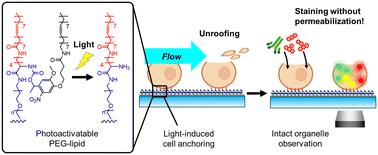
Molecular networks of organelle membranes are involved in many cell processes. However, the nature of plasma membrane as a barrier to various analytical tools, including antibodies, makes it challenging to examine intact organelle membranes without affecting their structure and functions via membrane permeabilization. Therefore, in this study, we aimed to develop a microfluidic method to unroof cells and observe the intrinsic membrane molecules in organelles. In our method, single cells were precisely arrayed on the bottom surface of microchannels in a light-guided manner using a photoactivatable cell-anchoring material. At sufficiently short cell intervals, horizontal stresses generated by the laminar flow instantly fractured the upper cell membranes, without significantly affecting some organelles inside the fractured cells. Subsequently, nucleus and other organelles in unroofed cells were observed via confocal fluorescence and scanning electron microscopy. Furthermore, distribution of the mitochondrial membrane protein, translocase of outer mitochondrial membrane 20, on the mitochondrial membrane was successfully observed via immunostaining without permeabilization. Overall, the established cell unroofing method shows great potential to examine the localization, functions, and affinities of proteins on intact organelle membranes.
期刊介绍:
Lab on a Chip is the premiere journal that publishes cutting-edge research in the field of miniaturization. By their very nature, microfluidic/nanofluidic/miniaturized systems are at the intersection of disciplines, spanning fundamental research to high-end application, which is reflected by the broad readership of the journal. Lab on a Chip publishes two types of papers on original research: full-length research papers and communications. Papers should demonstrate innovations, which can come from technical advancements or applications addressing pressing needs in globally important areas. The journal also publishes Comments, Reviews, and Perspectives.



 京公网安备 11010802042870号
京ICP备2023020795号-1
京公网安备 11010802042870号
京ICP备2023020795号-1

 分享
分享
 求助内容:
求助内容: 应助结果提醒方式:
 扫码关注我们
