Siyu Zhao, Zhaomiao Liu, Nan Zheng, Chenchen Zhang, Kai Zheng, Shuai Shi and Yan Pang
{"title":"Study on the size and spatial configuration of liquid metal droplets in conductive hydrogels induced by surface acoustic waves†","authors":"Siyu Zhao, Zhaomiao Liu, Nan Zheng, Chenchen Zhang, Kai Zheng, Shuai Shi and Yan Pang","doi":"10.1039/D4LC00935E","DOIUrl":null,"url":null,"abstract":"<p >Conductive hydrogels based on liquid metal microdroplets are widely used as wearable electronic devices. Droplet uniformity affects sensor sensitivity for weak signals, such as heart rate and pulse rate. Surface acoustic waves at micrometer wavelengths allow precise control of a single droplet, and have the potential to make uniformly discrete liquid metal droplets and distribute them in hydrogels. But the control law of liquid metal droplet size and its spatial configuration by acoustic surface waves is not clear. The aim of this paper is to present an analysis of the acoustic regulation mechanism in the interfacial evolution of fluids with high interfacial tension coefficients, and to investigate the influence of microdroplet generation characteristics (size and spacing) on the conductive and mechanical properties of conductive hydrogels. The results showed that the combined action of acoustic radiation force, shear force and pressure difference force helped to overcome interfacial tension and speed up the interfacial necking process during the filling and squeezing stages. The use of acoustic surface waves serves to diminish the influence of droplet size on the two-phase flow rate. This provides an effective approach for achieving decoupled control of microdroplet size and spacing, alongside the formation of a homogenous array of liquid metal droplets. The acoustic surface wave effect makes the liquid metal microdroplets more uniform in size and spacing. As the liquid metal content relative to the hydrogel substrate solution increases, the liquid metal size decreases. The hydrogel's initial conductivity and conductivity after self-healing increase by 10% and 25%, respectively, which can realize the effective monitoring of ECG and EMG signals. This study helps to reveal the evolution mechanism of liquid-metal interfaces induced by acoustic surface waves, elucidate the effects of microdroplet size and spacing on the conductive and mechanical properties of hydrogels, and provide theoretical guidance for the high-precision preparation of wearable electronic devices.</p>","PeriodicalId":85,"journal":{"name":"Lab on a Chip","volume":" 10","pages":" 2325-2337"},"PeriodicalIF":5.4000,"publicationDate":"2025-02-26","publicationTypes":"Journal Article","fieldsOfStudy":null,"isOpenAccess":false,"openAccessPdf":"","citationCount":"0","resultStr":null,"platform":"Semanticscholar","paperid":null,"PeriodicalName":"Lab on a Chip","FirstCategoryId":"5","ListUrlMain":"https://pubs.rsc.org/en/content/articlelanding/2025/lc/d4lc00935e","RegionNum":2,"RegionCategory":"工程技术","ArticlePicture":[],"TitleCN":null,"AbstractTextCN":null,"PMCID":null,"EPubDate":"","PubModel":"","JCR":"Q1","JCRName":"BIOCHEMICAL RESEARCH METHODS","Score":null,"Total":0}
引用次数: 0
Abstract
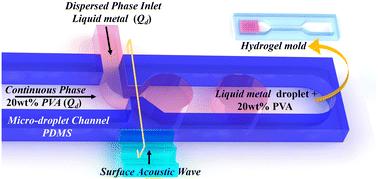
Conductive hydrogels based on liquid metal microdroplets are widely used as wearable electronic devices. Droplet uniformity affects sensor sensitivity for weak signals, such as heart rate and pulse rate. Surface acoustic waves at micrometer wavelengths allow precise control of a single droplet, and have the potential to make uniformly discrete liquid metal droplets and distribute them in hydrogels. But the control law of liquid metal droplet size and its spatial configuration by acoustic surface waves is not clear. The aim of this paper is to present an analysis of the acoustic regulation mechanism in the interfacial evolution of fluids with high interfacial tension coefficients, and to investigate the influence of microdroplet generation characteristics (size and spacing) on the conductive and mechanical properties of conductive hydrogels. The results showed that the combined action of acoustic radiation force, shear force and pressure difference force helped to overcome interfacial tension and speed up the interfacial necking process during the filling and squeezing stages. The use of acoustic surface waves serves to diminish the influence of droplet size on the two-phase flow rate. This provides an effective approach for achieving decoupled control of microdroplet size and spacing, alongside the formation of a homogenous array of liquid metal droplets. The acoustic surface wave effect makes the liquid metal microdroplets more uniform in size and spacing. As the liquid metal content relative to the hydrogel substrate solution increases, the liquid metal size decreases. The hydrogel's initial conductivity and conductivity after self-healing increase by 10% and 25%, respectively, which can realize the effective monitoring of ECG and EMG signals. This study helps to reveal the evolution mechanism of liquid-metal interfaces induced by acoustic surface waves, elucidate the effects of microdroplet size and spacing on the conductive and mechanical properties of hydrogels, and provide theoretical guidance for the high-precision preparation of wearable electronic devices.
期刊介绍:
Lab on a Chip is the premiere journal that publishes cutting-edge research in the field of miniaturization. By their very nature, microfluidic/nanofluidic/miniaturized systems are at the intersection of disciplines, spanning fundamental research to high-end application, which is reflected by the broad readership of the journal. Lab on a Chip publishes two types of papers on original research: full-length research papers and communications. Papers should demonstrate innovations, which can come from technical advancements or applications addressing pressing needs in globally important areas. The journal also publishes Comments, Reviews, and Perspectives.



 京公网安备 11010802042870号
京ICP备2023020795号-1
京公网安备 11010802042870号
京ICP备2023020795号-1

 分享
分享
 求助内容:
求助内容: 应助结果提醒方式:
 扫码关注我们
