Maia Sobejana, Mustafa Al Beiramani, Gerben J C Zwezerijnen, Anneke van der Kooi, Joost Raaphorst, Carel G M Meskers, Martin van der Esch, Conny J van der Laken, Maarten M Steinz
{"title":"Methodology Development for Investigating Pathophysiological [<sup>18</sup>F]-FDG Muscle Uptake in Patients with Rheumatic Musculoskeletal Diseases.","authors":"Maia Sobejana, Mustafa Al Beiramani, Gerben J C Zwezerijnen, Anneke van der Kooi, Joost Raaphorst, Carel G M Meskers, Martin van der Esch, Conny J van der Laken, Maarten M Steinz","doi":"10.3390/biomedicines13020465","DOIUrl":null,"url":null,"abstract":"<p><p><b>Objectives:</b> This retrospective study explored the qualitative and quantitative assessment of F18-fluordeoxyglucose ([<sup>18</sup>F]-FDG) positron emission tomography and computed tomography (PET/CT) scans to assess pathophysiological muscle glucose uptake in patients with a rheumatic musculoskeletal disease (RMD). [<sup>18</sup>F]-FDG PET/CT detects metabolic activity via glucose uptake in tissues. This study aimed to determine the feasibility of quantitative assessment of [<sup>18</sup>F]-FDG uptake in muscles across three different RMDs compared to controls. <b>Methods:</b> In this study we analysed whole-body [<sup>18</sup>F]-FDG PET/CT scans from patients with rheumatoid arthritis (RA; <i>n</i> = 11), osteoarthritis (OA; <i>n</i> = 10), and idiopathic inflammatory myositis (IIM; <i>n</i> = 10), and non-RMD controls (<i>n</i> = 11), focusing on muscle-tracer uptake in specific muscle groups. Qualitative assessment visually identified regions with high [<sup>18</sup>F]-FDG uptake, followed by quantitative assessment using two methods: fixed volume-of-interest (VOI) and hotspot VOI. In the fixed VOI method, a VOI was placed in the respective muscle at a fixed position (50% height from proximal to distal end) on PET/CT images. In the hotspot VOI method, the VOI was placed at the site of the highest [<sup>18</sup>F]-FDG uptake observed during qualitative assessment. Standardised uptake values (SUVs) were determined for different muscle groups between RMDs and controls. <b>Results:</b> Qualitative assessment revealed a heterogenous uptake pattern of [<sup>18</sup>F]-FDG that was found in 93% of quadriceps and hamstring muscles, while other muscles displayed either heterogenous or homogenous patterns. A Bland-Altman analysis showed that the hotspot VOI method had a higher sensitivity in detecting differential [<sup>18</sup>F]-FDG uptake in muscles. Across all muscle groups, patients with IIM had the highest [<sup>18</sup>F]-FDG uptake, followed by patients with OA and RA, respectively. <b>Conclusions:</b> [<sup>18</sup>F]-FDG PET/CT enables qualitative and quantitative differentiation of muscle glucose uptake in patients with RA, OA, and IIM, at both individual muscle and patient group levels. The hotspot method and SUV<sub>peak</sub> are recommended for quantitative assessment. High [<sup>18</sup>F]-FDG uptake in multiple muscle groups suggests pathophysiological glucose metabolism in RMD-affected muscles.</p>","PeriodicalId":8937,"journal":{"name":"Biomedicines","volume":"13 2","pages":""},"PeriodicalIF":3.9000,"publicationDate":"2025-02-14","publicationTypes":"Journal Article","fieldsOfStudy":null,"isOpenAccess":false,"openAccessPdf":"https://www.ncbi.nlm.nih.gov/pmc/articles/PMC11853360/pdf/","citationCount":"0","resultStr":null,"platform":"Semanticscholar","paperid":null,"PeriodicalName":"Biomedicines","FirstCategoryId":"5","ListUrlMain":"https://doi.org/10.3390/biomedicines13020465","RegionNum":3,"RegionCategory":"工程技术","ArticlePicture":[],"TitleCN":null,"AbstractTextCN":null,"PMCID":null,"EPubDate":"","PubModel":"","JCR":"Q2","JCRName":"BIOCHEMISTRY & MOLECULAR BIOLOGY","Score":null,"Total":0}
引用次数: 0
Abstract
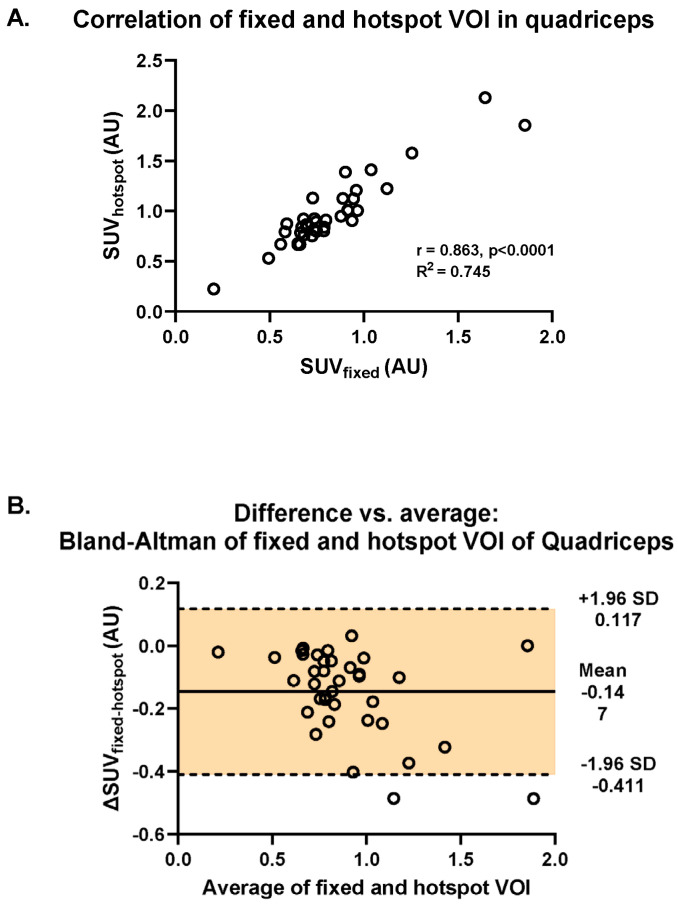
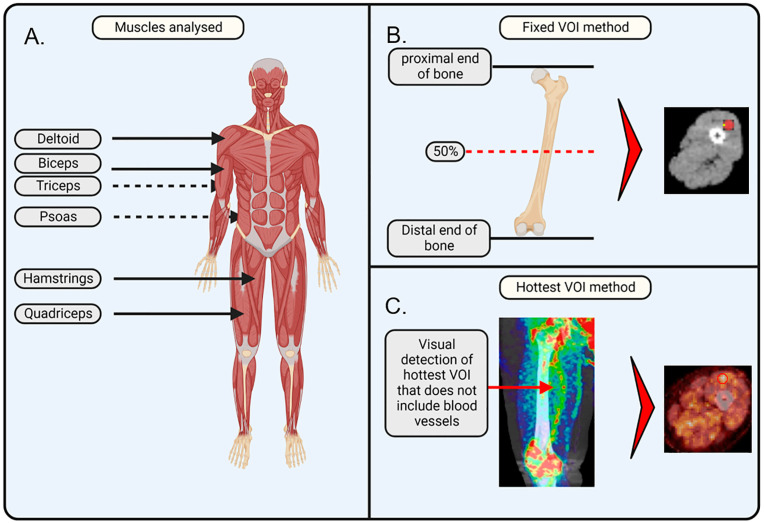
Objectives: This retrospective study explored the qualitative and quantitative assessment of F18-fluordeoxyglucose ([18F]-FDG) positron emission tomography and computed tomography (PET/CT) scans to assess pathophysiological muscle glucose uptake in patients with a rheumatic musculoskeletal disease (RMD). [18F]-FDG PET/CT detects metabolic activity via glucose uptake in tissues. This study aimed to determine the feasibility of quantitative assessment of [18F]-FDG uptake in muscles across three different RMDs compared to controls. Methods: In this study we analysed whole-body [18F]-FDG PET/CT scans from patients with rheumatoid arthritis (RA; n = 11), osteoarthritis (OA; n = 10), and idiopathic inflammatory myositis (IIM; n = 10), and non-RMD controls (n = 11), focusing on muscle-tracer uptake in specific muscle groups. Qualitative assessment visually identified regions with high [18F]-FDG uptake, followed by quantitative assessment using two methods: fixed volume-of-interest (VOI) and hotspot VOI. In the fixed VOI method, a VOI was placed in the respective muscle at a fixed position (50% height from proximal to distal end) on PET/CT images. In the hotspot VOI method, the VOI was placed at the site of the highest [18F]-FDG uptake observed during qualitative assessment. Standardised uptake values (SUVs) were determined for different muscle groups between RMDs and controls. Results: Qualitative assessment revealed a heterogenous uptake pattern of [18F]-FDG that was found in 93% of quadriceps and hamstring muscles, while other muscles displayed either heterogenous or homogenous patterns. A Bland-Altman analysis showed that the hotspot VOI method had a higher sensitivity in detecting differential [18F]-FDG uptake in muscles. Across all muscle groups, patients with IIM had the highest [18F]-FDG uptake, followed by patients with OA and RA, respectively. Conclusions: [18F]-FDG PET/CT enables qualitative and quantitative differentiation of muscle glucose uptake in patients with RA, OA, and IIM, at both individual muscle and patient group levels. The hotspot method and SUVpeak are recommended for quantitative assessment. High [18F]-FDG uptake in multiple muscle groups suggests pathophysiological glucose metabolism in RMD-affected muscles.
BiomedicinesBiochemistry, Genetics and Molecular Biology-General Biochemistry,Genetics and Molecular Biology
CiteScore
5.20
自引率
8.50%
发文量
2823
审稿时长
8 weeks
期刊介绍:
Biomedicines (ISSN 2227-9059; CODEN: BIOMID) is an international, scientific, open access journal on biomedicines published quarterly online by MDPI.




 京公网安备 11010802042870号
京ICP备2023020795号-1
京公网安备 11010802042870号
京ICP备2023020795号-1

 分享
分享
 求助内容:
求助内容: 应助结果提醒方式:
 扫码关注我们
