{"title":"Telomere Dynamics in Post-Traumatic Stress Disorder: A Critical Synthesis.","authors":"Ravi Philip Rajkumar","doi":"10.3390/biomedicines13020507","DOIUrl":null,"url":null,"abstract":"<p><p>Post-traumatic stress disorder (PTSD), a mental disorder caused by exposure to traumatic stress, affects 5-10% of the world's population. There is some evidence that PTSD is associated with accelerated cellular aging, leading to an increased risk of medical and neurodegenerative comorbidities. Alterations in telomere length (TL) and telomerase enzyme activity have been proposed as biomarkers of this process. This hypothesis was seemingly confirmed in preliminary research, but more recent studies have yielded mixed results. The current narrative review was conducted to provide a critical synthesis of existing research on telomere length and telomerase in PTSD. Data from 26 clinical studies suggest that TL in PTSD is highly variable and may be influenced by methodological, demographic, trauma-related, and psychosocial factors. There is no evidence for altered telomerase activity in PTSD. In contrast, animal research suggests that exposure to traumatic stress does lead to TL shortening. Overall, it is likely that TL is not, by itself, a reliable biomarker of cellular aging in PTSD. Other markers of cellular senescence, such as epigenetic changes, may prove to be more specific in measuring this process in patients with PTSD.</p>","PeriodicalId":8937,"journal":{"name":"Biomedicines","volume":"13 2","pages":""},"PeriodicalIF":3.9000,"publicationDate":"2025-02-18","publicationTypes":"Journal Article","fieldsOfStudy":null,"isOpenAccess":false,"openAccessPdf":"https://www.ncbi.nlm.nih.gov/pmc/articles/PMC11853385/pdf/","citationCount":"0","resultStr":null,"platform":"Semanticscholar","paperid":null,"PeriodicalName":"Biomedicines","FirstCategoryId":"5","ListUrlMain":"https://doi.org/10.3390/biomedicines13020507","RegionNum":3,"RegionCategory":"工程技术","ArticlePicture":[],"TitleCN":null,"AbstractTextCN":null,"PMCID":null,"EPubDate":"","PubModel":"","JCR":"Q2","JCRName":"BIOCHEMISTRY & MOLECULAR BIOLOGY","Score":null,"Total":0}
引用次数: 0
Abstract
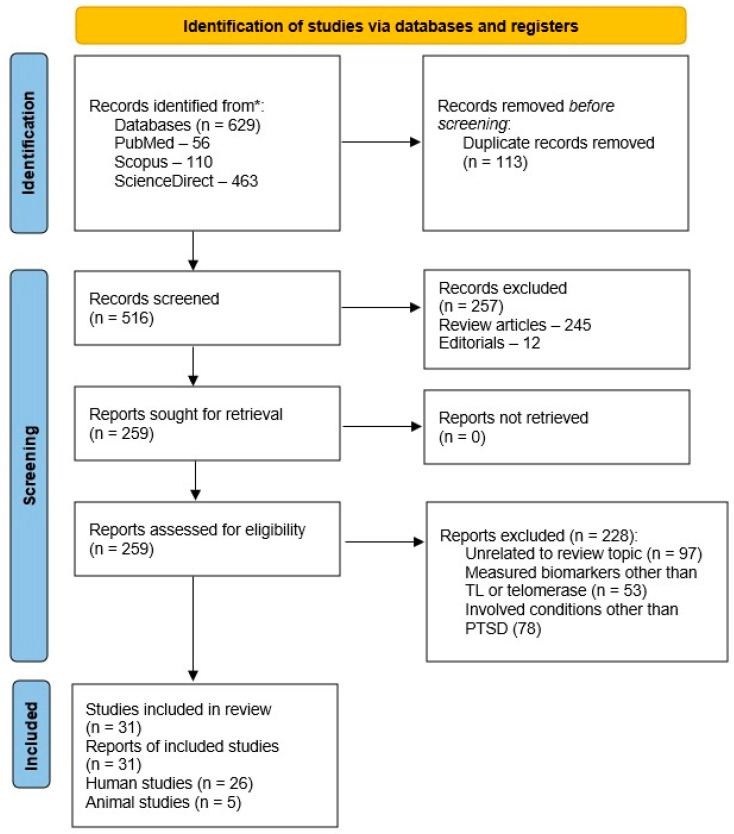
Post-traumatic stress disorder (PTSD), a mental disorder caused by exposure to traumatic stress, affects 5-10% of the world's population. There is some evidence that PTSD is associated with accelerated cellular aging, leading to an increased risk of medical and neurodegenerative comorbidities. Alterations in telomere length (TL) and telomerase enzyme activity have been proposed as biomarkers of this process. This hypothesis was seemingly confirmed in preliminary research, but more recent studies have yielded mixed results. The current narrative review was conducted to provide a critical synthesis of existing research on telomere length and telomerase in PTSD. Data from 26 clinical studies suggest that TL in PTSD is highly variable and may be influenced by methodological, demographic, trauma-related, and psychosocial factors. There is no evidence for altered telomerase activity in PTSD. In contrast, animal research suggests that exposure to traumatic stress does lead to TL shortening. Overall, it is likely that TL is not, by itself, a reliable biomarker of cellular aging in PTSD. Other markers of cellular senescence, such as epigenetic changes, may prove to be more specific in measuring this process in patients with PTSD.
BiomedicinesBiochemistry, Genetics and Molecular Biology-General Biochemistry,Genetics and Molecular Biology
CiteScore
5.20
自引率
8.50%
发文量
2823
审稿时长
8 weeks
期刊介绍:
Biomedicines (ISSN 2227-9059; CODEN: BIOMID) is an international, scientific, open access journal on biomedicines published quarterly online by MDPI.



 京公网安备 11010802042870号
京ICP备2023020795号-1
京公网安备 11010802042870号
京ICP备2023020795号-1

 分享
分享
 求助内容:
求助内容: 应助结果提醒方式:
 扫码关注我们
