Abdulaziz Algethami, Amjad M A Ahmed, Husam Ardah, Seham Alsalamah, Ghadah Alhabs, Ghadah Al Fraihi, Shahad Alanazi, Hend Alharbi, Ahmed Aljizeeri
{"title":"Real-World Efficacy and Safety of Apixaban vs. Warfarin in Obese Atrial Fibrillation Patients: Propensity Matching Analysis.","authors":"Abdulaziz Algethami, Amjad M A Ahmed, Husam Ardah, Seham Alsalamah, Ghadah Alhabs, Ghadah Al Fraihi, Shahad Alanazi, Hend Alharbi, Ahmed Aljizeeri","doi":"10.3390/biomedicines13020490","DOIUrl":null,"url":null,"abstract":"<p><p><b>Background/Objectives</b>: The use of direct oral anticoagulants (DOACs) in obese patients is scarcely studied despite having many advantages over warfarin. Consequently, this study aims to assess the real-world safety and effectiveness of apixaban compared to warfarin in treating atrial fibrillation (AF) in obese patients. <b>Methods</b>: A retrospective cohort study examined consecutive AF patients with a BMI of ≥ 30 kg/m<sup>2</sup> treated with apixaban or warfarin. Patients were started on these medications between January 2015 and December 2021. Efficacy outcomes included ischemic stroke and venous thromboembolism (VTE) occurrences, while safety outcomes encompassed bleeding incidents and mortality rates. Outcomes were assessed following propensity score matching. <b>Results</b>: We identified 876 patients treated with either apixaban (414) or warfarin (462). Their mean age was 76.9, with a mean CHA<sub>2</sub>DS<sub>2</sub>VASc score of 4.9 ± 1.97. After matching and compared to warfarin, apixaban was correlated with a lower incidence of all-cause mortality (19.7% vs. 33.7%, <i>p</i> < 0.001). The incidences of stroke, venous thromboembolism (VTE), and bleeding events were (4.7% vs. 4.7%, <i>p</i> = 1.000), (1.0% vs. 2.6%, <i>p</i> = 0.107), and (3.9% vs. 6.2%, <i>p</i> = 0.139), respectively. Using Cox-regression model, apixaban was associated with lower mortality risk (HR = 0.728, 95% CI: 0.55-0.97; <i>p</i> = 0.030) which remained significant after adjusting for the conventional cardiovascular risk factors and BMI values. <b>Conclusions</b>: Apixaban is associated with a trend of reduced incidence of thromboembolism among obese patients with atrial fibrillation and significantly lowers all-cause mortality. Despite earlier concerns, the use of apixaban is an effective and safe alternative to warfarin among obese patients with AF.</p>","PeriodicalId":8937,"journal":{"name":"Biomedicines","volume":"13 2","pages":""},"PeriodicalIF":3.9000,"publicationDate":"2025-02-17","publicationTypes":"Journal Article","fieldsOfStudy":null,"isOpenAccess":false,"openAccessPdf":"https://www.ncbi.nlm.nih.gov/pmc/articles/PMC11853457/pdf/","citationCount":"0","resultStr":null,"platform":"Semanticscholar","paperid":null,"PeriodicalName":"Biomedicines","FirstCategoryId":"5","ListUrlMain":"https://doi.org/10.3390/biomedicines13020490","RegionNum":3,"RegionCategory":"工程技术","ArticlePicture":[],"TitleCN":null,"AbstractTextCN":null,"PMCID":null,"EPubDate":"","PubModel":"","JCR":"Q2","JCRName":"BIOCHEMISTRY & MOLECULAR BIOLOGY","Score":null,"Total":0}
引用次数: 0
Abstract
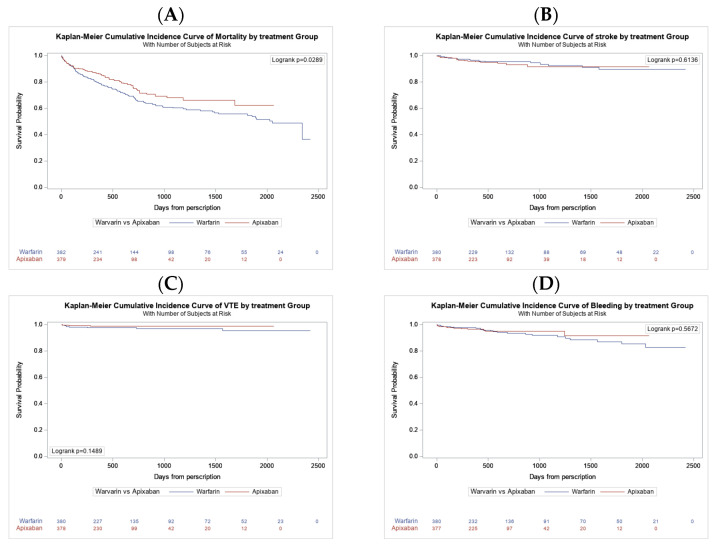
Background/Objectives: The use of direct oral anticoagulants (DOACs) in obese patients is scarcely studied despite having many advantages over warfarin. Consequently, this study aims to assess the real-world safety and effectiveness of apixaban compared to warfarin in treating atrial fibrillation (AF) in obese patients. Methods: A retrospective cohort study examined consecutive AF patients with a BMI of ≥ 30 kg/m2 treated with apixaban or warfarin. Patients were started on these medications between January 2015 and December 2021. Efficacy outcomes included ischemic stroke and venous thromboembolism (VTE) occurrences, while safety outcomes encompassed bleeding incidents and mortality rates. Outcomes were assessed following propensity score matching. Results: We identified 876 patients treated with either apixaban (414) or warfarin (462). Their mean age was 76.9, with a mean CHA2DS2VASc score of 4.9 ± 1.97. After matching and compared to warfarin, apixaban was correlated with a lower incidence of all-cause mortality (19.7% vs. 33.7%, p < 0.001). The incidences of stroke, venous thromboembolism (VTE), and bleeding events were (4.7% vs. 4.7%, p = 1.000), (1.0% vs. 2.6%, p = 0.107), and (3.9% vs. 6.2%, p = 0.139), respectively. Using Cox-regression model, apixaban was associated with lower mortality risk (HR = 0.728, 95% CI: 0.55-0.97; p = 0.030) which remained significant after adjusting for the conventional cardiovascular risk factors and BMI values. Conclusions: Apixaban is associated with a trend of reduced incidence of thromboembolism among obese patients with atrial fibrillation and significantly lowers all-cause mortality. Despite earlier concerns, the use of apixaban is an effective and safe alternative to warfarin among obese patients with AF.
背景/目的:在肥胖患者中使用直接口服抗凝剂(DOACs)的研究很少,尽管与华法林相比有许多优势。因此,本研究旨在评估阿哌沙班与华法林治疗肥胖患者心房颤动(AF)的安全性和有效性。方法:一项回顾性队列研究检查了连续接受阿哌沙班或华法林治疗的BMI≥30 kg/m2的房颤患者。患者在2015年1月至2021年12月期间开始服用这些药物。疗效指标包括缺血性卒中和静脉血栓栓塞(VTE)发生率,而安全性指标包括出血事件和死亡率。根据倾向评分匹配评估结果。结果:我们确定了876例接受阿哌沙班(414例)或华法林(462例)治疗的患者。平均年龄76.9岁,CHA2DS2VASc平均评分4.9±1.97分。与华法林比较后,阿哌沙班与较低的全因死亡率相关(19.7%比33.7%,p < 0.001)。卒中、静脉血栓栓塞(VTE)和出血事件的发生率分别为(4.7% vs. 4.7%, p = 1.000)、(1.0% vs. 2.6%, p = 0.107)和(3.9% vs. 6.2%, p = 0.139)。使用cox回归模型,阿哌沙班与较低的死亡风险相关(HR = 0.728, 95% CI: 0.55-0.97;p = 0.030),在校正常规心血管危险因素和BMI值后,这一差异仍然显著。结论:阿哌沙班与肥胖心房颤动患者血栓栓塞发生率降低的趋势相关,并显著降低全因死亡率。尽管有早期的担忧,阿哌沙班在患有房颤的肥胖患者中是一种有效且安全的华法林替代品。
BiomedicinesBiochemistry, Genetics and Molecular Biology-General Biochemistry,Genetics and Molecular Biology
CiteScore
5.20
自引率
8.50%
发文量
2823
审稿时长
8 weeks
期刊介绍:
Biomedicines (ISSN 2227-9059; CODEN: BIOMID) is an international, scientific, open access journal on biomedicines published quarterly online by MDPI.




 京公网安备 11010802042870号
京ICP备2023020795号-1
京公网安备 11010802042870号
京ICP备2023020795号-1

 分享
分享
 求助内容:
求助内容: 应助结果提醒方式:
 扫码关注我们
