{"title":"From Cardiovascular-Kidney-Metabolic Syndrome to Cardiovascular-Renal-Hepatic-Metabolic Syndrome: Proposing an Expanded Framework.","authors":"Nikolaos Theodorakis, Maria Nikolaou","doi":"10.3390/biom15020213","DOIUrl":null,"url":null,"abstract":"<p><p>Cardiometabolic diseases represent an escalating global health crisis, slowing or even reversing earlier declines in cardiovascular disease (CVD) mortality. Traditionally, conditions such as obesity, type 2 diabetes mellitus (T2DM), atherosclerotic CVD, heart failure (HF), chronic kidney disease (CKD), and metabolic dysfunction-associated steatotic liver disease (MASLD) were managed in isolation. However, emerging evidence reveals that these disorders share overlapping pathophysiological mechanisms and treatment strategies. In 2023, the American Heart Association proposed the Cardiovascular-Kidney-Metabolic (CKM) syndrome, recognizing the interconnected roles of the heart, kidneys, and metabolic system. Yet, this model omits the liver-a critical organ impacted by metabolic dysfunction. MASLD, which can progress to metabolic dysfunction-associated steatohepatitis (MASH), is closely tied to insulin resistance and obesity, contributing directly to cardiovascular and renal impairment. Notably, MASLD is bidirectionally associated with the development and progression of CKM syndrome. As a result, we introduce an expanded framework-the Cardiovascular-Renal-Hepatic-Metabolic (CRHM) syndrome-to more comprehensively capture the broader inter-organ dynamics. We provide guidance for an integrated diagnostic approach aimed at halting progression to advanced stages and preventing further organ damage. In addition, we highlight advances in medical management that target shared pathophysiological pathways, offering benefits across multiple organ systems. Viewing these conditions as an integrated whole, rather than as discrete entities, and incorporating the liver into this framework fosters a more holistic management strategy and offers a promising path to addressing the cardiometabolic pandemic.</p>","PeriodicalId":8943,"journal":{"name":"Biomolecules","volume":"15 2","pages":""},"PeriodicalIF":4.8000,"publicationDate":"2025-02-02","publicationTypes":"Journal Article","fieldsOfStudy":null,"isOpenAccess":false,"openAccessPdf":"https://www.ncbi.nlm.nih.gov/pmc/articles/PMC11853431/pdf/","citationCount":"0","resultStr":null,"platform":"Semanticscholar","paperid":null,"PeriodicalName":"Biomolecules","FirstCategoryId":"99","ListUrlMain":"https://doi.org/10.3390/biom15020213","RegionNum":2,"RegionCategory":"生物学","ArticlePicture":[],"TitleCN":null,"AbstractTextCN":null,"PMCID":null,"EPubDate":"","PubModel":"","JCR":"Q1","JCRName":"BIOCHEMISTRY & MOLECULAR BIOLOGY","Score":null,"Total":0}
引用次数: 0
Abstract
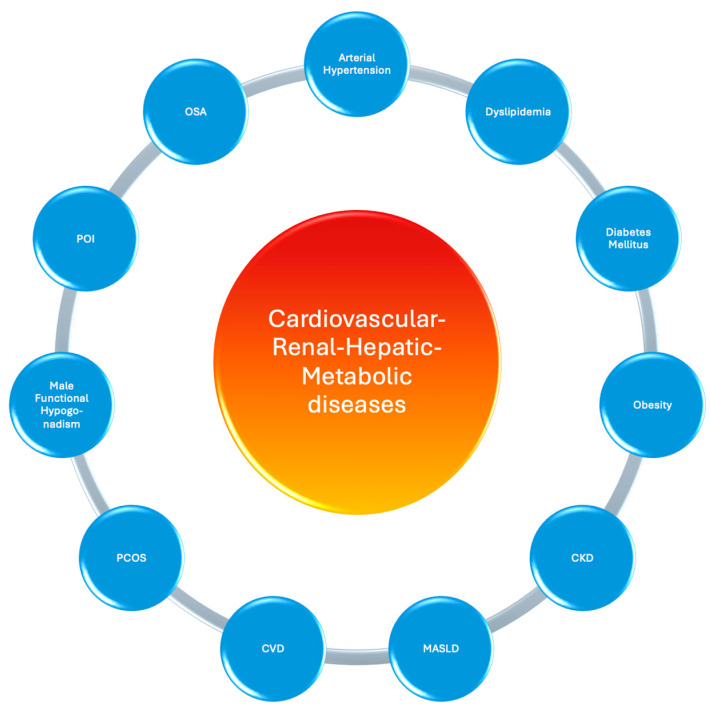
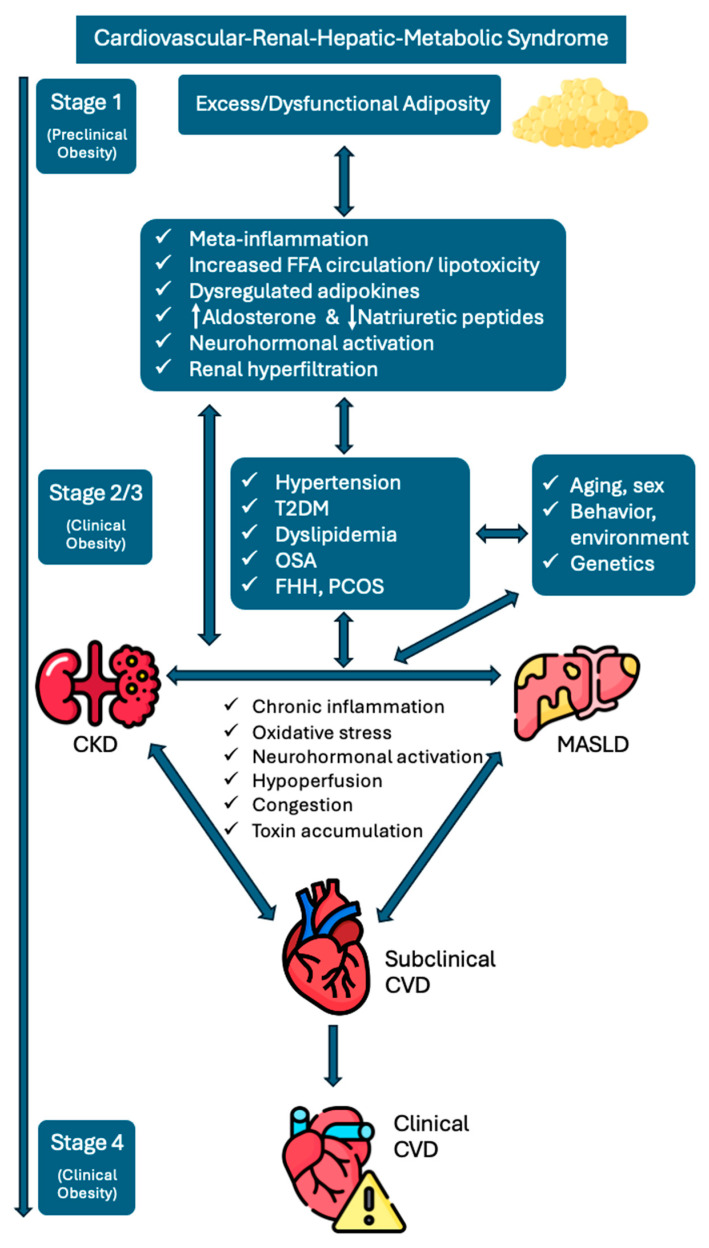
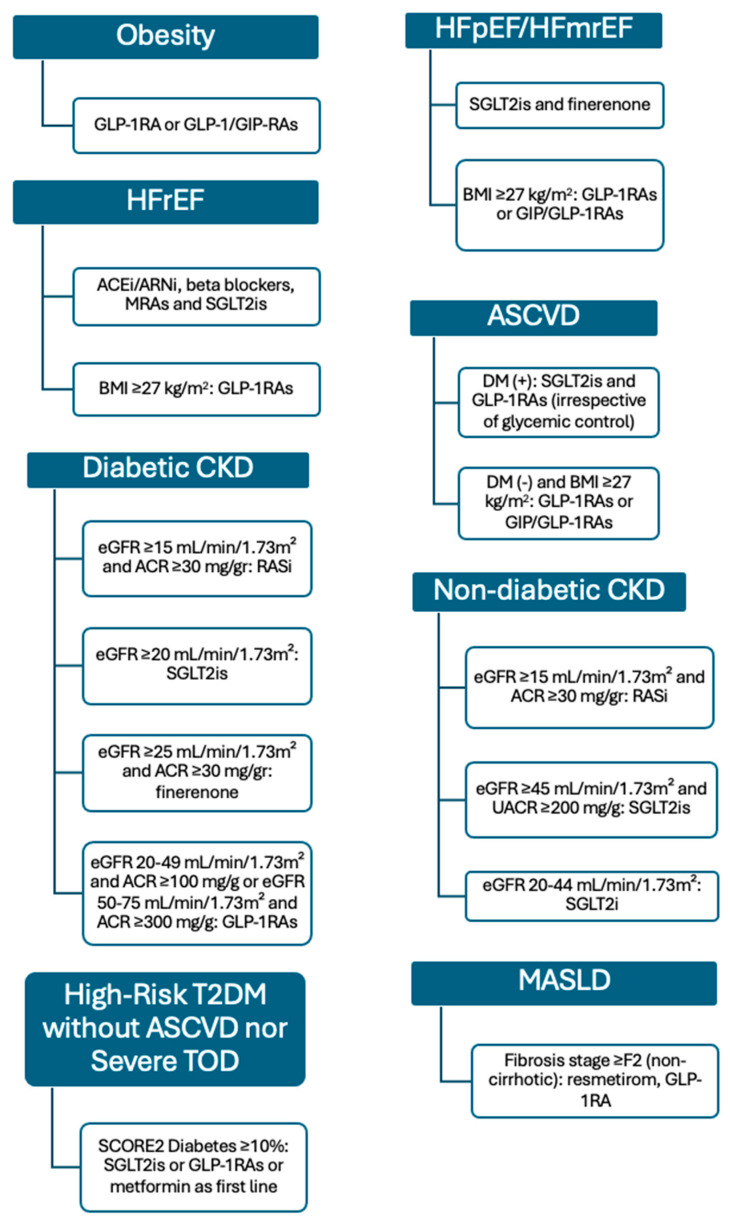
Cardiometabolic diseases represent an escalating global health crisis, slowing or even reversing earlier declines in cardiovascular disease (CVD) mortality. Traditionally, conditions such as obesity, type 2 diabetes mellitus (T2DM), atherosclerotic CVD, heart failure (HF), chronic kidney disease (CKD), and metabolic dysfunction-associated steatotic liver disease (MASLD) were managed in isolation. However, emerging evidence reveals that these disorders share overlapping pathophysiological mechanisms and treatment strategies. In 2023, the American Heart Association proposed the Cardiovascular-Kidney-Metabolic (CKM) syndrome, recognizing the interconnected roles of the heart, kidneys, and metabolic system. Yet, this model omits the liver-a critical organ impacted by metabolic dysfunction. MASLD, which can progress to metabolic dysfunction-associated steatohepatitis (MASH), is closely tied to insulin resistance and obesity, contributing directly to cardiovascular and renal impairment. Notably, MASLD is bidirectionally associated with the development and progression of CKM syndrome. As a result, we introduce an expanded framework-the Cardiovascular-Renal-Hepatic-Metabolic (CRHM) syndrome-to more comprehensively capture the broader inter-organ dynamics. We provide guidance for an integrated diagnostic approach aimed at halting progression to advanced stages and preventing further organ damage. In addition, we highlight advances in medical management that target shared pathophysiological pathways, offering benefits across multiple organ systems. Viewing these conditions as an integrated whole, rather than as discrete entities, and incorporating the liver into this framework fosters a more holistic management strategy and offers a promising path to addressing the cardiometabolic pandemic.
BiomoleculesBiochemistry, Genetics and Molecular Biology-Molecular Biology
CiteScore
9.40
自引率
3.60%
发文量
1640
审稿时长
18.28 days
期刊介绍:
Biomolecules (ISSN 2218-273X) is an international, peer-reviewed open access journal focusing on biogenic substances and their biological functions, structures, interactions with other molecules, and their microenvironment as well as biological systems. Biomolecules publishes reviews, regular research papers and short communications. Our aim is to encourage scientists to publish their experimental and theoretical results in as much detail as possible. There is no restriction on the length of the papers. The full experimental details must be provided so that the results can be reproduced.




 京公网安备 11010802042870号
京ICP备2023020795号-1
京公网安备 11010802042870号
京ICP备2023020795号-1

 分享
分享
 求助内容:
求助内容: 应助结果提醒方式:
 扫码关注我们
