Ramisha Khan, Alyna Turner, Michael Berk, Ken Walder, Susan Rossell, Alexandre A Guerin, Jee Hyun Kim
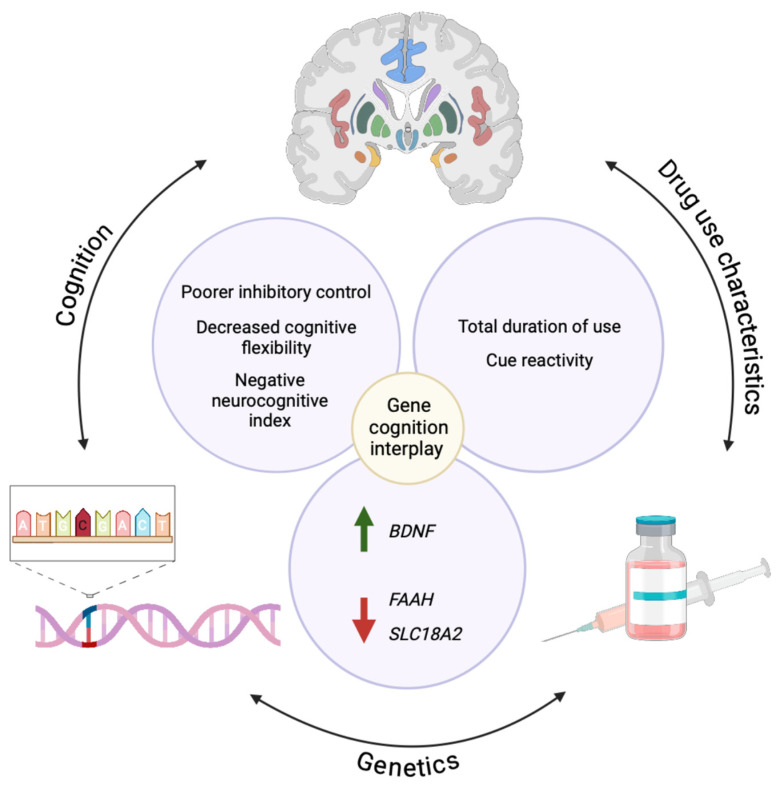
{"title":"Genes, Cognition, and Their Interplay in Methamphetamine Use Disorder.","authors":"Ramisha Khan, Alyna Turner, Michael Berk, Ken Walder, Susan Rossell, Alexandre A Guerin, Jee Hyun Kim","doi":"10.3390/biom15020306","DOIUrl":null,"url":null,"abstract":"<p><p>Methamphetamine use disorder is a pressing global health issue, often accompanied by significant cognitive deficits that impair daily functioning and quality of life and complicate treatment. Emerging evidence highlights the potential role of genetic factors in methamphetamine use disorder, particularly in association with cognitive function. This review examines the key genetic and cognitive dimensions and their interplay in methamphetamine use disorder. There is converging evidence from several studies that genetic polymorphisms in <i>BDNF</i>, <i>FAAH</i>, <i>SLC18A1</i>, and <i>SLC18A2</i> are associated with protection against or susceptibility to the disorder. In addition, people with methamphetamine use disorder consistently displayed impairments in cognitive flexibility and inhibitory control compared with people without the disorder. These cognitive domains were associated with reactivity to methamphetamine cues that were positively correlated with total years of methamphetamine use history. Emerging research also suggests that inhibitory control is negatively correlated with lower blood <i>FAAH</i> mRNA levels, while cognitive flexibility positively correlates with higher blood <i>SLC18A2</i> mRNA levels, highlighting how genetic and cognitive dimensions interact in methamphetamine use disorder. We also include some future directions, emphasizing potential personalized therapeutic strategies that integrate genetic and cognitive insights. By drawing attention to the interplay between genes and cognition, we hope to advance our understanding of methamphetamine use disorder and inform the development of targeted interventions.</p>","PeriodicalId":8943,"journal":{"name":"Biomolecules","volume":"15 2","pages":""},"PeriodicalIF":4.8000,"publicationDate":"2025-02-19","publicationTypes":"Journal Article","fieldsOfStudy":null,"isOpenAccess":false,"openAccessPdf":"https://www.ncbi.nlm.nih.gov/pmc/articles/PMC11852989/pdf/","citationCount":"0","resultStr":null,"platform":"Semanticscholar","paperid":null,"PeriodicalName":"Biomolecules","FirstCategoryId":"99","ListUrlMain":"https://doi.org/10.3390/biom15020306","RegionNum":2,"RegionCategory":"生物学","ArticlePicture":[],"TitleCN":null,"AbstractTextCN":null,"PMCID":null,"EPubDate":"","PubModel":"","JCR":"Q1","JCRName":"BIOCHEMISTRY & MOLECULAR BIOLOGY","Score":null,"Total":0}
引用次数: 0
Abstract
Methamphetamine use disorder is a pressing global health issue, often accompanied by significant cognitive deficits that impair daily functioning and quality of life and complicate treatment. Emerging evidence highlights the potential role of genetic factors in methamphetamine use disorder, particularly in association with cognitive function. This review examines the key genetic and cognitive dimensions and their interplay in methamphetamine use disorder. There is converging evidence from several studies that genetic polymorphisms in BDNF, FAAH, SLC18A1, and SLC18A2 are associated with protection against or susceptibility to the disorder. In addition, people with methamphetamine use disorder consistently displayed impairments in cognitive flexibility and inhibitory control compared with people without the disorder. These cognitive domains were associated with reactivity to methamphetamine cues that were positively correlated with total years of methamphetamine use history. Emerging research also suggests that inhibitory control is negatively correlated with lower blood FAAH mRNA levels, while cognitive flexibility positively correlates with higher blood SLC18A2 mRNA levels, highlighting how genetic and cognitive dimensions interact in methamphetamine use disorder. We also include some future directions, emphasizing potential personalized therapeutic strategies that integrate genetic and cognitive insights. By drawing attention to the interplay between genes and cognition, we hope to advance our understanding of methamphetamine use disorder and inform the development of targeted interventions.
BiomoleculesBiochemistry, Genetics and Molecular Biology-Molecular Biology
CiteScore
9.40
自引率
3.60%
发文量
1640
审稿时长
18.28 days
期刊介绍:
Biomolecules (ISSN 2218-273X) is an international, peer-reviewed open access journal focusing on biogenic substances and their biological functions, structures, interactions with other molecules, and their microenvironment as well as biological systems. Biomolecules publishes reviews, regular research papers and short communications. Our aim is to encourage scientists to publish their experimental and theoretical results in as much detail as possible. There is no restriction on the length of the papers. The full experimental details must be provided so that the results can be reproduced.





 京公网安备 11010802042870号
京ICP备2023020795号-1
京公网安备 11010802042870号
京ICP备2023020795号-1

 分享
分享
 求助内容:
求助内容: 应助结果提醒方式:
 扫码关注我们
