A Neuroprotective Peptide Modulates Retinal cAMP Response Element-Binding Protein (CREB), Synapsin I (SYN1), and Growth-Associated Protein 43 (GAP43) in Rats with Silicone Oil-Induced Ocular Hypertension.
Gretchen A Johnson, Raghu R Krishnamoorthy, Ram H Nagaraj, Dorota L Stankowska
{"title":"A Neuroprotective Peptide Modulates Retinal cAMP Response Element-Binding Protein (CREB), Synapsin I (SYN1), and Growth-Associated Protein 43 (GAP43) in Rats with Silicone Oil-Induced Ocular Hypertension.","authors":"Gretchen A Johnson, Raghu R Krishnamoorthy, Ram H Nagaraj, Dorota L Stankowska","doi":"10.3390/biom15020219","DOIUrl":null,"url":null,"abstract":"<p><p>This study evaluated the neuroprotective potential of peptain-1 conjugated to a cell-penetrating peptide (CPP-P1) in an ocular hypertension model of glaucoma. Brown Norway (BN) rats were subjected to intraocular pressure (IOP) elevation via intracameral injection of silicone oil (SO), with concurrent intravitreal injections of either CPP-P1 or a vehicle. Retinal cross-sections were analyzed for markers of neuroprotection, including cAMP response element-binding protein (CREB), phosphorylated CREB (p-CREB), growth-associated protein-43 (GAP43), synapsin-1 (SYN1), and superoxide dismutase 2 (SOD2). Hematoxylin and eosin staining was used to assess retinal-layer thickness. SO-treated rats exhibited significant reductions in the thickness of the inner nuclear layer (INL, 41%, <i>p</i> = 0.016), inner plexiform layer (IPL, 52%, <i>p</i> = 0.0002), and ganglion cell layer (GCL, 57%, <i>p</i> = 0.001). CPP-P1 treatment mitigated these reductions, preserving INL thickness by 32% (<i>p</i> = 0.059), IPL by 19% (<i>p</i> = 0.119), and GCL by 31% (<i>p</i> = 0.057). Increased levels of CREB (<i>p</i> = 0.17) and p-CREB (<i>p</i> = 0.04) were observed in IOP-elevated, CPP-P1-treated retinas compared to IOP-elevated, vehicle-treated retinas. Although overall GAP43 levels were low, there was a modest increase in expression within the IPL and GCL in SO- and CPP-P1-treated retinas (<i>p</i> = 0.15 and <i>p</i> = 0.09, respectively) compared to SO- and vehicle-treated retinas. SO injection reduced SYN1 expression in both IPL and GCL (<i>p</i> = 0.01), whereas CPP-P1 treatment significantly increased SYN1 levels in the IPL (<i>p</i> = 0.03) and GCL (<i>p</i> = 0.002). While SOD2 expression in the GCL was minimal across all groups, a trend toward increased expression was observed in CPP-P1-treated animals (<i>p</i> = 0.16). The SO model was replicated with SO removal after 7 days and monitored for 21 days followed by retinal flat-mount preparation to assess retinal ganglion cell (RGC) survival. A 42% loss in RGCs (<i>p</i> = 0.009) was observed in SO-injected eyes, which were reduced by approximately 37% (<i>p</i> = 0.03) with CPP-P1 treatment. These findings suggest that CPP-P1 is a promising neuroprotective agent that promotes retinal ganglion cell survival and the preservation of other retinal neurons, potentially through enhanced CREB signaling in a rat model of SO-induced ocular hypertension.</p>","PeriodicalId":8943,"journal":{"name":"Biomolecules","volume":"15 2","pages":""},"PeriodicalIF":4.8000,"publicationDate":"2025-02-03","publicationTypes":"Journal Article","fieldsOfStudy":null,"isOpenAccess":false,"openAccessPdf":"https://www.ncbi.nlm.nih.gov/pmc/articles/PMC11852426/pdf/","citationCount":"0","resultStr":null,"platform":"Semanticscholar","paperid":null,"PeriodicalName":"Biomolecules","FirstCategoryId":"99","ListUrlMain":"https://doi.org/10.3390/biom15020219","RegionNum":2,"RegionCategory":"生物学","ArticlePicture":[],"TitleCN":null,"AbstractTextCN":null,"PMCID":null,"EPubDate":"","PubModel":"","JCR":"Q1","JCRName":"BIOCHEMISTRY & MOLECULAR BIOLOGY","Score":null,"Total":0}
引用次数: 0
Abstract
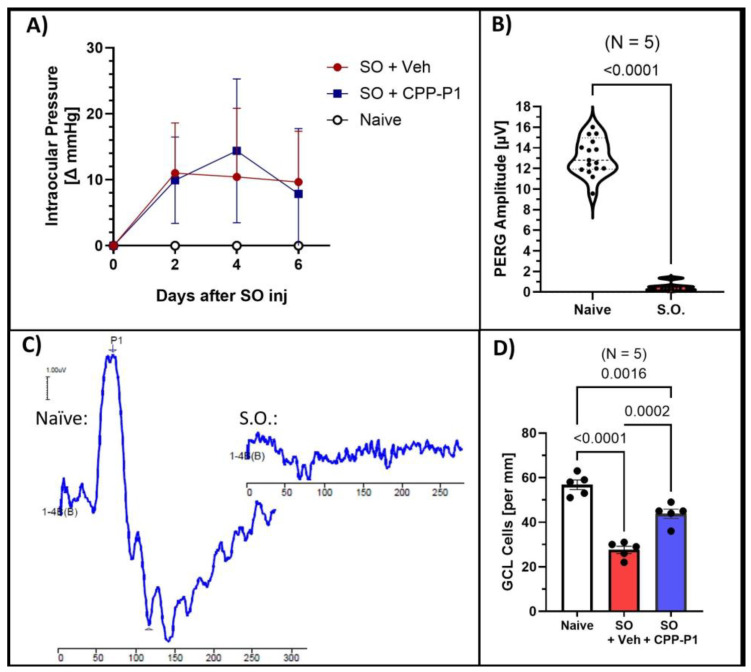
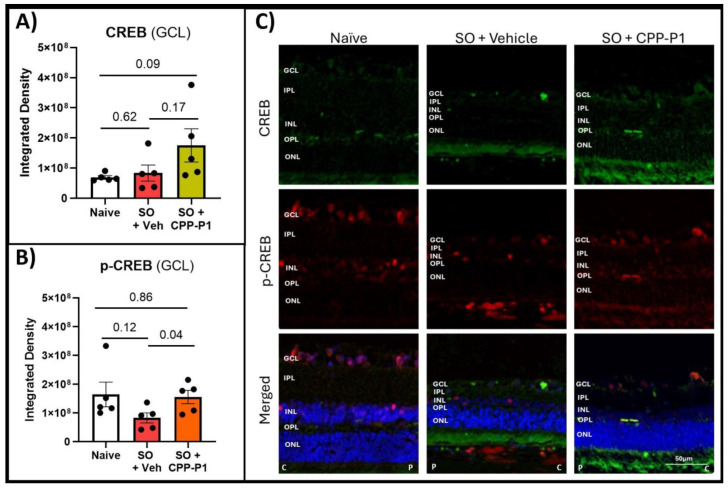
This study evaluated the neuroprotective potential of peptain-1 conjugated to a cell-penetrating peptide (CPP-P1) in an ocular hypertension model of glaucoma. Brown Norway (BN) rats were subjected to intraocular pressure (IOP) elevation via intracameral injection of silicone oil (SO), with concurrent intravitreal injections of either CPP-P1 or a vehicle. Retinal cross-sections were analyzed for markers of neuroprotection, including cAMP response element-binding protein (CREB), phosphorylated CREB (p-CREB), growth-associated protein-43 (GAP43), synapsin-1 (SYN1), and superoxide dismutase 2 (SOD2). Hematoxylin and eosin staining was used to assess retinal-layer thickness. SO-treated rats exhibited significant reductions in the thickness of the inner nuclear layer (INL, 41%, p = 0.016), inner plexiform layer (IPL, 52%, p = 0.0002), and ganglion cell layer (GCL, 57%, p = 0.001). CPP-P1 treatment mitigated these reductions, preserving INL thickness by 32% (p = 0.059), IPL by 19% (p = 0.119), and GCL by 31% (p = 0.057). Increased levels of CREB (p = 0.17) and p-CREB (p = 0.04) were observed in IOP-elevated, CPP-P1-treated retinas compared to IOP-elevated, vehicle-treated retinas. Although overall GAP43 levels were low, there was a modest increase in expression within the IPL and GCL in SO- and CPP-P1-treated retinas (p = 0.15 and p = 0.09, respectively) compared to SO- and vehicle-treated retinas. SO injection reduced SYN1 expression in both IPL and GCL (p = 0.01), whereas CPP-P1 treatment significantly increased SYN1 levels in the IPL (p = 0.03) and GCL (p = 0.002). While SOD2 expression in the GCL was minimal across all groups, a trend toward increased expression was observed in CPP-P1-treated animals (p = 0.16). The SO model was replicated with SO removal after 7 days and monitored for 21 days followed by retinal flat-mount preparation to assess retinal ganglion cell (RGC) survival. A 42% loss in RGCs (p = 0.009) was observed in SO-injected eyes, which were reduced by approximately 37% (p = 0.03) with CPP-P1 treatment. These findings suggest that CPP-P1 is a promising neuroprotective agent that promotes retinal ganglion cell survival and the preservation of other retinal neurons, potentially through enhanced CREB signaling in a rat model of SO-induced ocular hypertension.
BiomoleculesBiochemistry, Genetics and Molecular Biology-Molecular Biology
CiteScore
9.40
自引率
3.60%
发文量
1640
审稿时长
18.28 days
期刊介绍:
Biomolecules (ISSN 2218-273X) is an international, peer-reviewed open access journal focusing on biogenic substances and their biological functions, structures, interactions with other molecules, and their microenvironment as well as biological systems. Biomolecules publishes reviews, regular research papers and short communications. Our aim is to encourage scientists to publish their experimental and theoretical results in as much detail as possible. There is no restriction on the length of the papers. The full experimental details must be provided so that the results can be reproduced.





 京公网安备 11010802042870号
京ICP备2023020795号-1
京公网安备 11010802042870号
京ICP备2023020795号-1

 分享
分享
 求助内容:
求助内容: 应助结果提醒方式:
 扫码关注我们
