Shuang-Qing Lv, Xin Zeng, Guang-Peng Su, Wen-Feng Du, Yi Li, Meng-Liang Wen
{"title":"Improving Identification of Drug-Target Binding Sites Based on Structures of Targets Using Residual Graph Transformer Network.","authors":"Shuang-Qing Lv, Xin Zeng, Guang-Peng Su, Wen-Feng Du, Yi Li, Meng-Liang Wen","doi":"10.3390/biom15020221","DOIUrl":null,"url":null,"abstract":"<p><p>Improving identification of drug-target binding sites can significantly aid in drug screening and design, thereby accelerating the drug development process. However, due to challenges such as insufficient fusion of multimodal information from targets and imbalanced datasets, enhancing the performance of drug-target binding sites prediction models remains exceptionally difficult. Leveraging structures of targets, we proposed a novel deep learning framework, RGTsite, which employed a Residual Graph Transformer Network to improve the identification of drug-target binding sites. First, a residual 1D convolutional neural network (1D-CNN) and the pre-trained model ProtT5 were employed to extract the local and global sequence features from the target, respectively. These features were then combined with the physicochemical properties of amino acid residues to serve as the vertex features in graph. Next, the edge features were incorporated, and the residual graph transformer network (GTN) was applied to extract the more comprehensive vertex features. Finally, a fully connected network was used to classify whether the vertex was a binding site. Experimental results showed that RGTsite outperformed the existing state-of-the-art methods in key evaluation metrics, such as F1-score (F1) and Matthews Correlation Coefficient (MCC), across multiple benchmark datasets. Additionally, we conducted interpretability analysis for RGTsite through the real-world cases, and the results confirmed that RGTsite can effectively identify drug-target binding sites in practical applications.</p>","PeriodicalId":8943,"journal":{"name":"Biomolecules","volume":"15 2","pages":""},"PeriodicalIF":4.8000,"publicationDate":"2025-02-03","publicationTypes":"Journal Article","fieldsOfStudy":null,"isOpenAccess":false,"openAccessPdf":"https://www.ncbi.nlm.nih.gov/pmc/articles/PMC11853427/pdf/","citationCount":"0","resultStr":null,"platform":"Semanticscholar","paperid":null,"PeriodicalName":"Biomolecules","FirstCategoryId":"99","ListUrlMain":"https://doi.org/10.3390/biom15020221","RegionNum":2,"RegionCategory":"生物学","ArticlePicture":[],"TitleCN":null,"AbstractTextCN":null,"PMCID":null,"EPubDate":"","PubModel":"","JCR":"Q1","JCRName":"BIOCHEMISTRY & MOLECULAR BIOLOGY","Score":null,"Total":0}
引用次数: 0
Abstract
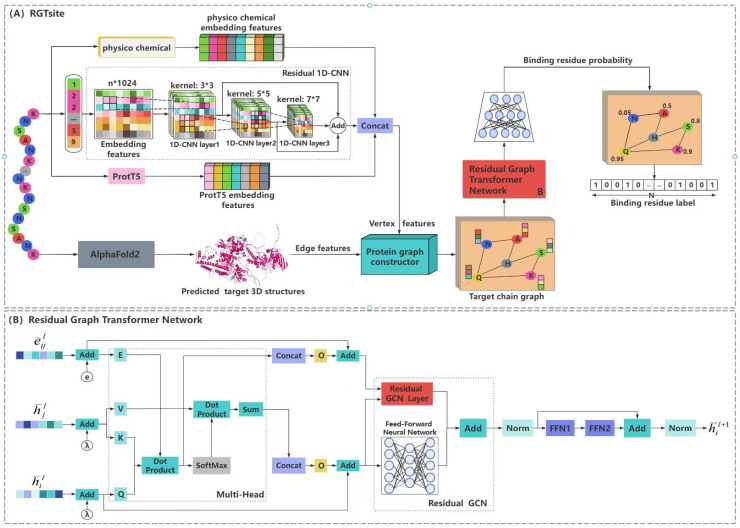
Improving identification of drug-target binding sites can significantly aid in drug screening and design, thereby accelerating the drug development process. However, due to challenges such as insufficient fusion of multimodal information from targets and imbalanced datasets, enhancing the performance of drug-target binding sites prediction models remains exceptionally difficult. Leveraging structures of targets, we proposed a novel deep learning framework, RGTsite, which employed a Residual Graph Transformer Network to improve the identification of drug-target binding sites. First, a residual 1D convolutional neural network (1D-CNN) and the pre-trained model ProtT5 were employed to extract the local and global sequence features from the target, respectively. These features were then combined with the physicochemical properties of amino acid residues to serve as the vertex features in graph. Next, the edge features were incorporated, and the residual graph transformer network (GTN) was applied to extract the more comprehensive vertex features. Finally, a fully connected network was used to classify whether the vertex was a binding site. Experimental results showed that RGTsite outperformed the existing state-of-the-art methods in key evaluation metrics, such as F1-score (F1) and Matthews Correlation Coefficient (MCC), across multiple benchmark datasets. Additionally, we conducted interpretability analysis for RGTsite through the real-world cases, and the results confirmed that RGTsite can effectively identify drug-target binding sites in practical applications.
BiomoleculesBiochemistry, Genetics and Molecular Biology-Molecular Biology
CiteScore
9.40
自引率
3.60%
发文量
1640
审稿时长
18.28 days
期刊介绍:
Biomolecules (ISSN 2218-273X) is an international, peer-reviewed open access journal focusing on biogenic substances and their biological functions, structures, interactions with other molecules, and their microenvironment as well as biological systems. Biomolecules publishes reviews, regular research papers and short communications. Our aim is to encourage scientists to publish their experimental and theoretical results in as much detail as possible. There is no restriction on the length of the papers. The full experimental details must be provided so that the results can be reproduced.



 京公网安备 11010802042870号
京ICP备2023020795号-1
京公网安备 11010802042870号
京ICP备2023020795号-1

 分享
分享
 求助内容:
求助内容: 应助结果提醒方式:
 扫码关注我们
