Exploring Motor-Cognitive Interference Effects and the Influence of Self-Reported Physical Activity on Dual-Task Walking in Parkinson's Disease and Healthy Older Adults.
Thomas Jürgen Klotzbier, Nadja Schott, Soo-Yong Park, Quincy J Almeida
{"title":"Exploring Motor-Cognitive Interference Effects and the Influence of Self-Reported Physical Activity on Dual-Task Walking in Parkinson's Disease and Healthy Older Adults.","authors":"Thomas Jürgen Klotzbier, Nadja Schott, Soo-Yong Park, Quincy J Almeida","doi":"10.3390/brainsci15020114","DOIUrl":null,"url":null,"abstract":"<p><p><b>Introduction:</b> Parkinson's disease (PD) is characterized by motor and cognitive impairments that often manifest as distinct motor subtypes: Postural Instability Gait Difficulty (PIGD) and Tremor-Dominant (TD). Motor-cognitive interference, especially under dual-task (DT) walking conditions, may vary by subtype, providing insights into specific impairments. This study explored DT interference effects in PD subtypes, focusing on the potential impact of self-reported physical activity, which may help mitigate subtype-specific impairments and improve motor-cognitive function. <b>Methods:</b> PD patients classified as PIGD or TD and healthy controls completed single-task (ST) and DT walking assessments involving different cognitive tasks (Serial Subtraction, Auditory Stroop, and Clock Task). Physical activity levels were evaluated using the CHAMPS questionnaire, analyzing the self-reported frequency and duration of weekly exercise-related activities. <b>Results:</b> Interference effects were significantly different between PD patients and controls, with the PIGD group showing greater motor impairment under high cognitive load, primarily affecting gait, than the TD and control groups. Performance differences between groups diminished as cognitive load increased. Self-reported physical activity does not significantly moderate motor performance under DT conditions, suggesting that activity levels in this sample are insufficient to offset motor-cognitive interference. However, like group affiliation, physical activity directly influences motor performance during DT conditions, indicating that both factors independently impact motor-cognitive function in PD. <b>Discussion:</b> These findings suggest that DT assessments help differentiate PD motor subtypes, as group differences were minimal in ST conditions. While physical activity is associated with general improvements in motor ST and DT performance in PD and controls, the lack of a significant moderating effect from self-reported exercise-related physical activity indicates that current activity levels may not be high enough to counter motor-cognitive interference. More intensive or DT-specific exercise may be required to reduce interference effects. Future research should examine the role of structured physical activity programs, potentially incorporating DT training, to evaluate their impact on motor-cognitive interference in PD.</p>","PeriodicalId":9095,"journal":{"name":"Brain Sciences","volume":"15 2","pages":""},"PeriodicalIF":2.8000,"publicationDate":"2025-01-25","publicationTypes":"Journal Article","fieldsOfStudy":null,"isOpenAccess":false,"openAccessPdf":"https://www.ncbi.nlm.nih.gov/pmc/articles/PMC11853502/pdf/","citationCount":"0","resultStr":null,"platform":"Semanticscholar","paperid":null,"PeriodicalName":"Brain Sciences","FirstCategoryId":"3","ListUrlMain":"https://doi.org/10.3390/brainsci15020114","RegionNum":3,"RegionCategory":"医学","ArticlePicture":[],"TitleCN":null,"AbstractTextCN":null,"PMCID":null,"EPubDate":"","PubModel":"","JCR":"Q3","JCRName":"NEUROSCIENCES","Score":null,"Total":0}
引用次数: 0
Abstract
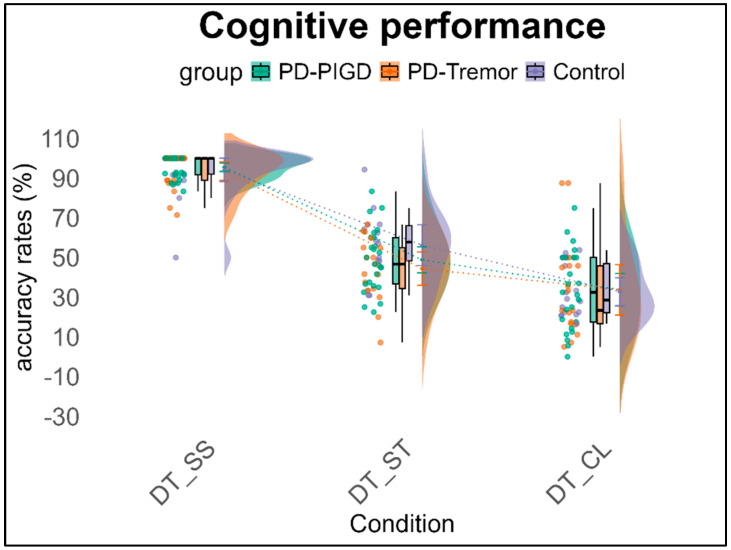
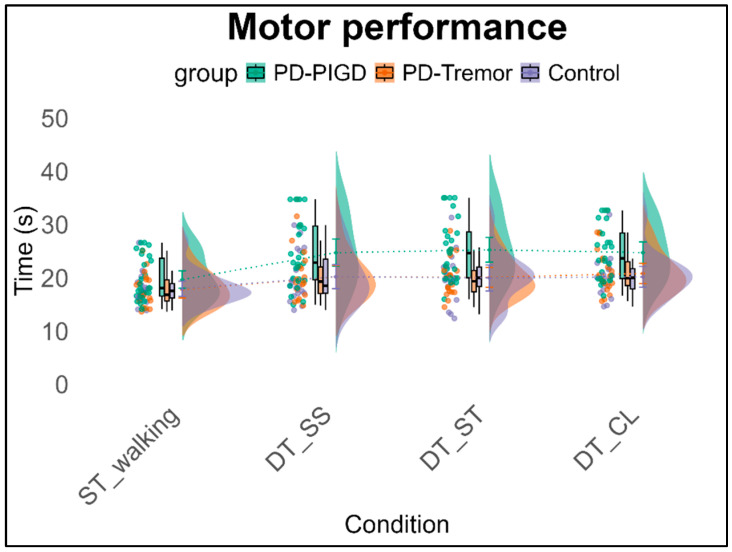
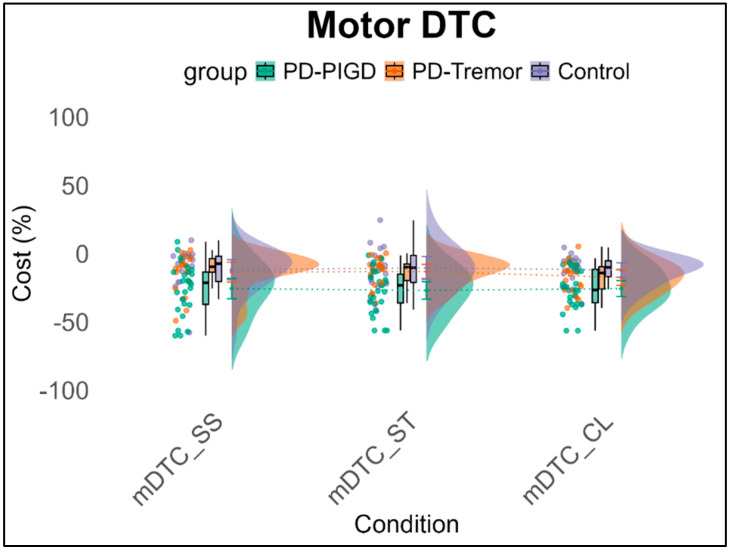
Introduction: Parkinson's disease (PD) is characterized by motor and cognitive impairments that often manifest as distinct motor subtypes: Postural Instability Gait Difficulty (PIGD) and Tremor-Dominant (TD). Motor-cognitive interference, especially under dual-task (DT) walking conditions, may vary by subtype, providing insights into specific impairments. This study explored DT interference effects in PD subtypes, focusing on the potential impact of self-reported physical activity, which may help mitigate subtype-specific impairments and improve motor-cognitive function. Methods: PD patients classified as PIGD or TD and healthy controls completed single-task (ST) and DT walking assessments involving different cognitive tasks (Serial Subtraction, Auditory Stroop, and Clock Task). Physical activity levels were evaluated using the CHAMPS questionnaire, analyzing the self-reported frequency and duration of weekly exercise-related activities. Results: Interference effects were significantly different between PD patients and controls, with the PIGD group showing greater motor impairment under high cognitive load, primarily affecting gait, than the TD and control groups. Performance differences between groups diminished as cognitive load increased. Self-reported physical activity does not significantly moderate motor performance under DT conditions, suggesting that activity levels in this sample are insufficient to offset motor-cognitive interference. However, like group affiliation, physical activity directly influences motor performance during DT conditions, indicating that both factors independently impact motor-cognitive function in PD. Discussion: These findings suggest that DT assessments help differentiate PD motor subtypes, as group differences were minimal in ST conditions. While physical activity is associated with general improvements in motor ST and DT performance in PD and controls, the lack of a significant moderating effect from self-reported exercise-related physical activity indicates that current activity levels may not be high enough to counter motor-cognitive interference. More intensive or DT-specific exercise may be required to reduce interference effects. Future research should examine the role of structured physical activity programs, potentially incorporating DT training, to evaluate their impact on motor-cognitive interference in PD.
期刊介绍:
Brain Sciences (ISSN 2076-3425) is a peer-reviewed scientific journal that publishes original articles, critical reviews, research notes and short communications in the areas of cognitive neuroscience, developmental neuroscience, molecular and cellular neuroscience, neural engineering, neuroimaging, neurolinguistics, neuropathy, systems neuroscience, and theoretical and computational neuroscience. Our aim is to encourage scientists to publish their experimental and theoretical results in as much detail as possible. There is no restriction on the length of the papers. The full experimental details must be provided so that the results can be reproduced. Electronic files or software regarding the full details of the calculation and experimental procedure, if unable to be published in a normal way, can be deposited as supplementary material.



 京公网安备 11010802042870号
京ICP备2023020795号-1
京公网安备 11010802042870号
京ICP备2023020795号-1

 分享
分享
 求助内容:
求助内容: 应助结果提醒方式:
 扫码关注我们
