Understanding Pediatric Bipolar Disorder Through the Investigation of Clinical, Neuroanatomic, Neurophysiological and Neurocognitive Dimensions: A Pilot Study.
Alessio Simonetti, Evelina Bernardi, Sherin Kurian, Antonio Restaino, Claudia Calderoni, Emanuela De Chiara, Francesca Bardi, Gabriele Sani, Jair C Soares, Kirti Saxena
{"title":"Understanding Pediatric Bipolar Disorder Through the Investigation of Clinical, Neuroanatomic, Neurophysiological and Neurocognitive Dimensions: A Pilot Study.","authors":"Alessio Simonetti, Evelina Bernardi, Sherin Kurian, Antonio Restaino, Claudia Calderoni, Emanuela De Chiara, Francesca Bardi, Gabriele Sani, Jair C Soares, Kirti Saxena","doi":"10.3390/brainsci15020152","DOIUrl":null,"url":null,"abstract":"<p><p><b>Background</b>: Pathophysiological models of pediatric bipolar disorder (PBD) are lacking. Multimodal approaches may provide a comprehensive description of the complex relationship between the brain and behavior. <b>Aim</b>: To assess behavioral, neuropsychological, neurophysiological, and neuroanatomical alterations in youth with PBD. <b>Methods</b>: Subjects with PBD (n = 23) and healthy controls (HCs, n = 23) underwent (a) clinical assessments encompassing the severity of psychiatric symptoms, (b) neuropsychological evaluation, (c) analyses of event-related potentials (related to the passive viewing of fearful, neutral, and happy faces during electroencephalography recording, and (d) cortical thickness and deep gray matter volume measurement using magnetic resonance imaging. Canonical correlation analyses were used to assess the relationships between these dimensions. <b>Results</b>: Youth with PBD had higher levels of anxiety (<i>p</i> < 0.001) and borderline personality features (<i>p</i> < 0.001), greater commission errors for negative stimuli (<i>p</i> = 0.003), delayed deliberation time (<i>p</i> < 0.001), and smaller risk adjustment scores (<i>p</i> = 0.002) than HCs. Furthermore, they showed cortical thinning in the frontal, parietal, and occipital areas (all <i>p</i> < 0.001) and greater P300 for happy faces (<i>p</i> = 0.29). In youth with PBD, cortical thickening and P300 amplitude positively correlated with more commission errors for negative stimuli, longer deliberation times, reduced risk adjustment, higher levels of panic and separation anxiety, and greater levels of negative relationships, whereas they negatively correlated with levels of depression (overall loadings > or <0.3). <b>Limitations:</b> Small sample size, cross-sectional design, and limited variables investigated. <b>Conclusions</b>: This preliminary work showed that multimodal assessment might be a viable tool for providing a pathophysiological model that unifies brain and behavioral alterations in youth with PBD.</p>","PeriodicalId":9095,"journal":{"name":"Brain Sciences","volume":"15 2","pages":""},"PeriodicalIF":2.8000,"publicationDate":"2025-02-03","publicationTypes":"Journal Article","fieldsOfStudy":null,"isOpenAccess":false,"openAccessPdf":"https://www.ncbi.nlm.nih.gov/pmc/articles/PMC11853575/pdf/","citationCount":"0","resultStr":null,"platform":"Semanticscholar","paperid":null,"PeriodicalName":"Brain Sciences","FirstCategoryId":"3","ListUrlMain":"https://doi.org/10.3390/brainsci15020152","RegionNum":3,"RegionCategory":"医学","ArticlePicture":[],"TitleCN":null,"AbstractTextCN":null,"PMCID":null,"EPubDate":"","PubModel":"","JCR":"Q3","JCRName":"NEUROSCIENCES","Score":null,"Total":0}
引用次数: 0
Abstract
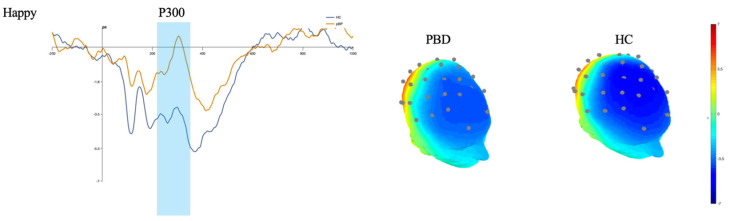
Background: Pathophysiological models of pediatric bipolar disorder (PBD) are lacking. Multimodal approaches may provide a comprehensive description of the complex relationship between the brain and behavior. Aim: To assess behavioral, neuropsychological, neurophysiological, and neuroanatomical alterations in youth with PBD. Methods: Subjects with PBD (n = 23) and healthy controls (HCs, n = 23) underwent (a) clinical assessments encompassing the severity of psychiatric symptoms, (b) neuropsychological evaluation, (c) analyses of event-related potentials (related to the passive viewing of fearful, neutral, and happy faces during electroencephalography recording, and (d) cortical thickness and deep gray matter volume measurement using magnetic resonance imaging. Canonical correlation analyses were used to assess the relationships between these dimensions. Results: Youth with PBD had higher levels of anxiety (p < 0.001) and borderline personality features (p < 0.001), greater commission errors for negative stimuli (p = 0.003), delayed deliberation time (p < 0.001), and smaller risk adjustment scores (p = 0.002) than HCs. Furthermore, they showed cortical thinning in the frontal, parietal, and occipital areas (all p < 0.001) and greater P300 for happy faces (p = 0.29). In youth with PBD, cortical thickening and P300 amplitude positively correlated with more commission errors for negative stimuli, longer deliberation times, reduced risk adjustment, higher levels of panic and separation anxiety, and greater levels of negative relationships, whereas they negatively correlated with levels of depression (overall loadings > or <0.3). Limitations: Small sample size, cross-sectional design, and limited variables investigated. Conclusions: This preliminary work showed that multimodal assessment might be a viable tool for providing a pathophysiological model that unifies brain and behavioral alterations in youth with PBD.
期刊介绍:
Brain Sciences (ISSN 2076-3425) is a peer-reviewed scientific journal that publishes original articles, critical reviews, research notes and short communications in the areas of cognitive neuroscience, developmental neuroscience, molecular and cellular neuroscience, neural engineering, neuroimaging, neurolinguistics, neuropathy, systems neuroscience, and theoretical and computational neuroscience. Our aim is to encourage scientists to publish their experimental and theoretical results in as much detail as possible. There is no restriction on the length of the papers. The full experimental details must be provided so that the results can be reproduced. Electronic files or software regarding the full details of the calculation and experimental procedure, if unable to be published in a normal way, can be deposited as supplementary material.





 京公网安备 11010802042870号
京ICP备2023020795号-1
京公网安备 11010802042870号
京ICP备2023020795号-1

 分享
分享
 求助内容:
求助内容: 应助结果提醒方式:
 扫码关注我们
