Jaime Raymond, Ileana M Howard, Jasmine Berry, Theodore Larson, D Kevin Horton, Paul Mehta
{"title":"Head Injury and Amyotrophic Lateral Sclerosis: Population-Based Study from the National ALS Registry.","authors":"Jaime Raymond, Ileana M Howard, Jasmine Berry, Theodore Larson, D Kevin Horton, Paul Mehta","doi":"10.3390/brainsci15020143","DOIUrl":null,"url":null,"abstract":"<p><p><b>Background/Objectives:</b> To examine if head injury (HI) is associated with age at ALS diagnosis in the United States. <b>Methods:</b> In this cross-sectional populationf-based analysis, we identified patients with ALS who were registered from 2015 to 2023 who completed the Registry's head trauma survey module. The association between HI and age at ALS diagnosis was assessed using multivariate analysis. <b>Results:</b> Of the 3424 respondents, 56.6% had experienced a HI. The adjusted odds ratio (aOR) for an ALS diagnosis before age 60 years for patients with a HI was 1.24 (95% CI, 1.07-1.45). One or two HIs had an aOR of 1.15 (95% CI, 0.97-1.36), and five or more HIs had an aOR of 1.58 (95% CI, 1.19-2.09). HI before age 18 years yielded an aOR of 2.03 (95% CI, 1.53-2.70) as well as HI between the ages of 18 and 30 years (aOR = 1.48, 95% CI: 1.06-2.06)). When narrowing the analysis to patients with HI before age 18 compared with patients with no HI, we found an association with HI that led to an emergency department or hospital visit (aOR = 1.50 (95% CI: 1.21-1.86)). <b>Conclusions:</b> In this cross-sectional analysis of ALS patients, HIs occurring in childhood and early adulthood and the number of HIs increased the odds of being diagnosed before age 60 years. These results suggest that HI continues to be a risk factor for ALS and could be associated with a younger age of diagnosis.</p>","PeriodicalId":9095,"journal":{"name":"Brain Sciences","volume":"15 2","pages":""},"PeriodicalIF":2.8000,"publicationDate":"2025-01-31","publicationTypes":"Journal Article","fieldsOfStudy":null,"isOpenAccess":false,"openAccessPdf":"https://www.ncbi.nlm.nih.gov/pmc/articles/PMC11852576/pdf/","citationCount":"0","resultStr":null,"platform":"Semanticscholar","paperid":null,"PeriodicalName":"Brain Sciences","FirstCategoryId":"3","ListUrlMain":"https://doi.org/10.3390/brainsci15020143","RegionNum":3,"RegionCategory":"医学","ArticlePicture":[],"TitleCN":null,"AbstractTextCN":null,"PMCID":null,"EPubDate":"","PubModel":"","JCR":"Q3","JCRName":"NEUROSCIENCES","Score":null,"Total":0}
引用次数: 0
Abstract
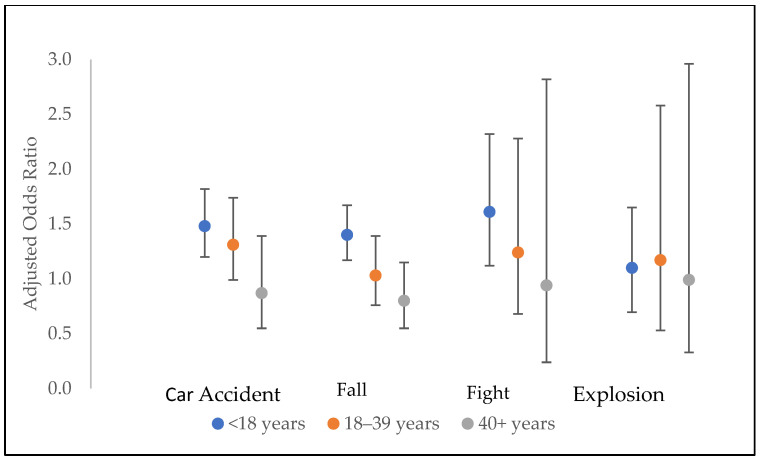
Background/Objectives: To examine if head injury (HI) is associated with age at ALS diagnosis in the United States. Methods: In this cross-sectional populationf-based analysis, we identified patients with ALS who were registered from 2015 to 2023 who completed the Registry's head trauma survey module. The association between HI and age at ALS diagnosis was assessed using multivariate analysis. Results: Of the 3424 respondents, 56.6% had experienced a HI. The adjusted odds ratio (aOR) for an ALS diagnosis before age 60 years for patients with a HI was 1.24 (95% CI, 1.07-1.45). One or two HIs had an aOR of 1.15 (95% CI, 0.97-1.36), and five or more HIs had an aOR of 1.58 (95% CI, 1.19-2.09). HI before age 18 years yielded an aOR of 2.03 (95% CI, 1.53-2.70) as well as HI between the ages of 18 and 30 years (aOR = 1.48, 95% CI: 1.06-2.06)). When narrowing the analysis to patients with HI before age 18 compared with patients with no HI, we found an association with HI that led to an emergency department or hospital visit (aOR = 1.50 (95% CI: 1.21-1.86)). Conclusions: In this cross-sectional analysis of ALS patients, HIs occurring in childhood and early adulthood and the number of HIs increased the odds of being diagnosed before age 60 years. These results suggest that HI continues to be a risk factor for ALS and could be associated with a younger age of diagnosis.
期刊介绍:
Brain Sciences (ISSN 2076-3425) is a peer-reviewed scientific journal that publishes original articles, critical reviews, research notes and short communications in the areas of cognitive neuroscience, developmental neuroscience, molecular and cellular neuroscience, neural engineering, neuroimaging, neurolinguistics, neuropathy, systems neuroscience, and theoretical and computational neuroscience. Our aim is to encourage scientists to publish their experimental and theoretical results in as much detail as possible. There is no restriction on the length of the papers. The full experimental details must be provided so that the results can be reproduced. Electronic files or software regarding the full details of the calculation and experimental procedure, if unable to be published in a normal way, can be deposited as supplementary material.



 京公网安备 11010802042870号
京ICP备2023020795号-1
京公网安备 11010802042870号
京ICP备2023020795号-1

 分享
分享
 求助内容:
求助内容: 应助结果提醒方式:
 扫码关注我们
