Chengzhen Wu, Bo Yao, Xin Zhang, Ting Li, Jinhai Wang, Jiangbo Pu
{"title":"The Application of Entropy in Motor Imagery Paradigms of Brain-Computer Interfaces.","authors":"Chengzhen Wu, Bo Yao, Xin Zhang, Ting Li, Jinhai Wang, Jiangbo Pu","doi":"10.3390/brainsci15020168","DOIUrl":null,"url":null,"abstract":"<p><p><b>Background:</b> In motor imagery brain-computer interface (MI-BCI) research, electroencephalogram (EEG) signals are complex and nonlinear. This complexity and nonlinearity render signal processing and classification challenging when employing traditional linear methods. Information entropy, with its intrinsic nonlinear characteristics, effectively captures the dynamic behavior of EEG signals, thereby addressing the limitations of traditional methods in capturing linear features. However, the multitude of entropy types leads to unclear application scenarios, with a lack of systematic descriptions. <b>Methods:</b> This study conducted a review of 63 high-quality research articles focused on the application of entropy in MI-BCI, published between 2019 and 2023. It summarizes the names, functions, and application scopes of 13 commonly used entropy measures. <b>Results:</b> The findings indicate that sample entropy (16.3%), Shannon entropy (13%), fuzzy entropy (12%), permutation entropy (9.8%), and approximate entropy (7.6%) are the most frequently utilized entropy features in MI-BCI. The majority of studies employ a single entropy feature (79.7%), with dual entropy (9.4%) and triple entropy (4.7%) being the most prevalent combinations in multiple entropy applications. The incorporation of entropy features can significantly enhance pattern classification accuracy (by 8-10%). Most studies (67%) utilize public datasets for classification verification, while a minority design and conduct experiments (28%), and only 5% combine both methods. <b>Conclusions:</b> Future research should delve into the effects of various entropy features on specific problems to clarify their application scenarios. As research methodologies continue to evolve and advance, entropy features are poised to play a significant role in a wide array of fields and contexts.</p>","PeriodicalId":9095,"journal":{"name":"Brain Sciences","volume":"15 2","pages":""},"PeriodicalIF":2.8000,"publicationDate":"2025-02-08","publicationTypes":"Journal Article","fieldsOfStudy":null,"isOpenAccess":false,"openAccessPdf":"https://www.ncbi.nlm.nih.gov/pmc/articles/PMC11853529/pdf/","citationCount":"0","resultStr":null,"platform":"Semanticscholar","paperid":null,"PeriodicalName":"Brain Sciences","FirstCategoryId":"3","ListUrlMain":"https://doi.org/10.3390/brainsci15020168","RegionNum":3,"RegionCategory":"医学","ArticlePicture":[],"TitleCN":null,"AbstractTextCN":null,"PMCID":null,"EPubDate":"","PubModel":"","JCR":"Q3","JCRName":"NEUROSCIENCES","Score":null,"Total":0}
引用次数: 0
Abstract
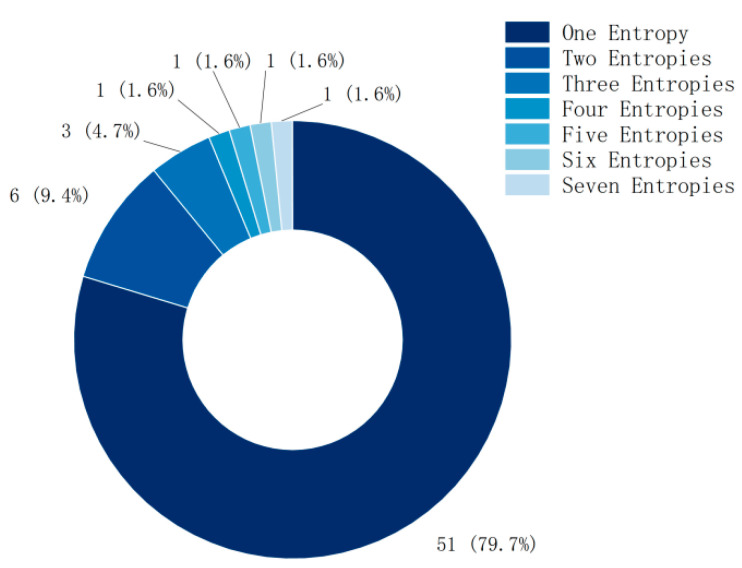
Background: In motor imagery brain-computer interface (MI-BCI) research, electroencephalogram (EEG) signals are complex and nonlinear. This complexity and nonlinearity render signal processing and classification challenging when employing traditional linear methods. Information entropy, with its intrinsic nonlinear characteristics, effectively captures the dynamic behavior of EEG signals, thereby addressing the limitations of traditional methods in capturing linear features. However, the multitude of entropy types leads to unclear application scenarios, with a lack of systematic descriptions. Methods: This study conducted a review of 63 high-quality research articles focused on the application of entropy in MI-BCI, published between 2019 and 2023. It summarizes the names, functions, and application scopes of 13 commonly used entropy measures. Results: The findings indicate that sample entropy (16.3%), Shannon entropy (13%), fuzzy entropy (12%), permutation entropy (9.8%), and approximate entropy (7.6%) are the most frequently utilized entropy features in MI-BCI. The majority of studies employ a single entropy feature (79.7%), with dual entropy (9.4%) and triple entropy (4.7%) being the most prevalent combinations in multiple entropy applications. The incorporation of entropy features can significantly enhance pattern classification accuracy (by 8-10%). Most studies (67%) utilize public datasets for classification verification, while a minority design and conduct experiments (28%), and only 5% combine both methods. Conclusions: Future research should delve into the effects of various entropy features on specific problems to clarify their application scenarios. As research methodologies continue to evolve and advance, entropy features are poised to play a significant role in a wide array of fields and contexts.
期刊介绍:
Brain Sciences (ISSN 2076-3425) is a peer-reviewed scientific journal that publishes original articles, critical reviews, research notes and short communications in the areas of cognitive neuroscience, developmental neuroscience, molecular and cellular neuroscience, neural engineering, neuroimaging, neurolinguistics, neuropathy, systems neuroscience, and theoretical and computational neuroscience. Our aim is to encourage scientists to publish their experimental and theoretical results in as much detail as possible. There is no restriction on the length of the papers. The full experimental details must be provided so that the results can be reproduced. Electronic files or software regarding the full details of the calculation and experimental procedure, if unable to be published in a normal way, can be deposited as supplementary material.






 京公网安备 11010802042870号
京ICP备2023020795号-1
京公网安备 11010802042870号
京ICP备2023020795号-1

 分享
分享
 求助内容:
求助内容: 应助结果提醒方式:
 扫码关注我们
