{"title":"Risk factor analysis and nomogram model of DVT in hip fracture patients at hospital admission.","authors":"Yanling Xiang, Hui Xing, Yali Ran, Xiaoqiang He, Yu Cheng","doi":"10.1186/s12891-025-08308-5","DOIUrl":null,"url":null,"abstract":"<p><strong>Background: </strong>The incidence of deep vein thrombosis (DVT) on the first day of hospitalization in patients with hip fractures is as high as 42%, significantly impacting perioperative safety and, in severe cases, leading to patient mortality. This study aims to develop a diagnostic model based on the available demographic variables, comorbidities, and laboratory test results at admission in patients with hip fractures, and to evaluate its diagnostic performance.</p><p><strong>Methods: </strong>This study retrospectively collected clinical data from 238 patients with hip fractures admitted to the Third Affiliated Hospital of Chongqing Medical University between January 2019 and December 2021. The collected clinical data included demographic variables, medical history, comorbidities, laboratory test results, and Caprini scores. All patients were diagnosed with deep vein thrombosis (DVT) using ultrasonography. The multivariate logistic regression analysis was performed to identify risk factors for lower extremity DVT in hip fracture patients upon admission. The diagnostic performance of the model was evaluated using receiver operating characteristic (ROC) curve analysis. Additionally, the diagnostic effectiveness of different indicators was compared using the integrated discrimination improvement (IDI), net reclassification improvement (NRI), and decision curve analysis (DCA). A nomogram was further developed to provide a visual representation of the multivariate logistic regression model.</p><p><strong>Results: </strong>The multivariate logistic regression model identified female gender, cardiac arrhythmia, intertrochanteric fractures, fracture duration before admission (≥ 48 h), aPTT, and Caprini scores as factors associated with the occurrence of thrombosis upon admission in patients with hip fractures. Leave-one-out cross-validation demonstrated that the diagnostic model achieved an accuracy (Acc) of 76.47%, a sensitivity (Sen) of 81.03%, and a specificity (Spe) of 75.00%. When the risk probability was < 0.2, the thrombosis rate was 7.64%, whereas it increased significantly to 80.65% when the risk probability exceeded 0.6. Compared to the traditional Caprini score, the model showed an improvement in AUC (AUC difference = 0.072, 95% CI = 0.028-0.117). The Integrated Discrimination Improvement (IDI = 0.131, 95% CI = 0.074-0.187), Net Reclassification Improvement (NRI = 0.814, 95% CI = 0.544-1.084), and Decision Curve Analysis (DCA) at threshold probabilities of 0.10-0.22 and 0.35-1.00 demonstrated that the model outperformed the traditional Caprini score in diagnosing thrombosis. Finally, the diagnostic model constructed through multivariate logistic regression was visualized using a nomogram. After 2,000 bootstrap resampling validations, the model's C-index was 0.855, and the bias-corrected C-index was 0.836, indicating good discriminatory ability.</p><p><strong>Conclusions: </strong>This study developed a nomogram model for deep vein thrombosis (DVT) that significantly outperforms the traditional Caprini score. The model can assist clinicians in rapidly identifying and screening high-risk patients with hip fractures for DVT, providing a valuable reference for timely preventive and therapeutic interventions.</p>","PeriodicalId":9189,"journal":{"name":"BMC Musculoskeletal Disorders","volume":"26 1","pages":"189"},"PeriodicalIF":2.4000,"publicationDate":"2025-02-25","publicationTypes":"Journal Article","fieldsOfStudy":null,"isOpenAccess":false,"openAccessPdf":"https://www.ncbi.nlm.nih.gov/pmc/articles/PMC11852817/pdf/","citationCount":"0","resultStr":null,"platform":"Semanticscholar","paperid":null,"PeriodicalName":"BMC Musculoskeletal Disorders","FirstCategoryId":"3","ListUrlMain":"https://doi.org/10.1186/s12891-025-08308-5","RegionNum":3,"RegionCategory":"医学","ArticlePicture":[],"TitleCN":null,"AbstractTextCN":null,"PMCID":null,"EPubDate":"","PubModel":"","JCR":"Q2","JCRName":"ORTHOPEDICS","Score":null,"Total":0}
引用次数: 0
Abstract
Background: The incidence of deep vein thrombosis (DVT) on the first day of hospitalization in patients with hip fractures is as high as 42%, significantly impacting perioperative safety and, in severe cases, leading to patient mortality. This study aims to develop a diagnostic model based on the available demographic variables, comorbidities, and laboratory test results at admission in patients with hip fractures, and to evaluate its diagnostic performance.
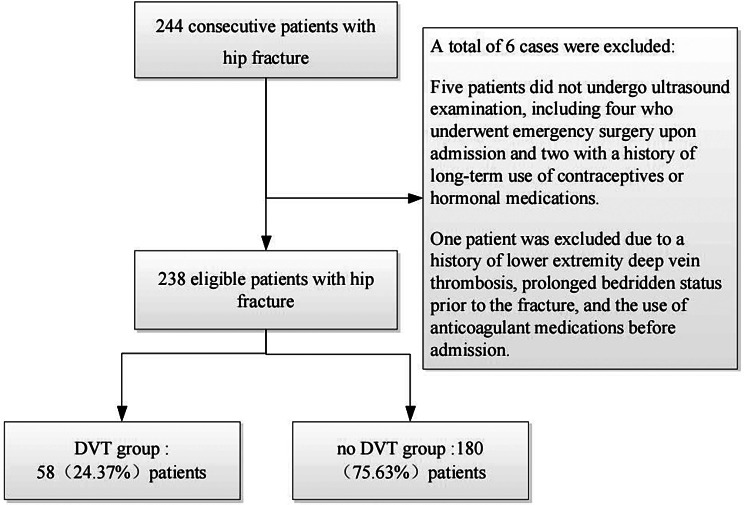
Methods: This study retrospectively collected clinical data from 238 patients with hip fractures admitted to the Third Affiliated Hospital of Chongqing Medical University between January 2019 and December 2021. The collected clinical data included demographic variables, medical history, comorbidities, laboratory test results, and Caprini scores. All patients were diagnosed with deep vein thrombosis (DVT) using ultrasonography. The multivariate logistic regression analysis was performed to identify risk factors for lower extremity DVT in hip fracture patients upon admission. The diagnostic performance of the model was evaluated using receiver operating characteristic (ROC) curve analysis. Additionally, the diagnostic effectiveness of different indicators was compared using the integrated discrimination improvement (IDI), net reclassification improvement (NRI), and decision curve analysis (DCA). A nomogram was further developed to provide a visual representation of the multivariate logistic regression model.
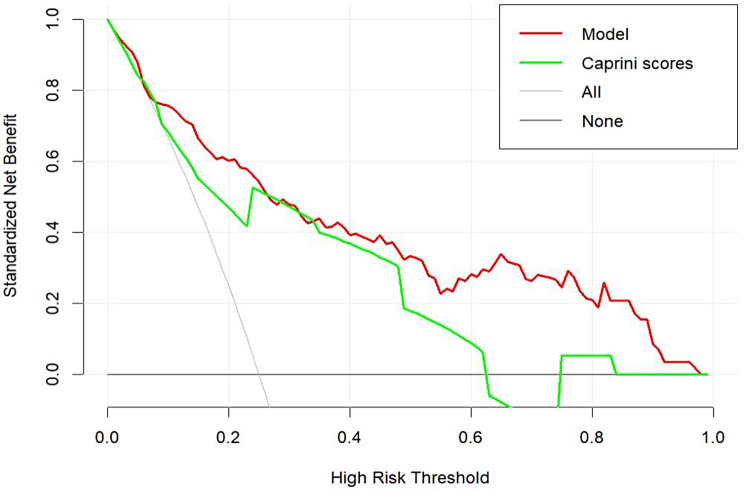
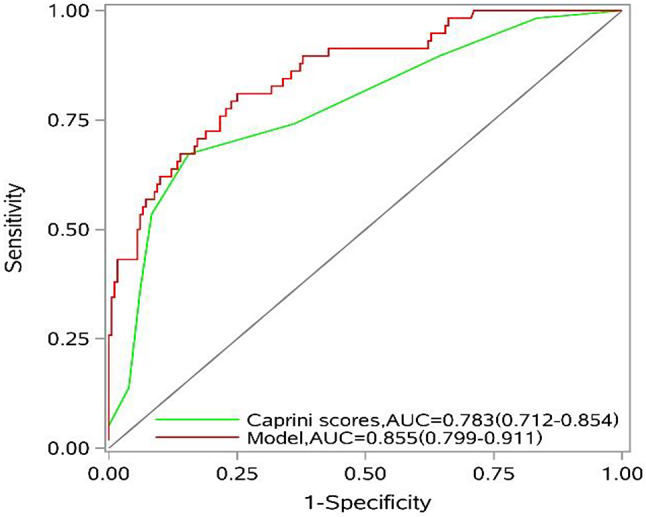
Results: The multivariate logistic regression model identified female gender, cardiac arrhythmia, intertrochanteric fractures, fracture duration before admission (≥ 48 h), aPTT, and Caprini scores as factors associated with the occurrence of thrombosis upon admission in patients with hip fractures. Leave-one-out cross-validation demonstrated that the diagnostic model achieved an accuracy (Acc) of 76.47%, a sensitivity (Sen) of 81.03%, and a specificity (Spe) of 75.00%. When the risk probability was < 0.2, the thrombosis rate was 7.64%, whereas it increased significantly to 80.65% when the risk probability exceeded 0.6. Compared to the traditional Caprini score, the model showed an improvement in AUC (AUC difference = 0.072, 95% CI = 0.028-0.117). The Integrated Discrimination Improvement (IDI = 0.131, 95% CI = 0.074-0.187), Net Reclassification Improvement (NRI = 0.814, 95% CI = 0.544-1.084), and Decision Curve Analysis (DCA) at threshold probabilities of 0.10-0.22 and 0.35-1.00 demonstrated that the model outperformed the traditional Caprini score in diagnosing thrombosis. Finally, the diagnostic model constructed through multivariate logistic regression was visualized using a nomogram. After 2,000 bootstrap resampling validations, the model's C-index was 0.855, and the bias-corrected C-index was 0.836, indicating good discriminatory ability.
Conclusions: This study developed a nomogram model for deep vein thrombosis (DVT) that significantly outperforms the traditional Caprini score. The model can assist clinicians in rapidly identifying and screening high-risk patients with hip fractures for DVT, providing a valuable reference for timely preventive and therapeutic interventions.
期刊介绍:
BMC Musculoskeletal Disorders is an open access, peer-reviewed journal that considers articles on all aspects of the prevention, diagnosis and management of musculoskeletal disorders, as well as related molecular genetics, pathophysiology, and epidemiology.
The scope of the Journal covers research into rheumatic diseases where the primary focus relates specifically to a component(s) of the musculoskeletal system.




 京公网安备 11010802042870号
京ICP备2023020795号-1
京公网安备 11010802042870号
京ICP备2023020795号-1

 分享
分享
 求助内容:
求助内容: 应助结果提醒方式:
 扫码关注我们
