Tobias L Mraz, Miranda Kirby, Robab Breyer-Kohansal, Emiel F M Wouters, Wan Tan
{"title":"Lung volumes by computed tomography and plethysmography: are we measuring the same? CanCOLD study data.","authors":"Tobias L Mraz, Miranda Kirby, Robab Breyer-Kohansal, Emiel F M Wouters, Wan Tan","doi":"10.1183/23120541.00646-2024","DOIUrl":null,"url":null,"abstract":"<p><strong>Background: </strong>Measurement of lung volumes forms an integral part of pulmonary function testing. Lung volumes determined by computed tomography (CT) scans are well established, but the comparability to other methods like plethysmography in large cohorts remains in question.</p><p><strong>Methods: </strong>CanCOLD is a prospective longitudinal cohort study from Canada, including three matched groups of individuals with COPD I-II, smokers at risk and healthy controls. All participants underwent lung volume measurement by plethysmography and CT, using inspiratory and expiratory imaging. We compared total lung capacity (TLC) and residual volume (RV) in the different cohorts between plethysmography and CT.</p><p><strong>Results: </strong>Data from 1235 (518 females) individuals were analysed. Baseline characteristics were comparable in all three groups. Significant differences between CT and plethysmography could be observed in all groups, with consistently higher TLC and lower RV by plethysmography, respectively. Correlation was strong for TLC between the methods of measurement with a very stable bias of about 1.68 L for all groups, but the correlation was only low/moderate for RV. Variability of differences seemed to be higher for RV. No correction for supine position or dead airspace was used for CT-based measurements.</p><p><strong>Conclusion: </strong>Measurement of TLC and RV by plethysmography yields higher and lower values than by CT, respectively, so results of the different methods should not be used interchangeably.</p>","PeriodicalId":11739,"journal":{"name":"ERJ Open Research","volume":"11 1","pages":""},"PeriodicalIF":4.0000,"publicationDate":"2025-02-25","publicationTypes":"Journal Article","fieldsOfStudy":null,"isOpenAccess":false,"openAccessPdf":"https://www.ncbi.nlm.nih.gov/pmc/articles/PMC11849101/pdf/","citationCount":"0","resultStr":null,"platform":"Semanticscholar","paperid":null,"PeriodicalName":"ERJ Open Research","FirstCategoryId":"3","ListUrlMain":"https://doi.org/10.1183/23120541.00646-2024","RegionNum":3,"RegionCategory":"医学","ArticlePicture":[],"TitleCN":null,"AbstractTextCN":null,"PMCID":null,"EPubDate":"2025/1/1 0:00:00","PubModel":"eCollection","JCR":"Q1","JCRName":"RESPIRATORY SYSTEM","Score":null,"Total":0}
引用次数: 0
Abstract
Background: Measurement of lung volumes forms an integral part of pulmonary function testing. Lung volumes determined by computed tomography (CT) scans are well established, but the comparability to other methods like plethysmography in large cohorts remains in question.
Methods: CanCOLD is a prospective longitudinal cohort study from Canada, including three matched groups of individuals with COPD I-II, smokers at risk and healthy controls. All participants underwent lung volume measurement by plethysmography and CT, using inspiratory and expiratory imaging. We compared total lung capacity (TLC) and residual volume (RV) in the different cohorts between plethysmography and CT.
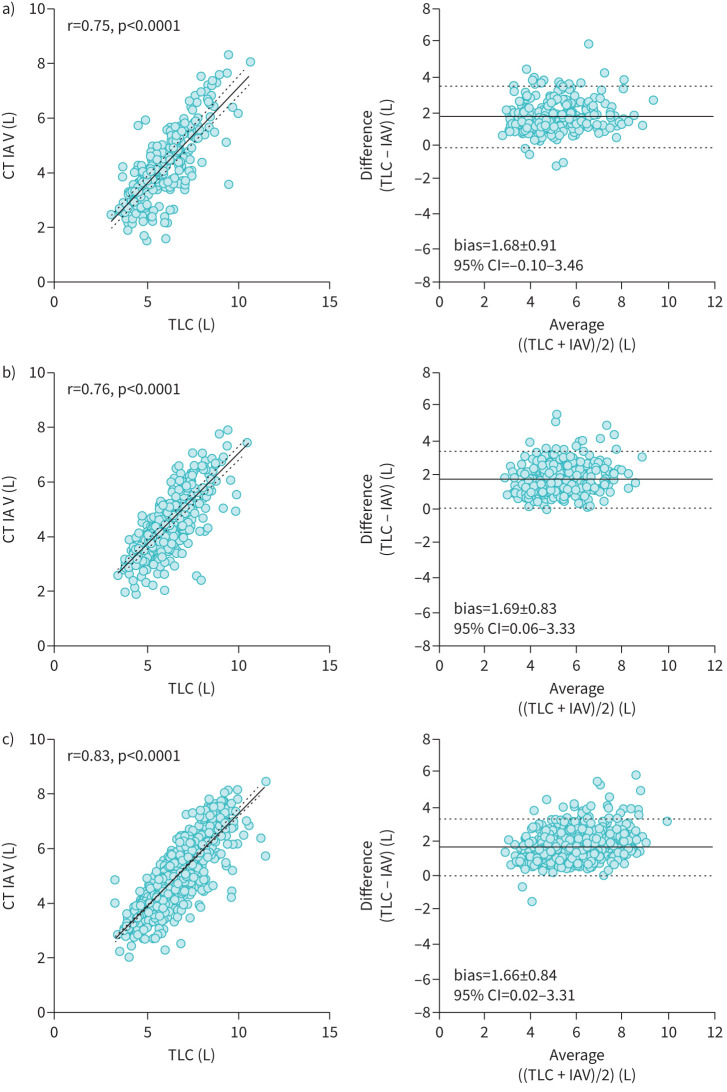
Results: Data from 1235 (518 females) individuals were analysed. Baseline characteristics were comparable in all three groups. Significant differences between CT and plethysmography could be observed in all groups, with consistently higher TLC and lower RV by plethysmography, respectively. Correlation was strong for TLC between the methods of measurement with a very stable bias of about 1.68 L for all groups, but the correlation was only low/moderate for RV. Variability of differences seemed to be higher for RV. No correction for supine position or dead airspace was used for CT-based measurements.
Conclusion: Measurement of TLC and RV by plethysmography yields higher and lower values than by CT, respectively, so results of the different methods should not be used interchangeably.
期刊介绍:
ERJ Open Research is a fully open access original research journal, published online by the European Respiratory Society. The journal aims to publish high-quality work in all fields of respiratory science and medicine, covering basic science, clinical translational science and clinical medicine. The journal was created to help fulfil the ERS objective to disseminate scientific and educational material to its members and to the medical community, but also to provide researchers with an affordable open access specialty journal in which to publish their work.






 京公网安备 11010802042870号
京ICP备2023020795号-1
京公网安备 11010802042870号
京ICP备2023020795号-1

 分享
分享
 求助内容:
求助内容: 应助结果提醒方式:
 扫码关注我们
