Kai Li, Tongtong Chen, Yuliang Li, Kai Sun, Kun Pang, Xiaoping Yu, Peiying Hao
{"title":"Risk Assessment of RNAi-Based Potential Pesticide ds<i>NlAtg3</i> and Its Homologues for <i>Nilaparvata lugens</i> and Non-Target Organisms.","authors":"Kai Li, Tongtong Chen, Yuliang Li, Kai Sun, Kun Pang, Xiaoping Yu, Peiying Hao","doi":"10.3390/insects16020225","DOIUrl":null,"url":null,"abstract":"<p><p>The brown planthopper (<i>Nilaparvata lugens</i>) is an insect pest of rice, which mainly feeds on the phloem sap of the leaf sheath. RNA interference (RNAi) has application prospects in pest control, but it is necessary to select target genes and design suitable dsRNA fragments for RNAi so that it can achieve effective pest control and avoid risks to non-target organisms. NlAtg3 is a key protein in the autophagy pathway of <i>N. lugens</i>. Three kinds of dsRNA fragments of the <i>NlAtg3</i> gene (ds<i>NlAtg3-</i>474×1, ds<i>NlAtg3</i>-138×3 and ds<i>NlAtg3</i>-47×10) were designed to compare the RNAi efficiency and specificity against the target insect <i>N. lugens</i> and non-target organisms through microinjection. The results showed that the fragment ds<i>NlAtg3-</i>474×1 showed strong inhibitory effects on the survival of <i>N. lugens</i>, which resulted in the survival rate decreasing to zero on the fifth day, while the survival rate of a closely related species, <i>Sogatella furcifera</i>, dropped to 2.22%. In contrast, ds<i>NlAtg3</i>-47×10 specifically designed against <i>N. lugens</i> only showed slight or no inhibitory effects on <i>S. furcifera</i> and other non-target organisms such as <i>Drosophila melanogaster</i>, but still showed good lethal effects against <i>N. lugens</i>, with the survival rate dropping to 18.89% on the ninth day. In addition, after being fed <i>N. lugens</i> injected with ds<i>NlAtg3</i>-47×10 fragments, the survival rate of the natural enemies <i>Dolomedes sulfureus</i> and <i>Tytthus chinensis</i> did not show significant change, compared with those treated with the ds<i>GFP</i> control. Our results suggest that the <i>NlAtg3</i> gene can serve as a potential target for controlling <i>N. lugens</i>. Moreover, by designing suitable RNAi fragments, it is possible to avoid harm to non-target organisms while effectively inhibiting the target insect <i>N. lugens</i>.</p>","PeriodicalId":13642,"journal":{"name":"Insects","volume":"16 2","pages":""},"PeriodicalIF":2.9000,"publicationDate":"2025-02-19","publicationTypes":"Journal Article","fieldsOfStudy":null,"isOpenAccess":false,"openAccessPdf":"https://www.ncbi.nlm.nih.gov/pmc/articles/PMC11855984/pdf/","citationCount":"0","resultStr":null,"platform":"Semanticscholar","paperid":null,"PeriodicalName":"Insects","FirstCategoryId":"97","ListUrlMain":"https://doi.org/10.3390/insects16020225","RegionNum":2,"RegionCategory":"农林科学","ArticlePicture":[],"TitleCN":null,"AbstractTextCN":null,"PMCID":null,"EPubDate":"","PubModel":"","JCR":"Q1","JCRName":"ENTOMOLOGY","Score":null,"Total":0}
引用次数: 0
Abstract
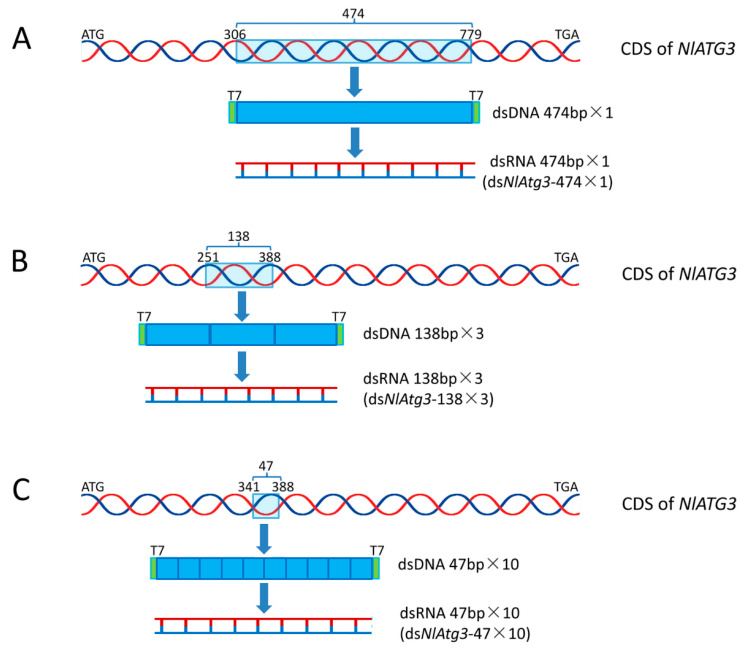
The brown planthopper (Nilaparvata lugens) is an insect pest of rice, which mainly feeds on the phloem sap of the leaf sheath. RNA interference (RNAi) has application prospects in pest control, but it is necessary to select target genes and design suitable dsRNA fragments for RNAi so that it can achieve effective pest control and avoid risks to non-target organisms. NlAtg3 is a key protein in the autophagy pathway of N. lugens. Three kinds of dsRNA fragments of the NlAtg3 gene (dsNlAtg3-474×1, dsNlAtg3-138×3 and dsNlAtg3-47×10) were designed to compare the RNAi efficiency and specificity against the target insect N. lugens and non-target organisms through microinjection. The results showed that the fragment dsNlAtg3-474×1 showed strong inhibitory effects on the survival of N. lugens, which resulted in the survival rate decreasing to zero on the fifth day, while the survival rate of a closely related species, Sogatella furcifera, dropped to 2.22%. In contrast, dsNlAtg3-47×10 specifically designed against N. lugens only showed slight or no inhibitory effects on S. furcifera and other non-target organisms such as Drosophila melanogaster, but still showed good lethal effects against N. lugens, with the survival rate dropping to 18.89% on the ninth day. In addition, after being fed N. lugens injected with dsNlAtg3-47×10 fragments, the survival rate of the natural enemies Dolomedes sulfureus and Tytthus chinensis did not show significant change, compared with those treated with the dsGFP control. Our results suggest that the NlAtg3 gene can serve as a potential target for controlling N. lugens. Moreover, by designing suitable RNAi fragments, it is possible to avoid harm to non-target organisms while effectively inhibiting the target insect N. lugens.
InsectsAgricultural and Biological Sciences-Insect Science
CiteScore
5.10
自引率
10.00%
发文量
1013
审稿时长
21.77 days
期刊介绍:
Insects (ISSN 2075-4450) is an international, peer-reviewed open access journal of entomology published by MDPI online quarterly. It publishes reviews, research papers and communications related to the biology, physiology and the behavior of insects and arthropods. Our aim is to encourage scientists to publish their experimental and theoretical results in as much detail as possible. There is no restriction on the length of the papers. The full experimental details must be provided so that the results can be reproduced. Electronic files regarding the full details of the experimental procedure, if unable to be published in a normal way, can be deposited as supplementary material.



 京公网安备 11010802042870号
京ICP备2023020795号-1
京公网安备 11010802042870号
京ICP备2023020795号-1

 分享
分享
 求助内容:
求助内容: 应助结果提醒方式:
 扫码关注我们
